

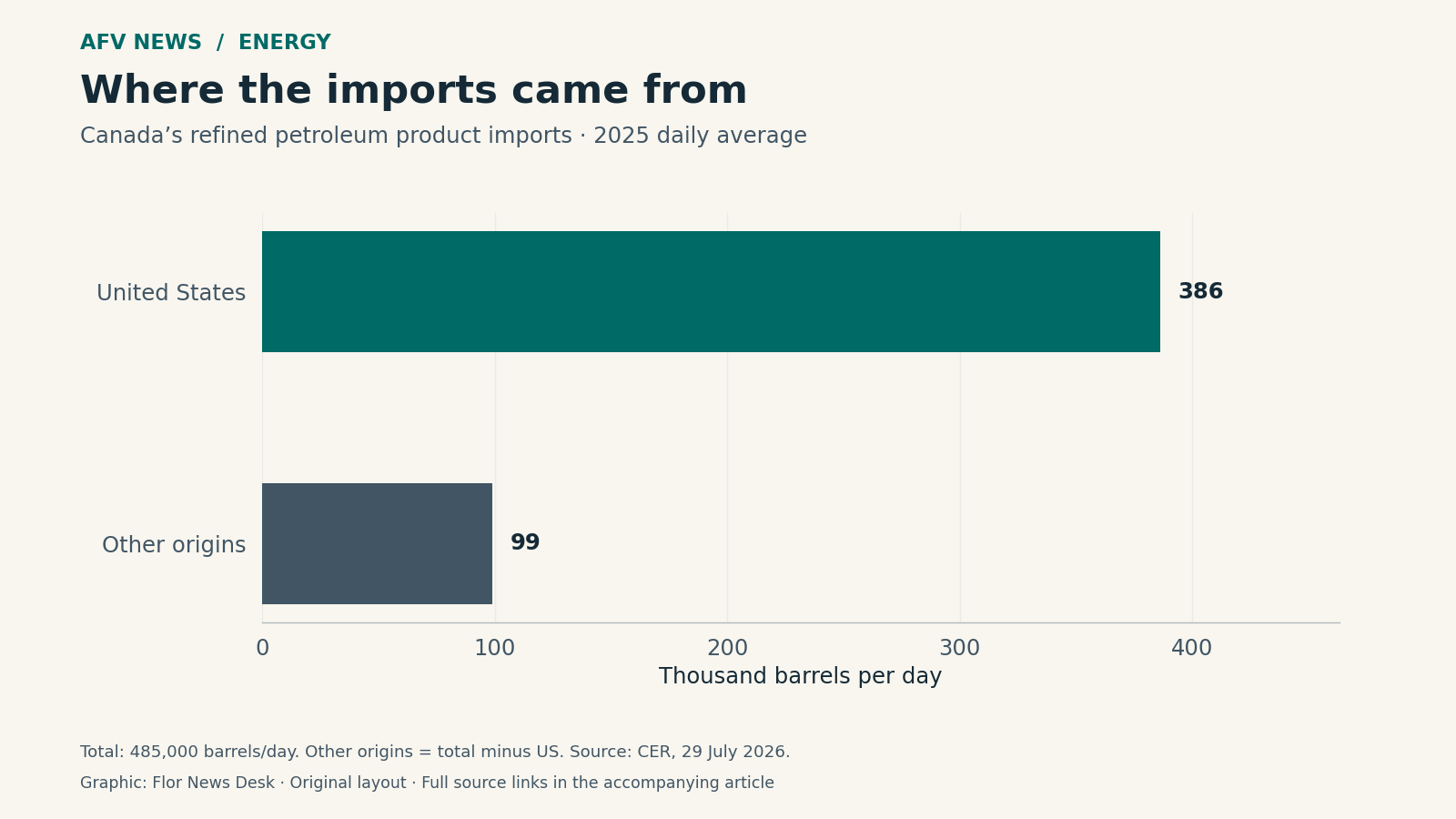
Canada imported an average of 485,000 barrels a day of refined petroleum products in 2025, up 3% from 2024, the Canada Energy Regulator reported on July 29. The United States supplied 386,000 barrels a day. But the category is broader than fuel bought at a filling station: it includes condensate used in oil-sands supply chains. CER import analysis
Condensate is a light hydrocarbon liquid that can be mixed with heavy oil to make the mixture easier to transport. The regulator’s Cochin pipeline profile describes shipments from Illinois toward Fort Saskatchewan, Alberta, for that purpose. The system’s flow was reversed in 2014 to support this trade. Cochin pipeline profile
That creates an important distinction in interpreting the national number. Some imports support the movement of Canadian-produced oil. A rise in the broad category cannot be treated automatically as equivalent growth in Canadian drivers’ purchases of gasoline.
The import analysis also warns about geography. A shipment may be recorded in the province where it enters Canada rather than its eventual destination. A change in a provincial total can therefore require examination of the reporting location before it is described as a change in local use. CER import analysis
For a distributor comparing its sales with national trade data, matching the product is the first step. Matching the geography and time period comes next. A company selling diesel in one region is not measuring the same market as a national aggregate that also includes industrial inputs.
The distinction does not make the aggregate unhelpful. It makes its boundary consequential. The total can describe the scale of cross-border supply, while a product-specific series is needed to support a narrower demand claim.
A useful briefing would identify the trade category beside every number and distinguish imported volume from domestic consumption. It would also preserve the year: the regulator’s July publication describes 2025 trade, rather than September 2026 deliveries.
Reading the classification and route together explains why an oil-producing country can import materials that help its own production reach a pipeline.
Read our editorial standards or send a correction to the editorial desk.