

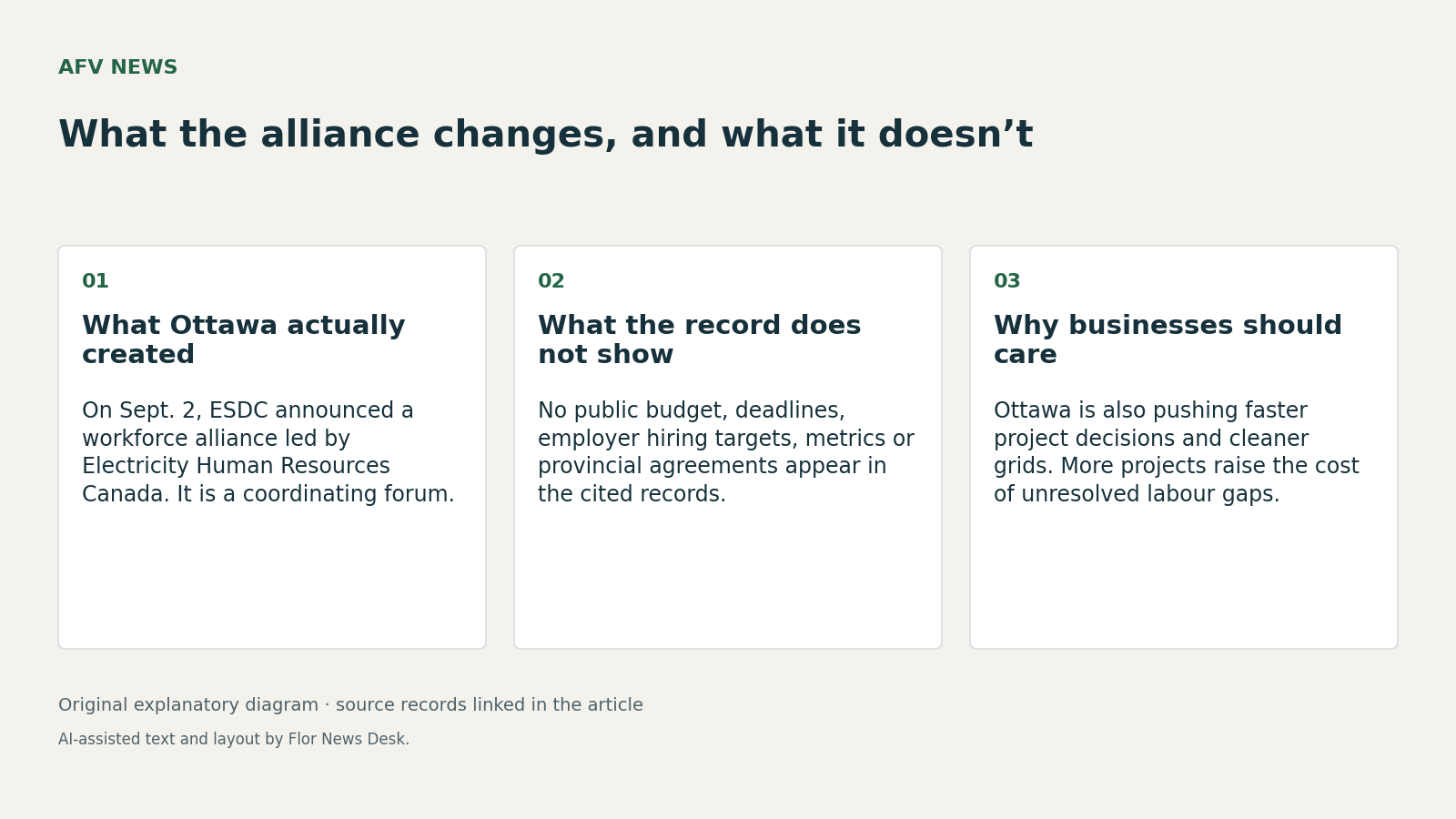
The federal government’s Sept. 2 creation of the Energy & Electricity Workforce Alliance matters for utilities, contractors and training providers because it names who Ottawa wants at the workforce-planning table. It does not yet give those businesses a funded program, a hiring commitment or a timeline for results. Employment and Social Development Canada said the alliance will be led by Electricity Human Resources Canada, with support from the Energy Council of Canada and the Canadian Renewable Energy Association, and will focus on labour gaps across conventional energy, clean electricity, transmission and grid modernization. ESDC announcement
That distinction matters because the announcement was framed around scale, not delivery. ESDC said Canada’s energy sector contributed $232 billion to GDP and employed 316,200 workers in 2024, and it pointed to skills issues such as reskilling, regional labour mobility and shortages in occupations including heavy-duty mechanics and industrial technicians. Those facts explain why a national convening could matter. They do not establish that any employer has signed on to apprenticeship targets, that any province has agreed to implement recommendations, or that any worker shortage will be reduced on a set schedule. ESDC announcement
The pre-event record reinforces that reading. A Sept. 1 media advisory said the alliance would identify labour market gaps and align investments and activities to support skills development, then scheduled a Sept. 2 event at Hydro Ottawa. But that advisory was prospective and subject to change at the time, so it cannot fill in what funding, if any, followed the launch. As of Oct. 11, 2026, the cited public record still does not show a budget line, signed funding agreement, performance metric or delivery timetable for the alliance itself. Media advisory ESDC announcement
The initiative’s institutional home also suggests what it is, and is not. The Labour Program describes itself as a federal institution within Employment and Social Development Canada that promotes safe, healthy, fair and inclusive work conditions and cooperative workplace relations. Based on that mandate, the alliance reads more like a labour-market coordination vehicle than a mechanism that can by itself change procurement rules, permit conditions or project economics. For businesses, that means its near-term value is likely to be influence over training priorities and sector signalling, not automatic access to workers. Labour Program
The timing is still important. On Sept. 21, 2026, Tim Hodgson’s letter on getting major projects built in Canada said the Building Canada Strong Act had been introduced and proposed new authorities for the Canada Energy Regulator, alongside a government objective of federal decisions within one year after proponents file required information and studies. The same letter said a follow-up would come only if relevant provisions enter into force. That does not prove faster approvals are operating now, but it does show Ottawa is pairing project-speed ambitions with a new workforce forum. If approvals accelerate before labour bottlenecks ease, execution risk shifts toward employers and training systems. CER letter
A separate federal background page helps explain why electricity skills are central, while also showing the limits of the current record. The Dec. 20, 2024 Clean Electricity Regulations explainer says the rules were designed to maintain reliability and affordability while supporting growing demand, and it outlines flexibilities such as annual emissions limits, credit pooling and short emergency exemptions. That page is background, not a 2026 status update, so it cannot show whether the alliance is affecting grid reliability or project staffing. It does, however, support the core analysis: Ottawa is designing for a bigger, cleaner, more complex power system, and the workforce piece is still at the convening stage. Clean Electricity Regulations background
For AFV News readers, the practical takeaway is narrow but useful. The alliance is real, named and sector-specific. As of Oct. 11, 2026, the public record supports watching it for future funding, metrics, provincial alignment and employer commitments, not treating it as evidence that labour supply constraints have already been solved. ESDC announcement
Read our editorial standards or send a correction to the editorial desk.