
Natural Resources Canada published Version 2.0 of its Clean Hydrogen Investment Tax Credit – Technical and Equipment Guidance Document on September 3, 2026. The department says the update reflects amendments in the Budget 2025 Implementation Act, No. 1 (Bill C-15). On the record reviewed here, the update is best understood as an administrative and technical clarification of what a project sponsor must document, what equipment can qualify, and where NRCan’s role ends and the Canada Revenue Agency’s begins (NRCan technical guidance).
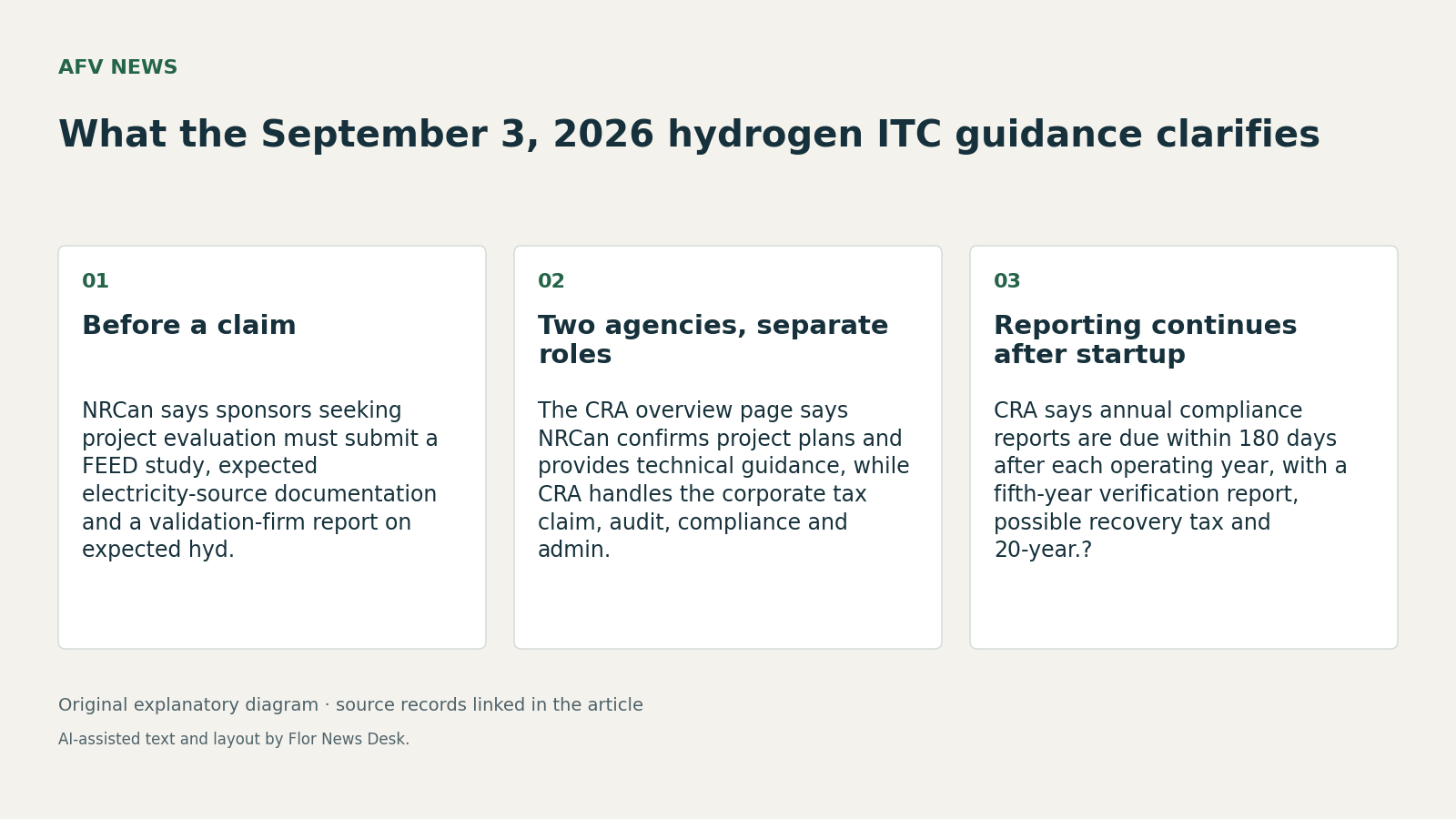
For project developers, lenders and major suppliers, the immediate practical point is the submission package. NRCan says a taxpayer seeking evaluation of a clean hydrogen project plan must provide the required material “in the form and manner determined by the Minister of Natural Resources.” The guidance specifically lists a front-end engineering design study, documentation on the project’s expected sources of electricity, and a validation-firm report setting out the expected carbon intensity of the hydrogen to be produced. NRCan also says the minister may confirm in writing that the project is a qualified clean hydrogen project after evaluation (NRCan technical guidance). That means project eligibility is not just a matter of listing costs on a later tax return. Sponsors need an engineering and carbon-intensity file that can withstand review.
Version 2.0 also restates the project boundaries that matter for capital planning. NRCan says eligible hydrogen pathways include low- and high-temperature electrolysis of water and the reforming or partial oxidation of eligible hydrocarbons with carbon dioxide captured using a CCUS process. If a project will produce clean ammonia, NRCan says that ammonia must use clean hydrogen produced by the same project. The guide also says eligible property must be acquired and become available for use in Canada from March 28, 2023 to December 31, 2034. For most eligible hydrogen property placed in service before 2034, the credit rate depends on expected carbon intensity, topping out at 40%, while rates are reduced by half in 2034 and fall to 0% after 2034 (NRCan technical guidance).
The records also make clear that NRCan confirmation is not the same as a full tax ruling. The CRA’s Clean Hydrogen Investment Tax Credit overview page, dated April 23, 2026, says the program is administered by both agencies: NRCan provides the project-plan submission portal, project-plan confirmation, and scientific, engineering and technical guidance, while CRA handles the claim on the corporate income tax return, audit and compliance activities, and administration of the credit (CRA overview). NRCan’s own guide says it applies conclusively only to engineering and scientific matters related to equipment eligibility and does not replace the Income Tax Act or CRA interpretation (NRCan technical guidance).
After a claim, the compliance burden continues. CRA’s reporting-responsibilities page, dated August 27, 2024, says a claimant must file a compliance report with CRA and NRCan within 180 days after each operating year, including the project’s actual carbon intensity, kilograms of hydrogen produced and shutdown time. For the fifth operating year, CRA says the report must include a qualified verification firm’s verification of actual carbon intensity over the compliance period. CRA also says failure to file can trigger a per-project penalty, a higher-than-expected average carbon intensity can trigger recovery tax, and recapture can apply for 20 calendar years if eligible property is disposed of, converted to a non-hydrogen or ammonia use, or exported from Canada (CRA reporting responsibilities).
What the source record does not show, as of materials retrieved on October 4, 2026, is market uptake. The reviewed public pages do not establish how many projects NRCan has confirmed, whether any taxpayer has successfully claimed the credit, or how often CRA has imposed penalties, recovery tax or recapture under this program. The verified takeaway is narrower, but still useful: the September 3, 2026 guidance gives sponsors a clearer checklist for eligibility and a clearer picture of the reporting risk that follows construction.
Read our editorial standards or send a correction to the editorial desk.