
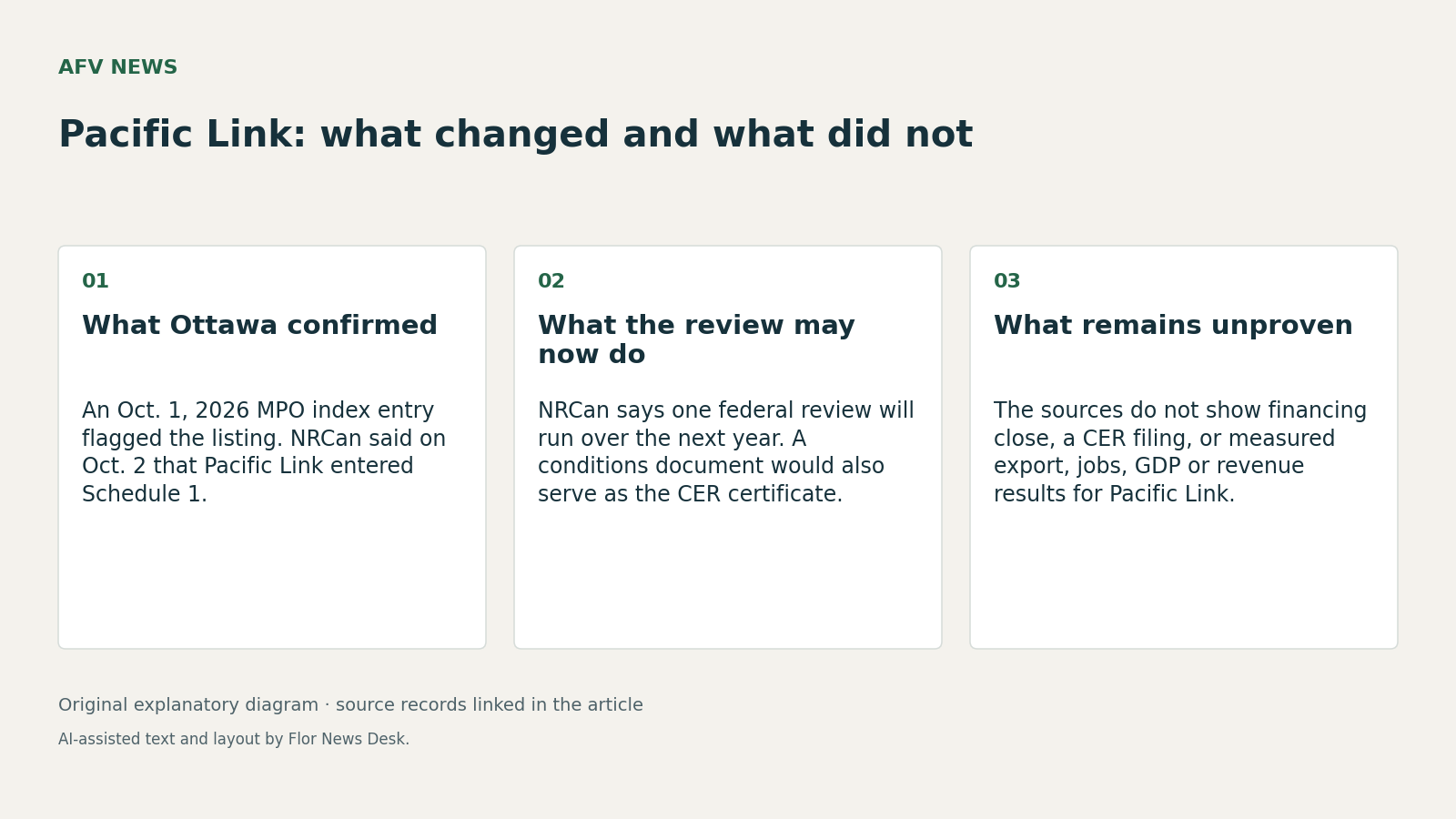
Ottawa’s verified move on Pacific Link is procedural, not commercial. A Government of Canada Major Projects Office news index carries an October 1, 2026 entry saying Prime Minister Mark Carney listed the West Coast Oil Pipeline, now known as Pacific Link, as a project of national interest, and Natural Resources Canada said on October 2 that the project had been listed under Schedule 1 of the Building Canada Act the previous day Major Projects Office news index Natural Resources Canada release. What that establishes is a federal referral. It does not, on its own, establish that construction is financed, permitted or imminent.
The main practical change is the review path Ottawa says will follow. Natural Resources Canada says Pacific Link now enters a single federal review process and that, over the next year, the Major Projects Office, with support from the Canada Energy Regulator, will run the review and prepare a conditions document Natural Resources Canada release. NRCan also says that document would serve as the CER certificate and fold in Fisheries Act authorizations, Species at Risk Act permits and other federal permits that would otherwise be issued separately. If that occurs as described, the immediate business consequence is a more centralized federal process and a clearer place to watch for new records.
That is still different from proof that the project is ready to proceed. The Major Projects Office source available here is only an index page, not the underlying October 1 release or a project file, so it does not set out conditions, consultation steps, financing or construction status Major Projects Office news index. The NRCan release is a ministerial announcement tied to a tour of Westridge Marine Terminal, not a CER application package. The sourced record does not show a published conditions document, a filed CER project application, financing close, executed Indigenous ownership or benefit agreements for Pacific Link specifically, or completed commercial offtake Natural Resources Canada release.
That gap matters because the October 2 release also contains the biggest commercial claims. NRCan says Trans Mountain Corporation is the lead developer, that 70 to 90 percent of the proposed project would use the existing Trans Mountain corridor, and that Pacific Link would enable an additional one million barrels per day of exports from a proposed new marine terminal in Delta, British Columbia Natural Resources Canada release. The same release attributes benefits of up to 140,000 jobs, more than $20 billion in annual GDP and $100 billion in government revenue by 2060 to the project. Those are government projections attached to a proposed facility, not measured outcomes. NRCan’s reference to getting shovels in the ground by September 2027 is likewise a target, not evidence that construction authority already exists.
The CER’s own April 23, 2026 committee information package helps explain why the regulator’s role is material, even though it predates Pacific Link’s listing. The package says the CER regulates interprovincial and international pipelines and energy trade, planned $29.6 million in 2026-27 spending for energy adjudication and $30.7 million for safety and environment oversight, and recovers about 95 percent of its costs from regulated industry CER information package. That suggests the promised single review would still run through a regulator built around adjudication and oversight, not merely a political announcement. But the package does not show staffing, timing or project documents for Pacific Link itself.
For Canadian energy firms and service providers, the next meaningful checkpoints are therefore documentary. Watch for the underlying Major Projects Office project record, any consultation schedule, the promised conditions document, and any CER filing that turns the announcement into a case-specific regulatory file Major Projects Office news index Natural Resources Canada release. Until those appear, Ottawa has changed the federal lane Pacific Link travels in, but the public record available here does not yet show that the road is clear to build.
Read our editorial standards or send a correction to the editorial desk.