

A September staff working paper published by the Bank of Canada reports that rearranging payments in Italy's TARGET2 system can reduce the liquidity needed to settle them. Its results also give technology buyers a reason to look past the word “quantum”: a conventional comparison method produced comparable savings for the smaller payment batches tested.
The research abstract reports daily average liquidity savings of €23 million for batches of 70 payments and €38 million for batches of 140, over a 35-day sample using D-Wave's hybrid solver. A simulated annealing algorithm, tested under the same time constraints, delivered comparable savings at those sizes. Extending that algorithm to batches of 700 produced more than ten times the savings.
These are research results for an Italian payment-system segment. They are not a Canadian bank's reported operating-cost reduction, a commercial rollout announcement or proof that the quantum-labelled method outperformed the conventional one.
Why order changes the cash requirement
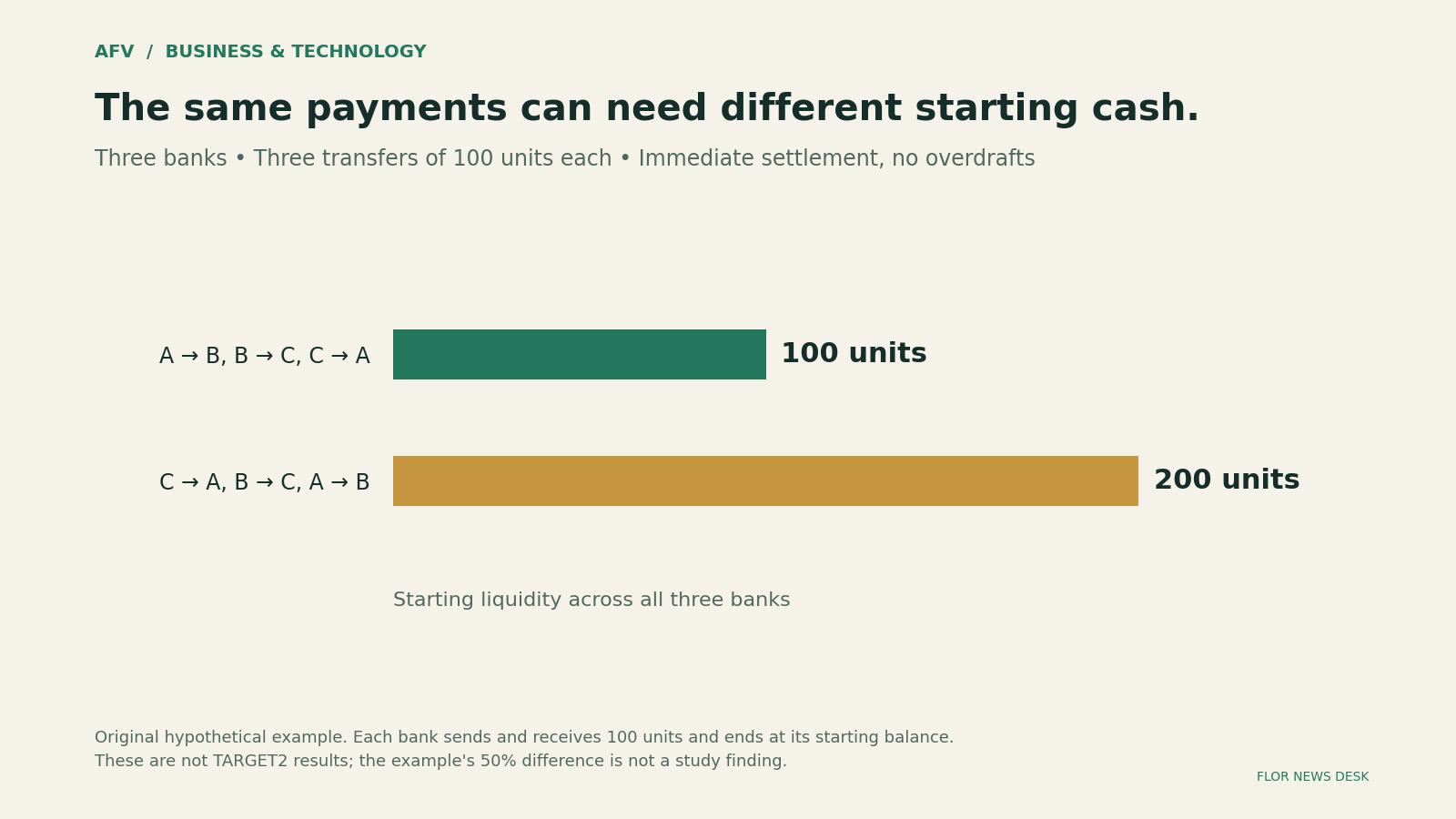
Imagine three banks, A, B and C. Each owes the next bank 100 illustrative currency units: A pays B, B pays C, and C pays A. Assume payments settle individually, in the stated order, with no overdrafts, simultaneous netting or other payments.
If A starts with 100 units and pays B first, B can pass those same units to C, which can then pay A. The full sequence settles with 100 units of starting liquidity.
Change the order to C paying A, then B paying C, then A paying B. Now C and B each need 100 units at the start. The sequence requires 200 units in total. Every bank still finishes with its original balance, because each sends and receives 100.
This is an intentionally small, hypothetical illustration of cash reuse. The 50% difference is the arithmetic of this example, not an estimated saving from TARGET2 and not a result readers should apply to their own payment flows.
Compare the complete task
For a buyer assessing an optimization system, AFV's reading is that the meaningful comparison includes the batch size, time allowed, operational restrictions and starting point. A result at one scale cannot establish performance at another.
Liquidity savings also need a careful unit. A reduction in the balance needed during settlement is different from income earned or an expense removed from an annual budget. Turning it into a financial benefit would require additional assumptions about funding costs and operations; this article makes no such estimate.
The paper's smaller-batch comparison and larger conventional run belong in the same account. Omitting either would leave a misleading impression of what the experiment demonstrated. The practical lesson for technology procurement is to require the benchmark alongside the promising result.
Read our editorial standards or send a correction to the editorial desk.