

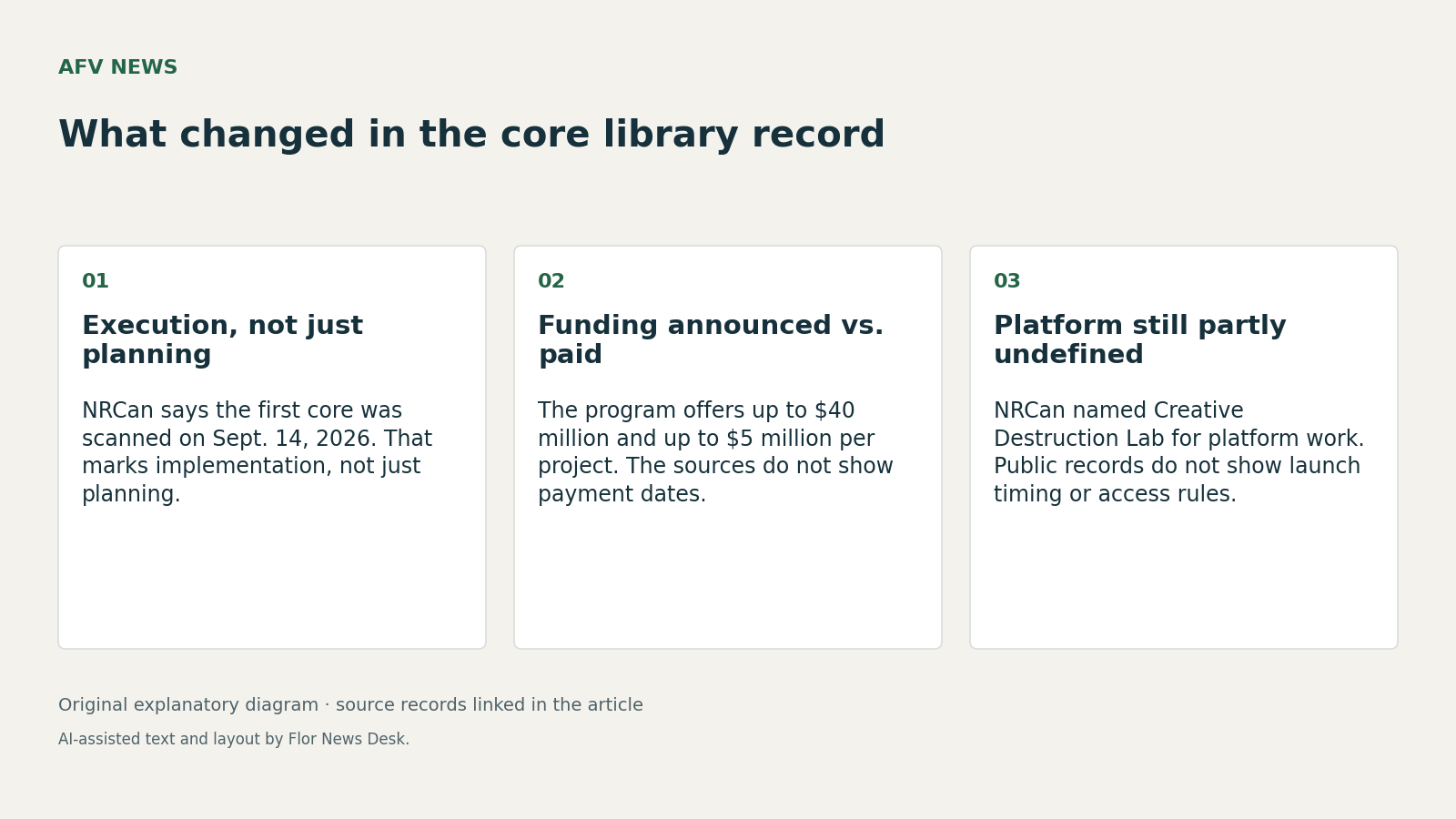
Canada’s move to digitize public drill core crossed an important line on September 14, 2026, when Natural Resources Canada said the first core for the Canadian Digital Core Library was scanned in Calgary using samples from the Northwest Territories. The department published that update on September 21, 2026. The significance is narrow but real: a program that had been described in June as expected to start scanning by September now has a dated implementation event on the record. It does not yet mean Canada has a functioning national repository available to industry users. NRCan Sept. 21 release NRCan June 26 release
The federal program architecture is clearer than the delivery record. NRCan’s call-for-proposals page says Ottawa is investing up to $40 million in non-repayable contribution funding over two years beginning in 2026–27, with projects running from April 2026 to March 2028. It set a June 1, 2026 deadline, allowed up to $5 million per project, and said federal support could cover as much as 90 percent of project costs. The same page says funded projects are meant to scan provincial or territorial drill cores and make the information freely and publicly available through the CDCL platform. But that page does not identify approved projects, signed contribution agreements or disbursements, so the funding envelope should be read as available program authority, not money proven paid. CDCL call for proposals
What changed most in September is not the headline dollar figure but the evidence that implementation is happening province by province. NRCan’s September 21 release announced $2.16 million for Saskatchewan to build a digital library of core scan data compatible with the national platform, and said other participating provinces and territories were identifying priority cores and preparing to begin scanning. That follows NRCan’s June 26 statement that memoranda of understanding had been signed with 10 provinces and territories, with priority actions that included drill-core scanning and faster geoscience data availability. The practical reading is that the national system is being assembled from regional projects, not switched on all at once. NRCan Sept. 21 release NRCan June 26 release
The platform story is even earlier in its lifecycle. NRCan said on June 26 that up to $15 million had been announced for Creative Destruction Lab to develop the national digital platform, and the department repeats that on its Canadian Digital Core Library program page and in the September release’s quick facts. What the public record does not establish is just as important: there is no cited platform launch date, no published operating rules, no public contract detail and no current list of datasets already accessible through a national interface. For technology vendors and mining companies, that makes the platform a funded development effort, not yet a proven live service. NRCan June 26 release CDCL program page NRCan Sept. 21 release
The source record also requires a timeline warning. NRCan’s Canadian Digital Core Library page still says applications are being evaluated and scanning is set to begin by fall 2026, even though a later departmental release says the first scan happened on September 14. As of October 2, 2026, that older wording is stale. It shows how the program was framed earlier in the year, but it cannot prove whether the broader rollout is complete, delayed or on schedule beyond the first recorded scan. CDCL program page NRCan Sept. 21 release
For Canadian explorers and service firms, the immediate business implication is modest and specific. The record supports upcoming work in scanning, data preparation and provincial integration. It does not yet support assumptions of immediate coast-to-coast searchability, standardized access terms or a known national release schedule. The shift from planning to first scans matters because it reduces one kind of uncertainty, whether the program is moving at all. The remaining uncertainty is commercial: who gets funded, when data appears, and how quickly a national platform becomes usable across jurisdictions. CDCL call for proposals CDCL program page
Read our editorial standards or send a correction to the editorial desk.