
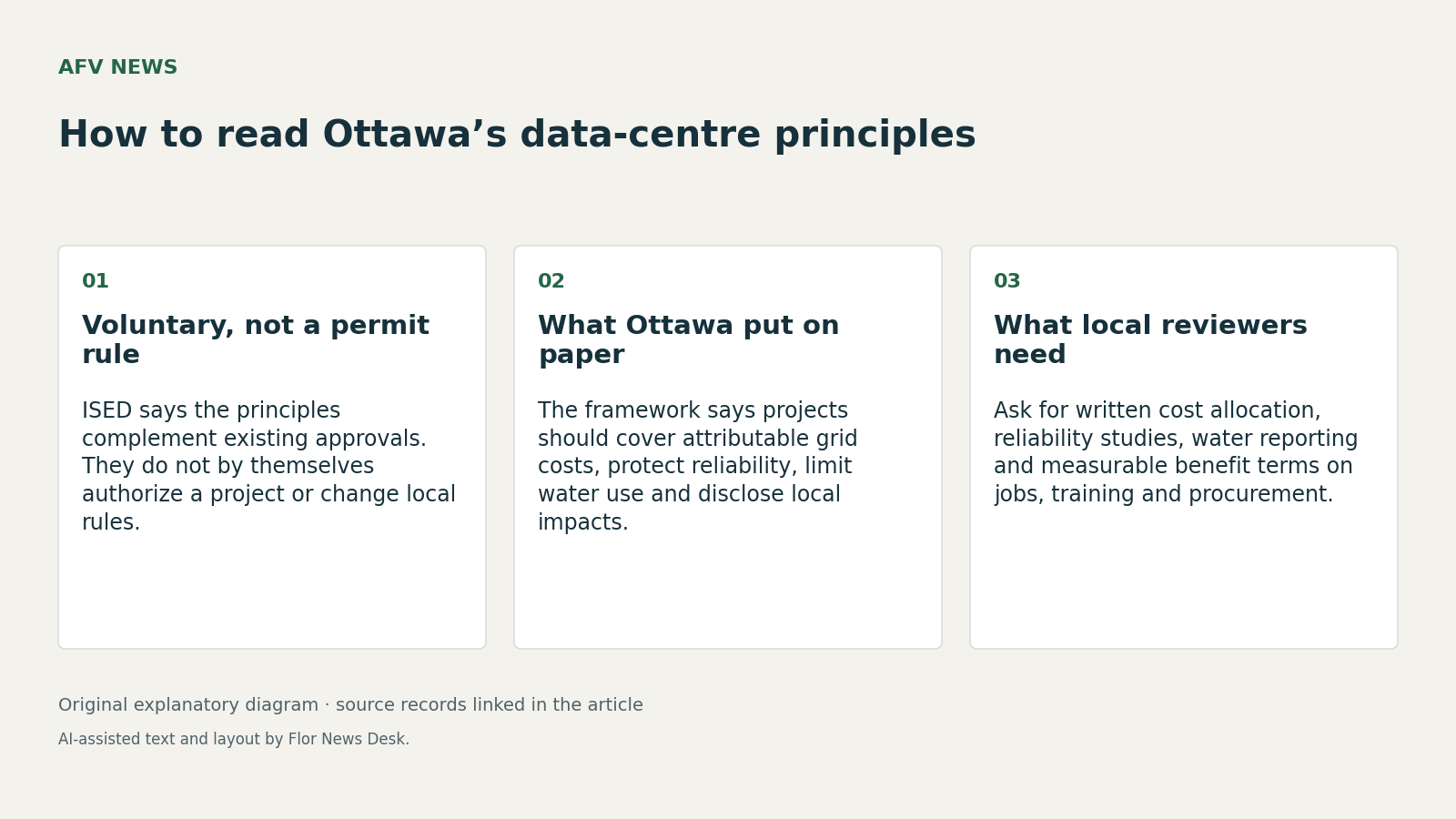
Ottawa’s Sept. 3, 2026 launch of Canada’s Responsible Data Centre Development Principles matters less as a new regulation than as a new baseline for negotiation. Innovation, Science and Economic Development Canada presented the framework as voluntary and national in scope, with signatories including major cloud, telecom and AI companies, while stressing that actual development decisions remain local and must fit existing provincial, territorial, municipal and Indigenous processes (ISED news release). For Canadian municipalities and utilities, that means the federal move is best read as a checklist to test projects against, not a shortcut around approvals.
The practical value is in the detail on the principles page. ISED says proponents should absorb project-attributable electricity connection and service costs, including directly attributable generation, transmission, substations and grid upgrades, in proportion to a project’s scale and impact. The same page says projects should avoid harming grid reliability, may need to support new supply or flexibility, should minimize freshwater use, and should provide independently verifiable information on local impacts while engaging host communities and Indigenous rights holders (principles page). That is more concrete than a general sustainability pledge.
What the record does not show is just as important. Neither the Sept. 3 release nor the principles page establishes binding enforcement, changed utility tariffs, approved projects or measured outcomes. A company’s signature is therefore not evidence that ratepayers are protected, that water use has been reduced or that local procurement will happen. That gap is the central business issue: if the principles stay at the level of public endorsement, municipalities and utilities still carry the burden of turning them into permit conditions, interconnection terms and reporting obligations.
The signatory story also needs care. An ISED artificial intelligence ecosystem page lists two separate items: the Sept. 3 launch and a Sept. 22, 2026 notice saying the government welcomed 19 additional signatories (AI ecosystem page). The principles page, which shows a modification date of Sept. 22, includes companies such as AMD, IBM, Intel, NVIDIA, Schneider Electric, STACK Infrastructure and Vantage Data Centres in addition to names cited in the original Sept. 3 release (principles page). But the available pages do not provide a change log, so they do not establish which firms were added on Sept. 22 or when each signed.
That uncertainty does not erase the policy signal. It sharpens what local decision-makers should ask for next. If a proponent cites the federal principles, municipalities and utilities can ask for the written cost-allocation basis for grid upgrades, the reliability study behind new load requests, water-use measurement and reporting plans, and project-specific disclosure of power, water, sound and emissions impacts. They can also ask how claimed benefits such as jobs, training, tax contributions, Indigenous procurement or access to compute will be measured and who can verify them. Those requests follow directly from the federal framework; they are the missing bridge between a voluntary commitment and an enforceable outcome.
The broader AI context explains why Ottawa is involved but not whether the policy will work. ISED’s AI ecosystem page places data centres within Canada’s National Artificial Intelligence Strategy, while a Sept. 2, 2026 media advisory shows the government had scheduled the announcement for Sept. 3 in Markham, Ontario (media advisory). Those records show timing and intent. They do not show implementation. The next meaningful evidence will come from project-level approvals, utility filings and local disclosure, not from the signatory list alone.
Read our editorial standards or send a correction to the editorial desk.