

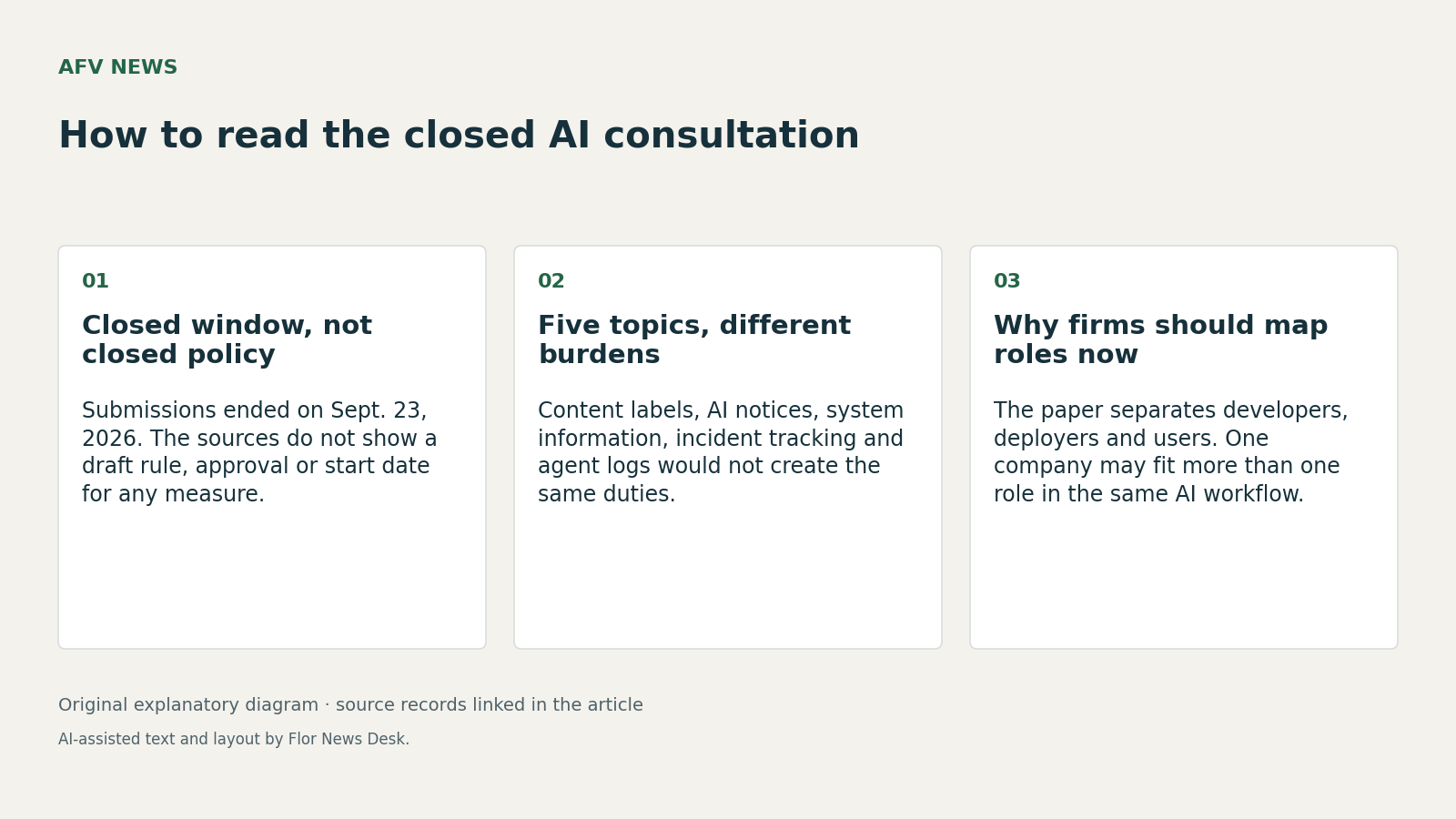
Innovation, Science and Economic Development Canada’s consultation on AI transparency closed on September 23, 2026, after running from July 23 to September 23, 2026, according to the federal consultation portal and the department’s July 23 launch release (consultation page, launch release). That closure is the verified change. It is not, on the current record, a new rule, a draft regulation or an implementation date.
What the federal record does show is the scope of the policy problem Ottawa chose to frame. The consultation page says the government identified five transparency areas for possible further action: identifying AI-generated content, telling people when they are interacting with an AI system, improving understandable information about AI systems’ development, capabilities and limitations, tracking serious AI incidents, and better tracking AI-agent activity and interactions (consultation page). The accompanying discussion paper says feedback will inform whether further action is needed and what form it should take, which means the exercise was exploratory rather than a settled policy announcement (discussion paper).
For businesses, the five-part structure matters because it points to different operational burdens. A labelling requirement for AI-generated content is not the same thing as a duty to notify users about AI interaction, and neither is the same as incident reporting or agent-activity tracking. The discussion paper gives the clearest detail on content disclosure, listing visible and invisible labels, watermarks, disclaimers and provenance metadata as possible tools, while also asking who in the AI value chain should be responsible (discussion paper). The available record is thinner on later sections, so it supports the policy categories but not a fully specified compliance design.
That value-chain question may be the most practical issue for Canadian companies. The paper distinguishes developers, deployers and users, and says one organization can occupy more than one role (discussion paper). In analysis terms, that means many firms should not assume any future transparency duty would sit only with a model maker. A company that builds internal tools, embeds third-party models in customer products and uses generative systems in marketing could span several roles at once.
The paper also cites Statistics Canada data showing 19.2% of Canadian companies reported using AI to produce goods or deliver services in the previous 12 months in the second quarter of 2026, up from 12.2% a year earlier (discussion paper). If adoption is rising while Ottawa is testing disclosure, notice and tracking ideas, the immediate business task is not legal prediction. It is basic inventory work. If later measures attach to content labelling, user notice or incident records, firms will first need to know which systems they use, which vendors supply them and where customer-facing outputs appear.
The July 23 release places the consultation within the government’s broader digital agenda and refers to Bill C-36 and Bill C-34 as related files (launch release). But the current sources do not establish that either bill will be the legal vehicle for any transparency measure. That distinction matters: related policy context is not the same as a drafted obligation.
The next confirmed milestone is procedural, not regulatory. The consultation portal says responses will be summarized in a What We Heard report in the coming months (consultation page). Until that appears, the strongest conclusion is modest but important: Ottawa has narrowed the transparency debate to five business-relevant areas, but the record still leaves open whether Canada will impose voluntary guidance, sector-specific measures or broader rules later on.
Read our editorial standards or send a correction to the editorial desk.