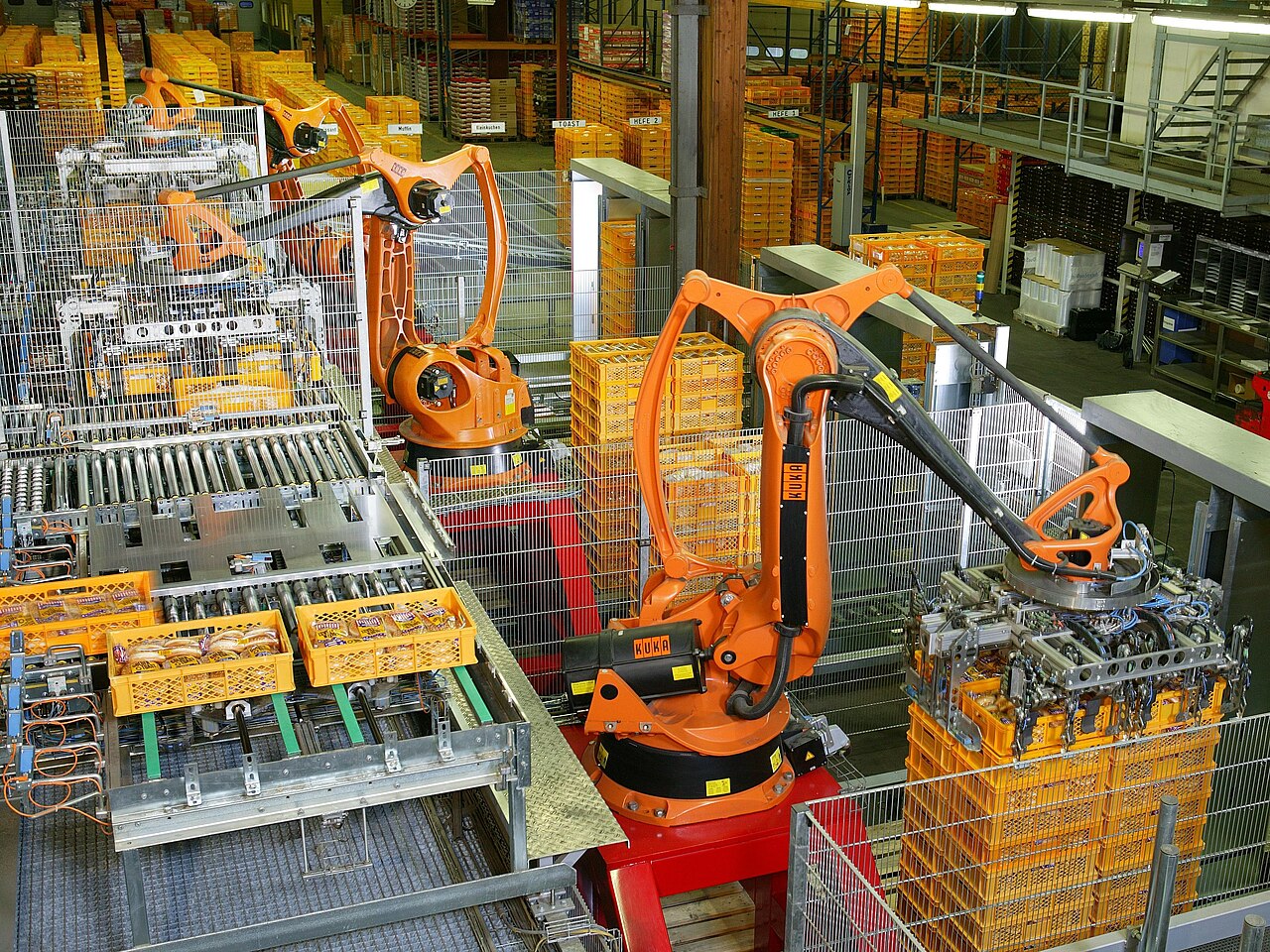
A September Bank of Canada staff working paper finds that industrial robot adoption in Canadian private corporations was associated with increases in employment and payroll among workers who did not own the business. Its central measurement question is unusually practical: when a company's payroll rises, how much reaches employees and how much is paid to owners?
Gabriela Galassi and Gaelan MacKenzie's study of automation and income distribution links robot-import records with information on firms, workers and individual owners. The authors find little evidence that adoption lowers the conventionally measured labour share of value added. Owners also benefit, principally through employment income.
The underlying paper restricts its empirical robot-adoption analysis to 2002–2018 and examines manufacturing and related sectors. These are historical firm-level findings published in 2026, not a count of robots installed this year or a forecast for generative AI.
One payroll total, different recipients
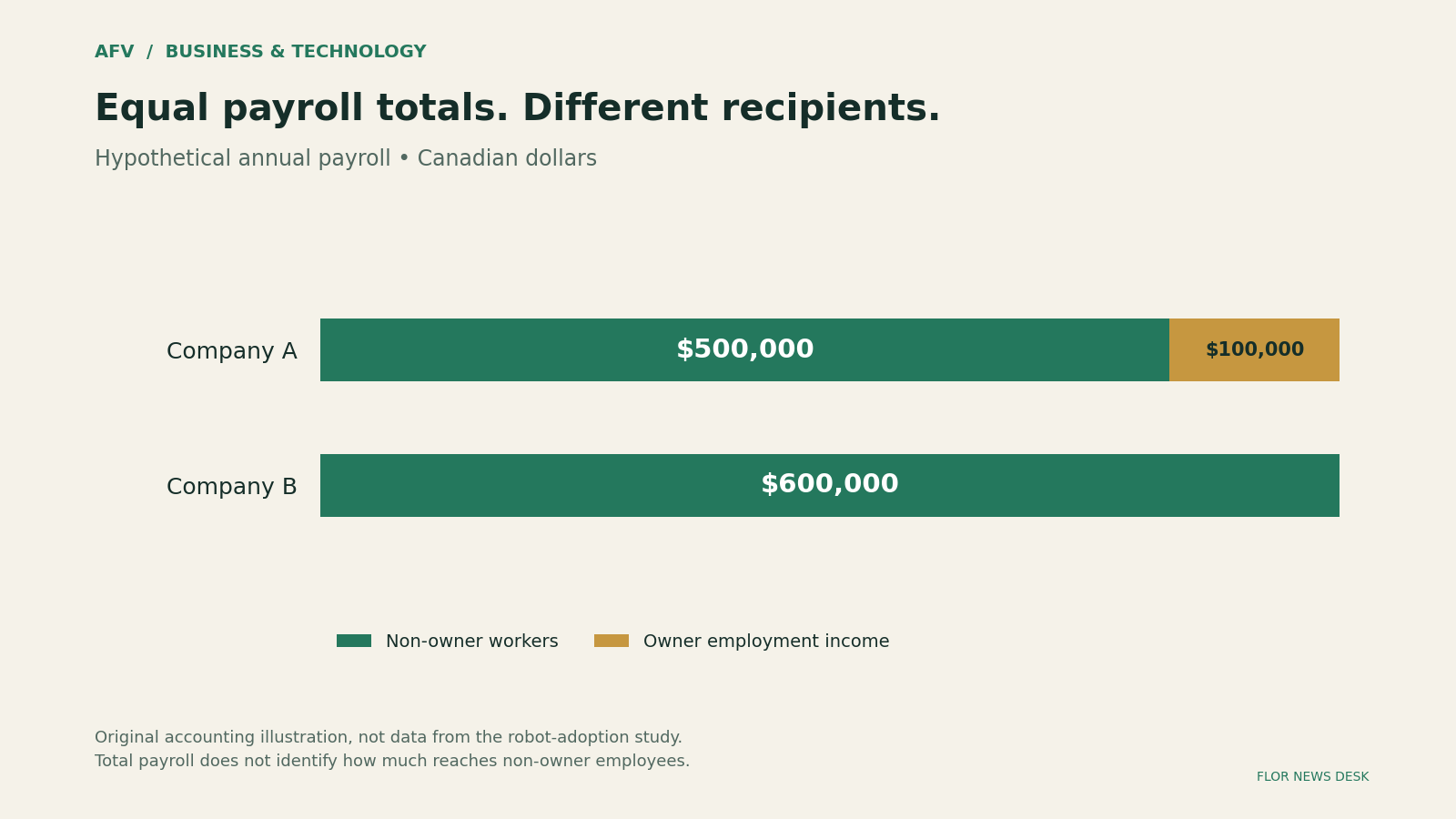
Consider two hypothetical companies, each reporting annual payroll of C$600,000. In the first, non-owner employees receive C$500,000 and an owner receives C$100,000 as employment income. In the second, all C$600,000 goes to non-owner employees.
The headline payroll totals are identical. The amounts reaching non-owner employees differ by C$100,000. The accompanying graphic illustrates that accounting distinction only; these are invented examples, not observations from the paper.
Neither example says how much work an owner performed, whether anyone was overpaid, or how much profit the firm made. Those questions require information absent from the payroll total. Separating recipients is useful precisely because it prevents one number from answering questions it cannot settle.
A more informative automation account
AFV's interpretation is that a business assessing a machinery investment could keep separate records of non-owner headcount, hours and pay, owner employment income, and the equipment's output. That would make it easier to explain who received a financial benefit and whether production expanded.
Even that record would not, by itself, prove the machine caused a change. A new customer, a longer shift or a price increase could coincide with installation. Comparing the same business before and after an investment requires attention to those other changes.
The research also should not be read as a guarantee that every worker benefits from automation. A firm can expand overall while specific tasks change. A company-level payroll measure cannot describe an individual employee's experience without additional evidence.
For readers weighing a claim that robots increased either “wages” or “profits,” the useful first question is how the author classified payments to people who both own and work in the business. The new paper shows why that definition deserves space beside the headline result.
Read our editorial standards or send a correction to the editorial desk.