

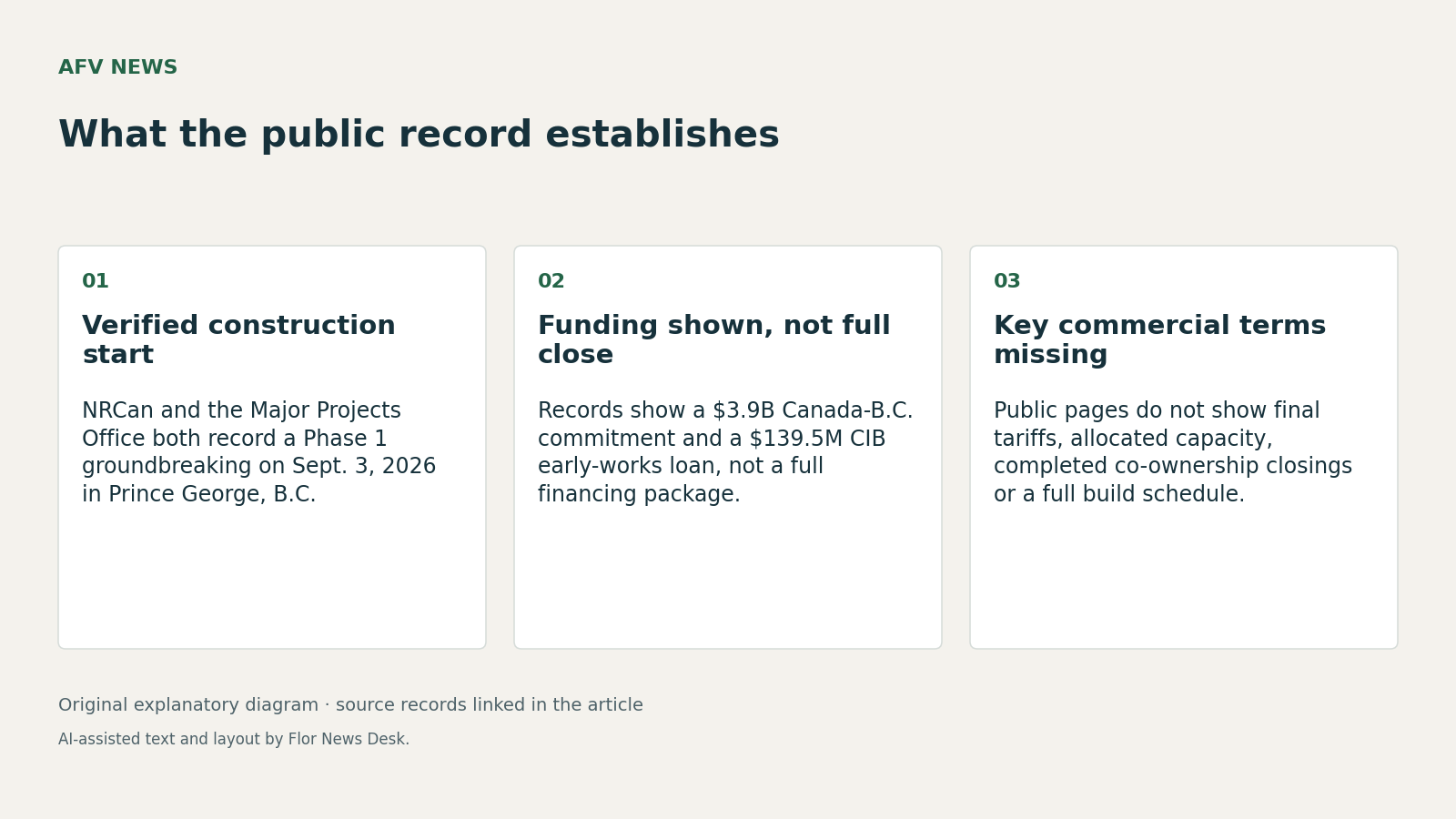
The North Coast Transmission Line now has something many Canadian infrastructure files do not: a recorded construction start. Natural Resources Canada said Phase 1 broke ground in Prince George, British Columbia, on September 3, 2026, and the Major Projects Office lists the same date in its project updates. Natural Resources Canada says that first phase covers a 165-kilometre, 500-kilovolt segment from the Williston Substation near Prince George to the Glenannan Substation near Fraser Lake. Natural Resources Canada Major Projects Office: North Coast Transmission Line
For Canadian energy and mining businesses, that is a real milestone, but it is not the same as full commercial certainty. The same public records say Canada and British Columbia committed $3.9 billion toward phases 1 and 2 on July 2, 2026 under the Canada–British Columbia Cooperative Prosperity Agreement. Natural Resources Canada also says the Canada Infrastructure Bank provided a $139.5 million loan to BC Hydro in November 2025 for pre-construction work such as engineering, route clearing and First Nations consultations, while the Major Projects Office page says that loan closed for those activities. What the pages do not show is a final overall financing package, a full construction schedule or the operating terms under which customers would actually take service. Natural Resources Canada Major Projects Office: North Coast Transmission Line
That distinction matters because the broader project is larger than the segment now under construction. The Major Projects Office describes the planned line as twinning existing transmission from Prince George to Terrace and extending north to the Bob Quinn substation. In other words, the verified September 3 event establishes physical work on Phase 1, not completion of the whole corridor or delivery of every future benefit attached to the project in government material. Major Projects Office: North Coast Transmission Line
The commercial relevance is clearest in industrial load growth, especially LNG. The Major Projects Office says BC Hydro signed a January 2026 memorandum of understanding with Ksi Lisims LNG on interconnection steps for 600 megawatts of electricity supply. But the separate Ksi Lisims page still describes that LNG development as proposed, says the power arrangement is contingent on the North Coast Transmission Line being expanded, and lists 2026 LNG sales arrangements whose expected first deliveries under the SEFE and Uniper items would begin in 2032. The public record therefore supports the line’s strategic importance to export projects, not proof that capacity has been allocated, contracted on final terms or delivered. Major Projects Office: North Coast Transmission Line Major Projects Office: Ksi Lisims LNG
The ownership record is also still preliminary. Natural Resources Canada says First Nations have the opportunity to co-own up to 50 percent of the new transmission line. The Major Projects Office page goes further, saying several First Nations in the K’uul Power consortium signed agreements giving an option to acquire up to 50 percent equity. For businesses assessing counterparty structure, that is meaningful progress, but it is still not the same as a publicly documented, executed co-ownership closing. Natural Resources Canada Major Projects Office: North Coast Transmission Line
The wider policy case for a line like this is clear in Ottawa’s May 2026 electricity strategy. Natural Resources Canada says Canada needs to double electricity supply by 2050, that expansion and modernization could cost more than $1 trillion by 2050, and that the document cites BC Hydro’s 2024 10-year capital investment plan at about $36 billion. That context helps explain why governments are backing major transmission, but it does not answer the near-term commercial questions a contractor, supplier or industrial power user needs answered before committing capital or lead times. Powering Canada Strong
The practical reading, as of October 4, 2026, is that businesses can treat the North Coast file as having moved beyond concept and early regulatory positioning. They still need harder documents before assuming when later phases will be built, how capacity will be priced, which customers will secure service, and how Indigenous equity will be finalized. The next proofs are not more broad announcements but project records such as procurement notices, connection and tariff terms, signed ownership agreements, financing-close documentation and updated Major Projects Office milestones. Natural Resources Canada Major Projects Office: North Coast Transmission Line
Read our editorial standards or send a correction to the editorial desk.