

Canada’s gas supply is becoming more dependent on the Montney. In a Market Snapshot published on Sept. 23, 2026, the Canada Energy Regulator said Montney tight gas accounted for 8.3 of 18.3 Bcf/d in its 2024 estimate of Canadian production, or 45%, up from 22% in 2015. The same record models 15.3 of 24.4 Bcf/d by 2035, or 63%, under the Energy Futures 2026 Current Measures scenario, but CER says that outlook depends heavily on future LNG export levels and natural gas prices. CER Market Snapshot, Sept. 23, 2026
CER’s update matters because it combines scale with better well productivity. The regulator says more than 9,500 wells were drilled in the Montney from 2005 to 2025, and its decline-curve comparison shows wells drilled before 2015 started below 3 MMcf/d, while recent wells average more than 4 MMcf/d in Alberta and nearly 7 MMcf/d in British Columbia. CER also says proppant intensity in British Columbia Montney wells rose from 117 tonnes per 100 metres of horizontal leg in 2015 to 197 tonnes in 2024. CER Market Snapshot, Sept. 23, 2026 The business implication is not only more supply. If more national output comes from one formation where newer wells start stronger, a larger share of Canada’s gas deliverability becomes tied to the same producing corridor.
That corridor is regional as well as geological. Natural Resources Canada describes the Montney as extending from the B.C.-Alberta border near Dawson Creek into the B.C. Rocky Mountain foothills, and calls it the largest and most productive play in British Columbia. Natural Resources Canada background page That page is mostly older background, with many figures tied to 2015 or earlier, so it does not establish current operations. It does, however, help explain why fiscal and infrastructure decisions in British Columbia and Alberta can carry national weight when one formation supplies such a large share of Canadian gas.
Statistics Canada’s national data show the output side of that shift. In a report published on Apr. 8, 2026 about 2025 results, Statistics Canada said marketable natural gas production reached 8.249087 billion gigajoules, up 3.4% from 2024. Exports rose 6.4%, domestic demand rose 2.7%, and British Columbia and Alberta together accounted for 99.1% of production. Statistics Canada also said the first cargo to Asian markets left the LNG export facility in Kitimat, B.C., in July 2025, while October 2025 inventories reached 1.2 billion gigajoules, the highest in the series. Statistics Canada 2025 gas report Those figures show more gas reaching market, but they do not prove unconstrained access from each producing area to each destination.
CER’s earlier pipeline data explain why that distinction matters. In a snapshot published on Nov. 19, 2025 and covering 2024 through the first half of 2025, CER said NGTL East Gate averaged 4.88 Bcf/d in 2024 and 5.68 Bcf/d in the first quarter of 2025; January 2025 throughput was nearly 14% above available capacity. The same record said NGTL West Gate reached 98% utilization in January 2025, Alliance had been full since November 2024, and Westcoast at Huntingdon/FortisBC Lower Mainland ran 7% above capacity in January 2025. CER pipeline utilization snapshot CER notes that throughput can exceed reported available capacity because estimates change with temperature, outages and downstream constraints, and this record does not establish conditions after June 2025. CER pipeline utilization snapshot
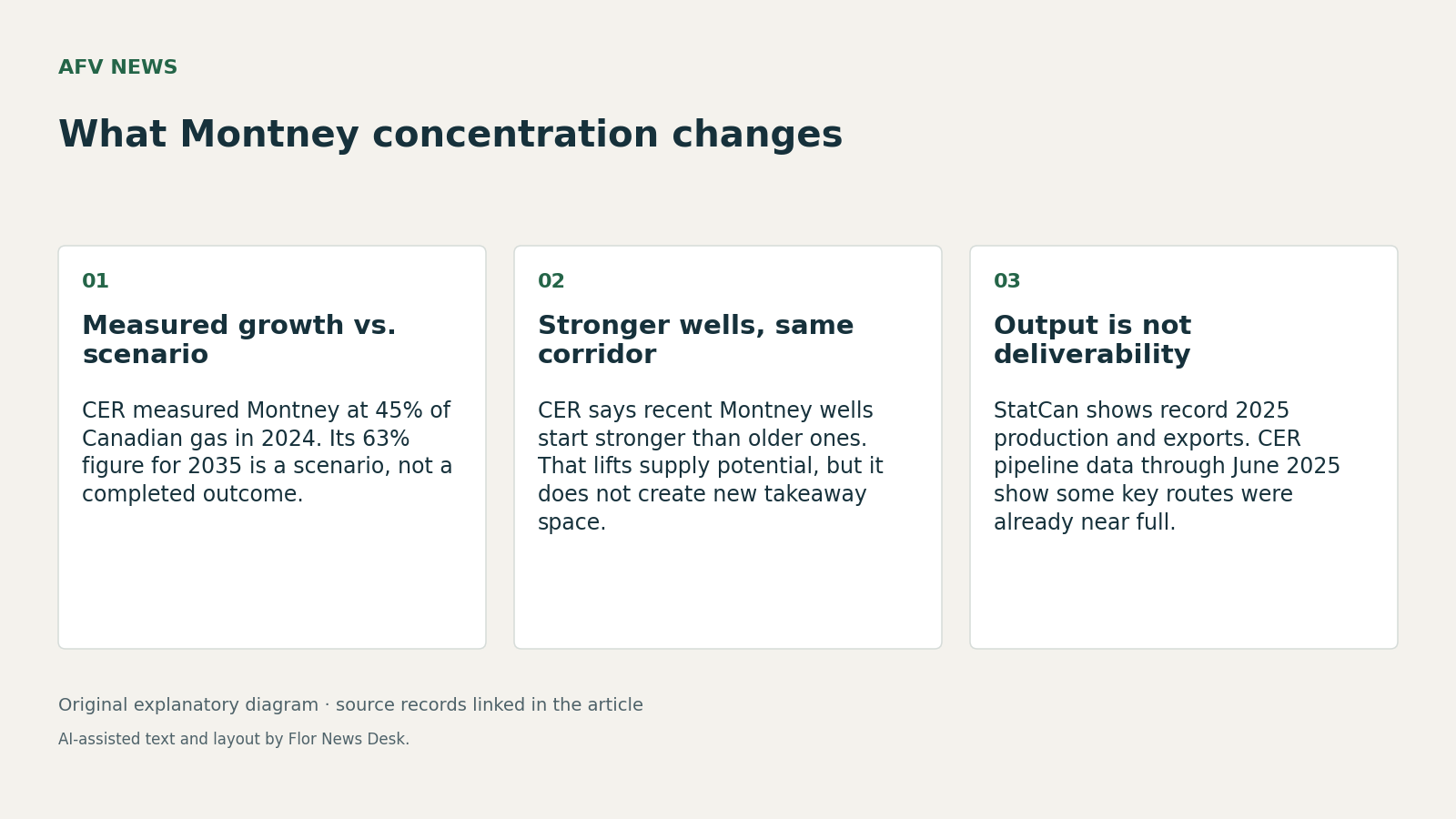
For Canadian businesses, the practical reading is to separate basin growth from delivery certainty. CER’s 2035 Montney share is a scenario result, not an achieved outcome, and Statistics Canada’s 2025 report is national rather than Montney-specific. CER Market Snapshot, Sept. 23, 2026 Statistics Canada 2025 gas report Still, the sourced record supports one clear conclusion: by 2024 Canada was already leaning more heavily on the Montney, and if that concentration continues, transport access and provincial policy exposure will matter more to realized sales than geology alone.
Read our editorial standards or send a correction to the editorial desk.