

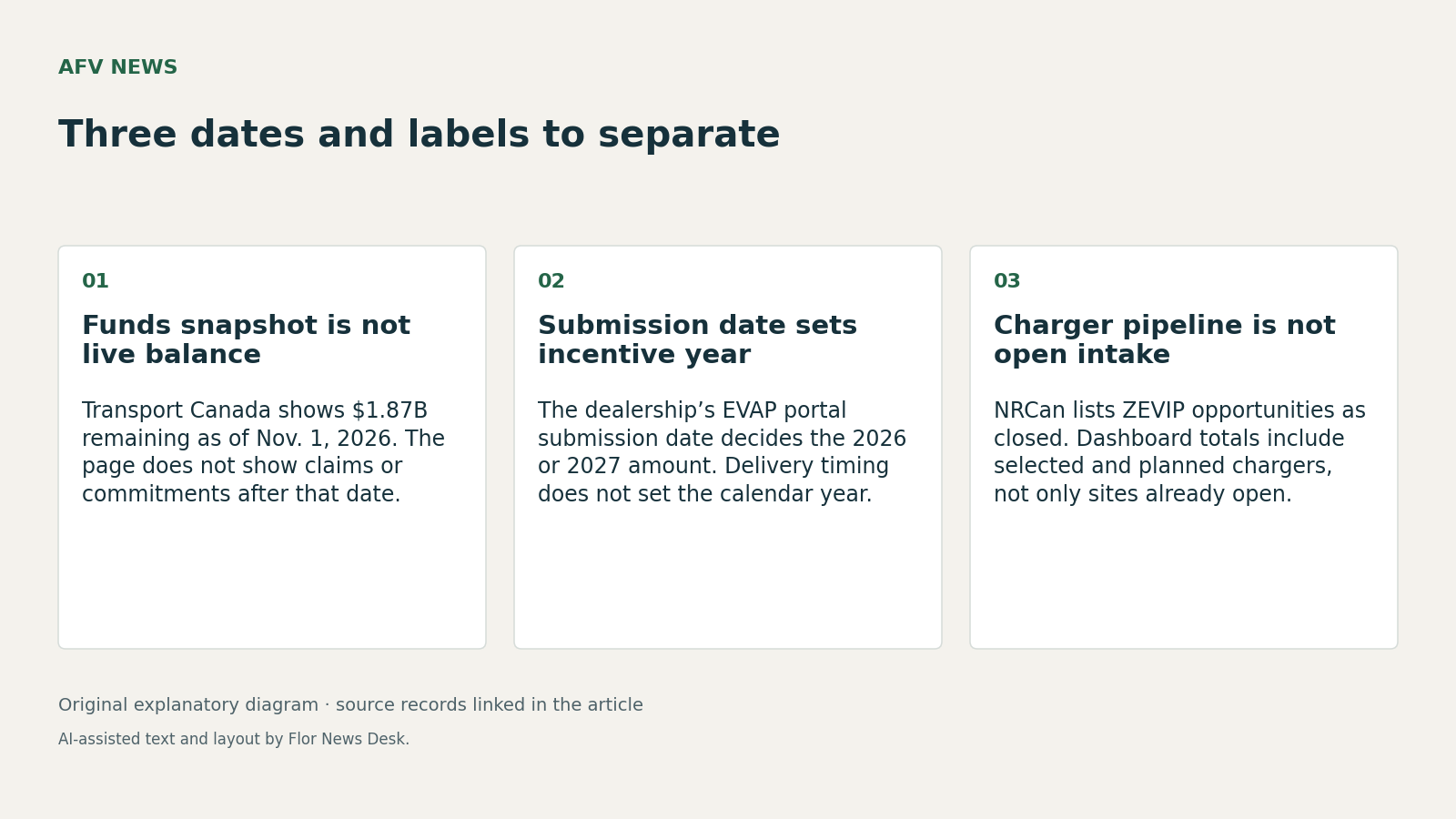
Transport Canada’s most actionable electric-vehicle update is not a new budget signal but a transaction rule with a fixed date. The department’s Electric Vehicle Affordability Program says incentive amounts drop at midnight on January 1, 2027, and the applicable year is determined by when a dealership submits the eligibility assessment through the EVAP portal, not when the vehicle is purchased, leased or delivered. The main program page also shows $1.87 billion remaining as of November 1, 2026, from $2.275 billion in program funding. EVAP program page EVAP questions and answers
For dealers and fleet buyers, that means the year-end task is administrative as much as commercial. Transport Canada says eligible purchases or leases made on or after February 16, 2026 may qualify, while the Q&A separately says the program started on March 31, 2026. Read together, those records indicate a distinction between the program launch and the earliest eligible transaction date, not a contradiction that businesses can ignore. The Q&A also says funding is first come, first served and gives examples in which an approved eligibility assessment remains valid for 90 days. EVAP program page EVAP questions and answers
The practical consequence is that a buyer waiting for a 2027 delivery date does not automatically fall into 2027 incentive levels if the dealership files the assessment before January 1, 2027 and the transaction still fits the program rules. Transport Canada’s examples list 2026 maximum incentives of up to $5,000 for battery electric vehicles and up to $2,500 for plug-in hybrids, versus 2027 maximums of up to $4,000 and up to $2,000. Lease deals can qualify at 12 months or longer, with smaller support for shorter qualifying lease terms. That creates a narrow planning window for fleet operators still negotiating order timing, lease structure and documentation. EVAP questions and answers
The funding snapshot is useful, but it is still only a snapshot. Transport Canada’s page dates the $1.87 billion figure specifically to November 1, 2026. It does not show claims submitted after that date, funds already committed but not paid, or a live queue. The department’s EV dashboard is older still: it says its data were updated in September 2026, with EVAP claims shown as 53,006 for 2026-27 as of July 2026. That table is evidence of early demand, not proof of the balance on November 10, 2026. EVAP program page Canada’s EV dashboard
For charger suppliers and municipalities, the current federal record points to pipeline, not immediate intake. Natural Resources Canada says the Zero Emission Vehicle Infrastructure Program remains available until 2027, but the opportunities listed on the program page are marked closed for applications. The same page does not show a reopening date, signed project contracts or money already disbursed. That matters because supplier planning based on federal targets alone can outrun the actual procurement calendar. Zero Emission Vehicle Infrastructure Program
The dashboard helps separate built capacity from planned capacity. It lists 40,119 public light-duty chargers in Canada as of June 2026, but 59,479 chargers selected for Government of Canada funding or financing, including 42,333 opened and 17,146 planned. Those are different categories. Selection is not the same as installation, and a target is not the same as an operating site. For Canadian businesses, the near-term message is simple: EV buyers can act on a verified January 1 filing rule now, while charger vendors still need to treat federal infrastructure pages as evidence of an existing program and a backlog, not a newly open market window. Canada’s EV dashboard Zero Emission Vehicle Infrastructure Program
Read our editorial standards or send a correction to the editorial desk.