

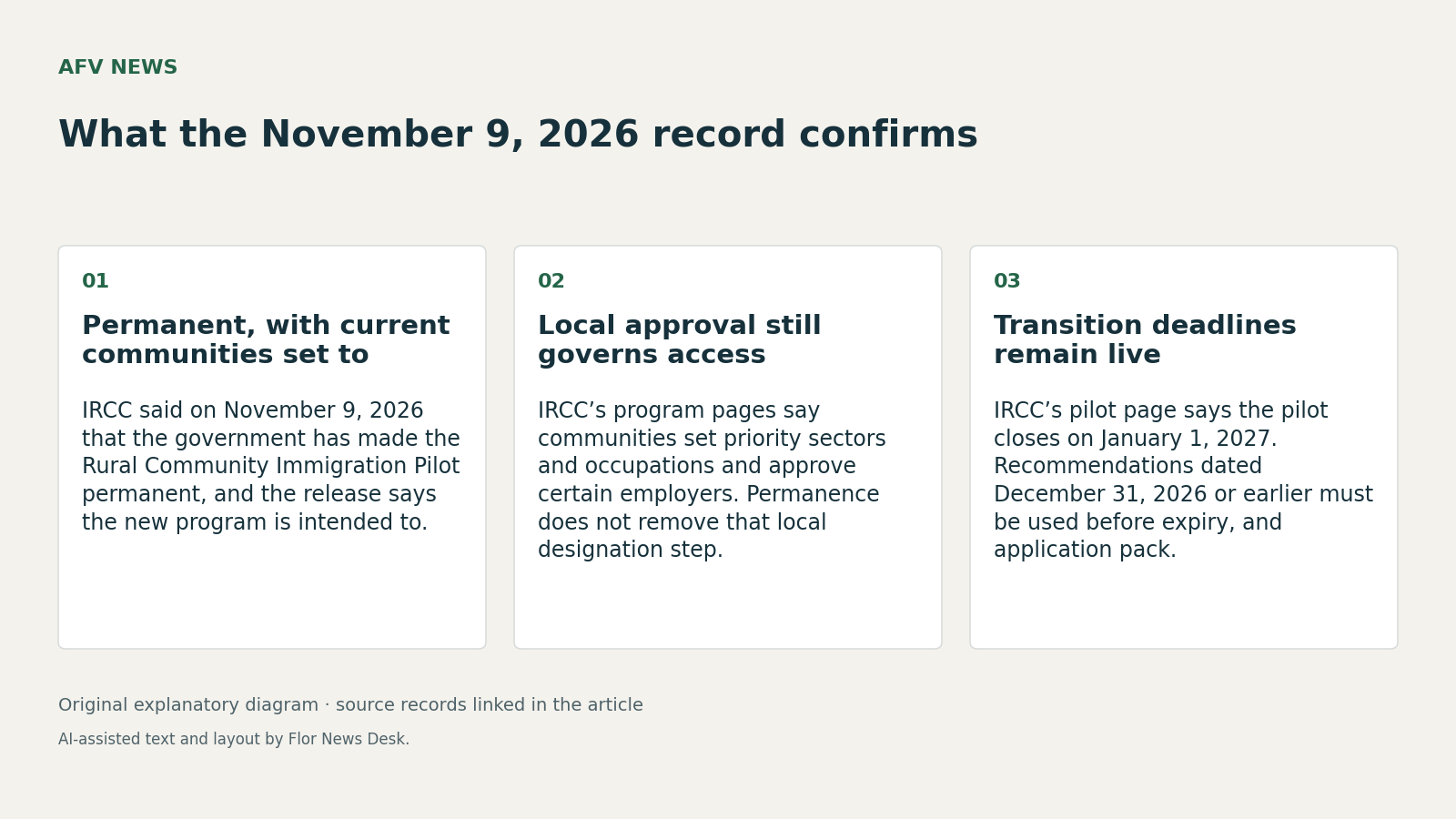
Immigration, Refugees and Citizenship Canada said on November 9, 2026 that the federal government has made the Rural Community Immigration Pilot permanent, creating a new Rural Community Immigration Program intended to continue with the 14 communities already participating in the pilot (IRCC release; program hub). For employers, the confirmed change is continuity of a permanent-residence pathway. The reviewed public record does not show a new funding envelope, a simplified national employer approval route, or additional communities already added.
The operating model remains local. IRCC’s program hub says each participating community has its own economic needs, designated employers, and priority occupations and sectors. The Rural Community Immigration Pilot page says participating communities approve certain employers to hire skilled migrants for jobs they cannot fill with local workers (program hub; pilot page). That matches the January 30, 2025 launch record, when IRCC said local economic development organizations would identify labour gaps, designate employers and recommend candidates for permanent residence (2025 launch release). In practice, permanence does not turn the stream into a single national intake that employers can use without community approval.
The handoff from pilot to permanent program also still matters. As of November 9, 2026, IRCC’s pilot page says the Rural Community Immigration Pilot will close on January 1, 2027. If a community recommendation is dated December 31, 2026 or earlier, the applicant must apply for permanent residence before that recommendation expires (pilot page). IRCC’s permanent-residence instructions add that the application package depends on whether the recommendation date is on or before December 31, 2026, or on or after January 1, 2027 (permanent-residence instructions).
IRCC is also presenting the program as material in scale, but some of those numbers need careful framing. The November 9 release says that from January 2025 to August 2026, participating communities designated more than 1,950 employers, which then issued more than 4,700 job offers and community recommendations (IRCC release). The same release says “this year’s plan” targets 5,500 admission spaces for the permanent Rural Community Immigration Program. However, the records reviewed here do not include a separately retrieved Immigration Levels Plan page that pins those 5,500 spaces to a specific calendar year, so it would overstate the evidence to assign that figure to 2026 alone.
Historical context supports Ottawa’s rationale, but not a current outcome claim for the new permanent program. IRCC says the earlier Rural and Northern Immigration Pilot ran from 2019 to 2024, and the January 30, 2025 launch release said 8,580 newcomers had been granted permanent residence through that predecessor as of December 31, 2024. That same release cited an October 2022 survey in which 87% of respondents said they stayed and planned to stay in their RNIP communities (2025 launch release). Those are predecessor-program indicators, not measured retention results for the 2025-2026 Rural Community Immigration Pilot.
For businesses in communities such as Pictou County, Thunder Bay, Brandon and Peace Liard, the practical reading is narrower than the headline. Ottawa has preserved a community-led route to permanent residence, but firms still need local designation and still need to watch the January 1, 2027 transition rules. The current record does not establish new funding, a national rollout timetable, or confirmed expansion beyond the 14 listed rural communities.
Read our editorial standards or send a correction to the editorial desk.