

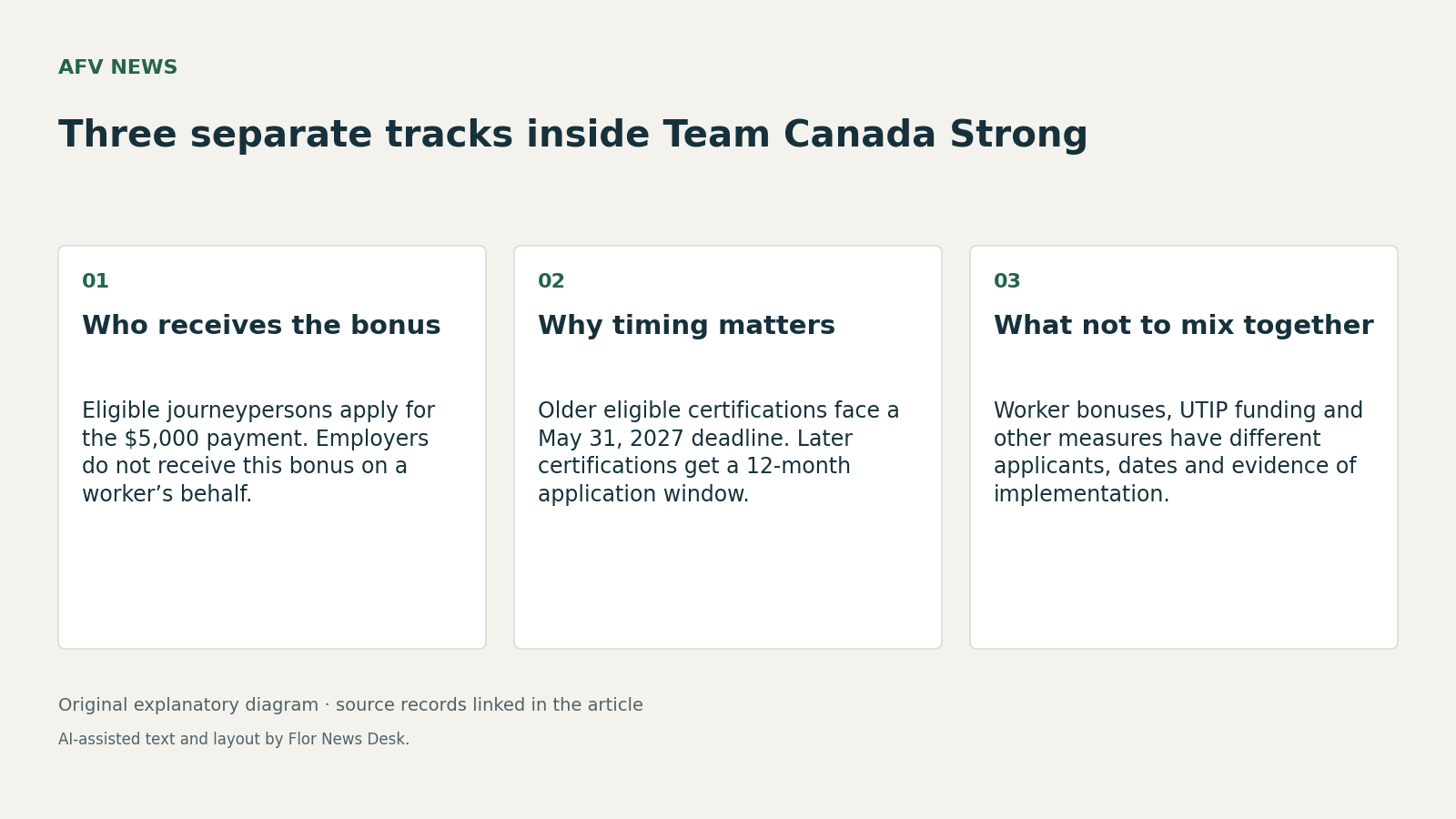
Employment and Social Development Canada says applications for the $5,000 Red Seal Completion Bonus are scheduled to open on November 16, 2026, for eligible newly certified journeypersons, not for employers ESDC release program page. As of the current date, November 6, 2026, those federal records still describe a future opening. That means businesses can prepare staff and hiring teams for the process, but cannot treat the measure as a live company-side funding source or proof that any payments have been made.
The mechanics matter because eligibility turns on the worker’s certification record, not the employer’s project needs. The federal release says eligible applicants are journeypersons who completed an apprenticeship and obtained certification in a designated Red Seal trade on or after April 1, 2025, and who are Canadian citizens, permanent residents or protected persons and not attending high school ESDC release. The program page adds that a journeyperson can receive the bonus for each Red Seal certification obtained in an eligible trade designated within the worker’s province or territory program page. For employers with crews crossing provincial borders, that is a reminder to check designation in each jurisdiction rather than assume one national list in practice.
The administrative deadlines are also more rigid than the headline amount suggests. Employment and Social Development Canada says certifications dated from April 1, 2025 to November 15, 2026 must be submitted by May 31, 2027, while certifications dated November 16, 2026 or later have a 12-month application window ESDC release. The same release says applicants need a Social Insurance Number, mailing address, banking information, trade and certification details, province or territory of certification, and an apprentice identification number, with some applicants needing proof of status or extra jurisdictional documents. Supporting documents must be provided within 28 calendar days after an application is started ESDC release. That points employers toward a practical role: reminding new hires to assemble records early, not expecting payroll or procurement teams to substitute for personal eligibility documents.
The bonus also sits inside a much larger federal package that mixes worker payments, employer-facing incentives and training-system funding. Employment and Social Development Canada’s backgrounder describes Team Canada Strong as an $8 billion initiative intended to recruit, train and hire 80,000 to 100,000 new Red Seal skilled trades workers by 2030-2031, including $2 billion for provincial and territorial workforce development and apprenticeship opportunities Team Canada Strong backgrounder. The same backgrounder says the Build Canada Apprenticeship Service would offer up to $10,000 for hiring a first-year apprentice in an eligible Red Seal trade, while the Apprenticeship Training Grant would add $400 per eligible week of technical training beginning on or after January 3, 2027 Team Canada Strong backgrounder. Those are separate measures with different recipients and timelines.
The contrast is even sharper with the Union Training and Innovation Program. A federal release dated October 15 says more than $430 million over five years is being directed to that program, with infrastructure expansion expressions of interest due November 12, 2026, innovation applications due December 17, 2026, and an open-ended call for investments in training equipment UTIP announcement. That same release says the maximum contribution rate for training equipment is temporarily rising from 50% to 70%, and that infrastructure projects from this intake could be launched in Spring 2027 UTIP announcement. For contractors and training organizations, those are application streams for organizations, not interchangeable with the Red Seal bonus.
A near-term planning consequence follows from the date structure. Because the bonus covers certifications obtained on or after April 1, 2025, but applications do not begin until November 16, 2026, there is a built-in first wave of already-certified workers who may decide to apply once the portal opens ESDC release program page. That is an analytical inference from the eligibility window, not evidence of expected volume. For employers, the realistic short-term effect is on recruiting conversations and onboarding reminders, not on project financing.
What the current record does not establish is just as important. The available federal pages do not show processing times, payment timing, tax treatment, the full province-by-province trade list, or any measured increase in labour supply from Team Canada Strong program page Team Canada Strong backgrounder. They also do not show approved UTIP projects or money already received by recipients UTIP announcement. The most solid conclusion for Canadian businesses on November 6 is narrower: a worker-directed bonus has a dated application launch, clear initial deadlines and document rules, and it should be planned for as an administrative hiring factor rather than a corporate subsidy.
Read our editorial standards or send a correction to the editorial desk.