

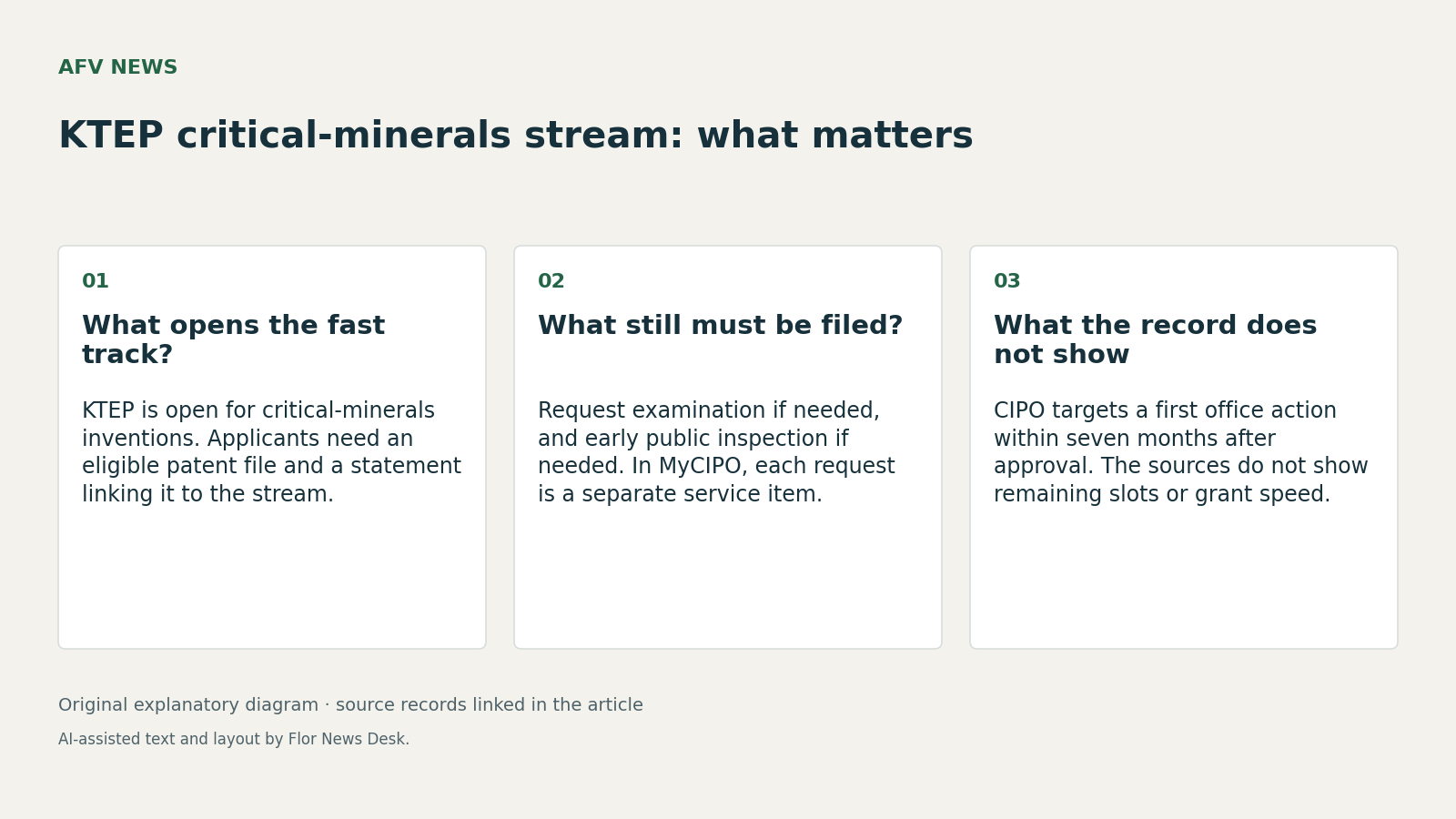
On September 2, 2026, the Canadian Intellectual Property Office opened a new queue for some patent applicants, not a new subsidy. CIPO said its new Key Technology Expedited Program, or KTEP, launched as a pilot, with the first active stream covering inventions that support Canada’s critical-minerals supply chain, including processing, extraction and refining technologies on Canada’s critical minerals list (CIPO launch notice). For approved requests, CIPO says applicants can expect a first office action within seven months, and the operational page says the critical-minerals stream is open for up to 50 eligible requests per calendar year on a first-come, first-served basis (KTEP program page).
For businesses, that makes KTEP mainly a filing-readiness issue. CIPO says a request can be made for a new or existing patent application at any point between filing and grant, but the application must relate to an open stream, remain in good standing, be open to public inspection or be opened at the same time, and have examination requested or requested at the same time (KTEP program page). The FAQ adds a practical detail that matters if a company is working through MyCIPO Patents: requesting examination, requesting early opening to public inspection and requesting accelerated examination are separate service requests that must each be added to the cart (KTEP FAQ).
The cost signal is narrower than the headline may suggest. CIPO says there is no fee to request KTEP acceleration and approved requests do not have to pay the advanced examination fee, which the September 2 notice listed at $744.10 for 2026, but regular patent application and examination fees still apply (CIPO launch notice; KTEP FAQ). In practical terms, the pilot changes queue position and one fee item. The source record does not support reading it as a broader reduction in patenting costs.
The timing promise is also narrower than a commercialization promise. The FAQ says CIPO’s performance target is a first office action within seven months for 90% of KTEP requests that comply with program requirements, and the program page says expedited treatment ends if an extension of time is authorized, the application is deemed abandoned or the applicant requests continued examination (KTEP FAQ; KTEP program page). That means the pilot is best understood as a faster route to initial examination, not evidence of a faster patent grant. As of 2026-11-20, the sources also do not show how many of the 50 annual slots remain or whether the seven-month target has been met in practice.
The policy history matters because it separates implementation from earlier plans. In its 2026-2031 business strategy, CIPO said it would introduce a no-cost accelerated stream for technologies aligned with government priorities such as critical minerals, AI, defence and energy (CIPO 2026-2031 business strategy). That strategy did not prove those streams were operating. A separate consultation summary, based on a small 2026 consultation, said respondents wanted clear, predictable eligibility criteria for a proposed key-technology program, while some preferred effort on restoring broader service levels instead (What we heard report). The September 2 launch is therefore the implementation record for critical minerals, not for every sector named earlier.
For Canadian miners, processors, equipment suppliers and patent agents, the immediate question is not whether KTEP exists. The records show that it does. The practical question is whether a company already has, or can promptly assemble, an application that is ready for public inspection, ready for examination and supported by a statement linking it to the critical-minerals stream (KTEP program page; KTEP FAQ). What the record cannot yet establish is the pilot’s real-world throughput, approval rate or effect on financing and bidding timelines. That missing evidence should keep applicants and investors from treating an expedited request as proof of an expedited business outcome.
Read our editorial standards or send a correction to the editorial desk.