
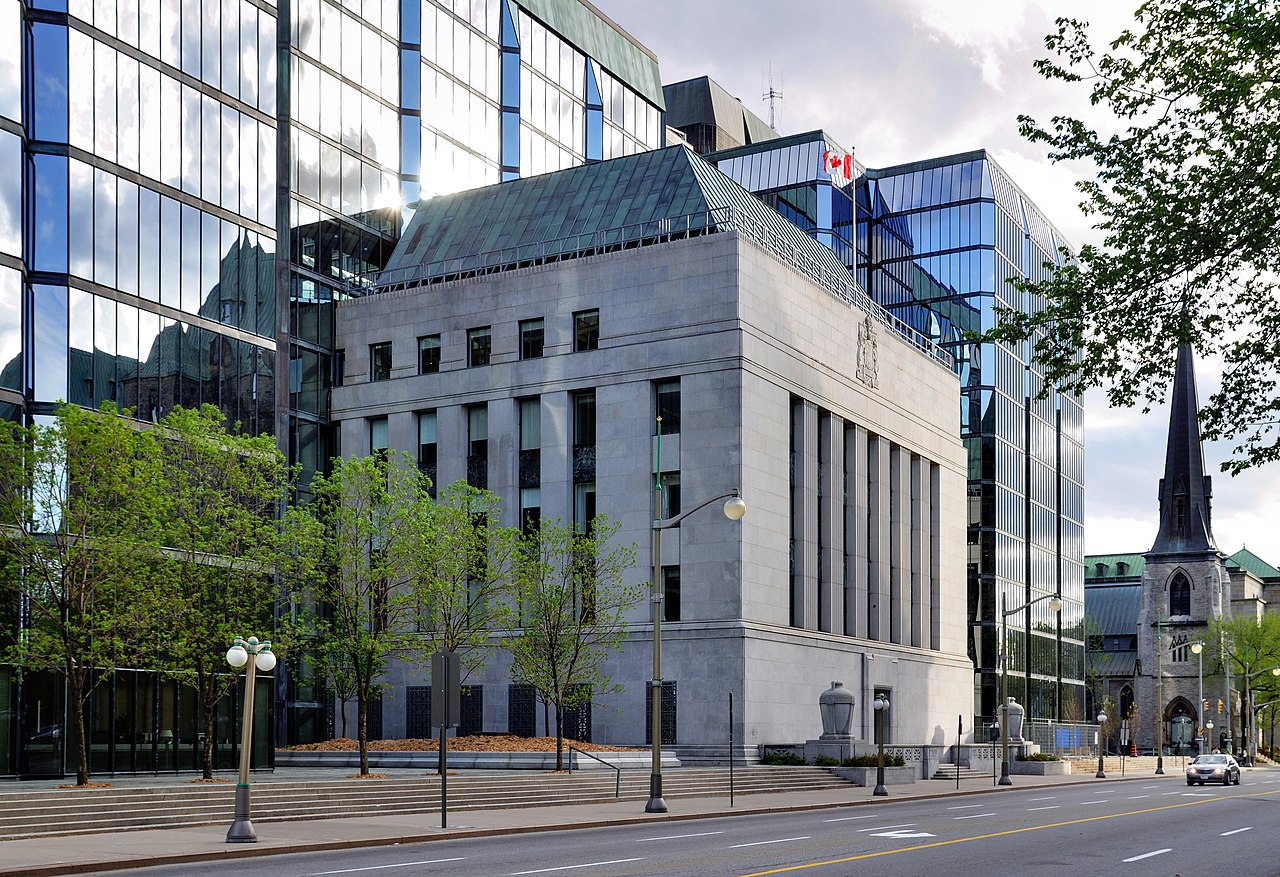
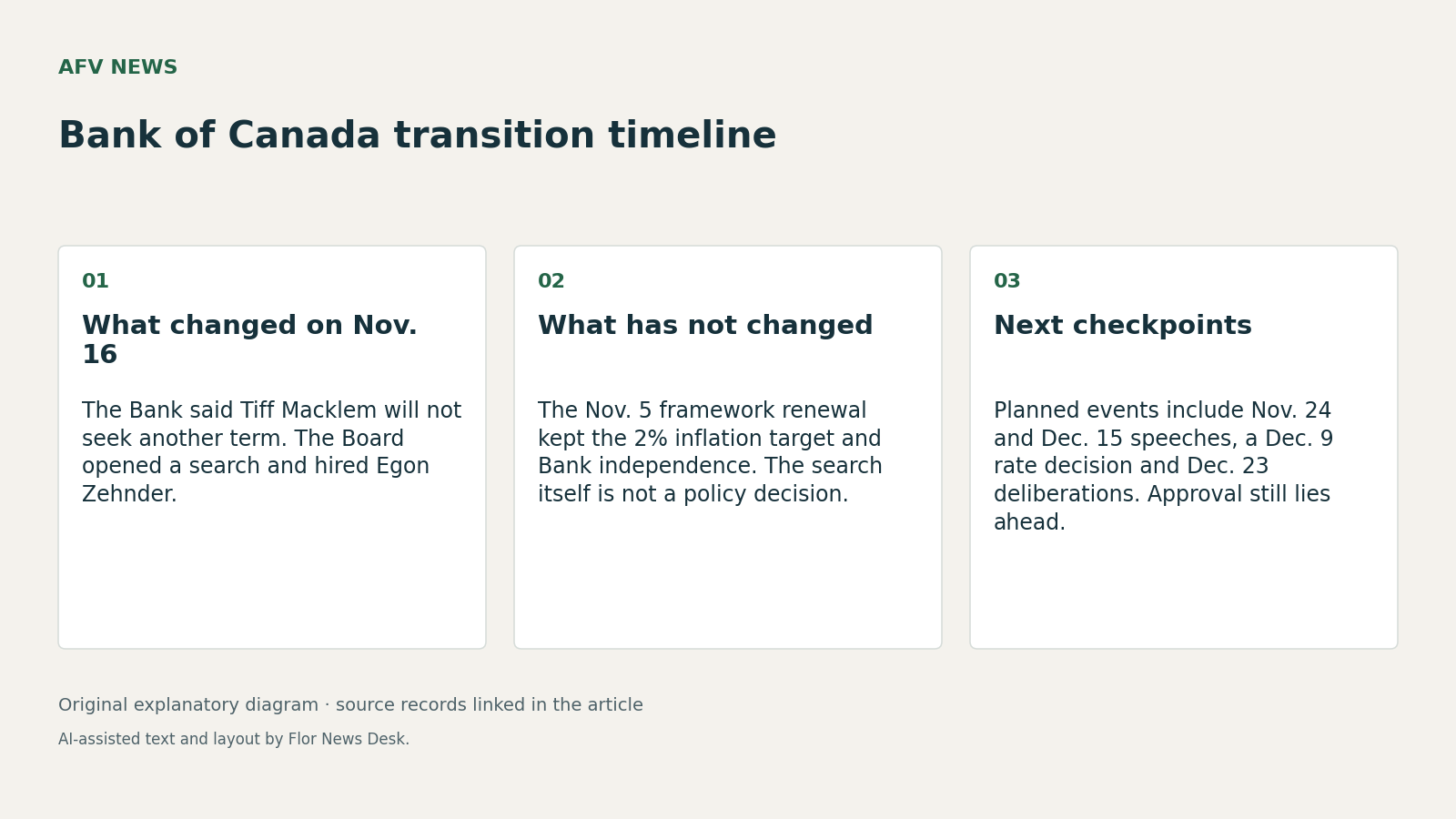
The Bank of Canada has turned succession from a background question into a dated public process. On November 16, 2026, the Bank said Governor Tiff Macklem told its Board of Directors he will not seek a second term, and that his current seven-year term ends on June 2, 2027. The Bank also said the Board’s independent directors have formed a Search Committee, engaged Egon Zehnder and expect recruitment to finish by spring 2027, with the next governor’s seven-year term to begin June 3, 2027, subject to approval by the Minister of Finance and the federal Cabinet (Bank of Canada release).
What that establishes is governance timing, not a new policy direction. Eleven days earlier, on November 5, 2026, the Government of Canada and the Bank of Canada renewed the monetary policy framework through December 31, 2031. That joint statement kept the 2% inflation target as the midpoint of the 1% to 3% consumer price index range and said the Bank independently conducts monetary policy within that framework (joint statement). The practical implication is narrow but important: the search opens before the leadership change, but inside a framework that was just reaffirmed.
The new fact for businesses is therefore procedural. The Bank has disclosed who is running the search, that an outside recruiter is involved and that federal approval remains a separate step (Bank of Canada release). The same record does not identify candidates, a shortlist or any approval decision. Its spring 2027 recruitment target and June 3, 2027 start date are expectations, not completed milestones. For planning purposes, that means firms can map the transition calendar, but cannot yet infer who will lead the Bank or whether the process will conclude on that schedule.
The near-term checkpoints are already on the Bank’s calendar. The Bank’s press release index lists the November 16 succession announcement, a November 5 framework renewal statement and an October 28, 2026 rate announcement that raised the target for the overnight rate by 25 basis points to 2.5% (press release index). As of November 20, 2026, the Bank’s upcoming-events page also lists a November 24 speech by Macklem in Toronto, a December 9 interest rate announcement, a December 15 speech in Vancouver and publication of the Summary of Deliberations on December 23 (upcoming events). Those are scheduled events, not evidence of any transition message, but they are the next public moments when continuity or governance questions could come into sharper view.
That is why the main business risk is interpretive rather than mechanical. No source here shows an immediate rule change for borrowing costs, inflation targeting or the Bank’s independence. The live question is whether future communications stay tightly anchored to the renewed framework, or whether the appointment process itself becomes a larger part of how businesses read policy signals. Because the Bank says the appointment still needs ministerial and Cabinet approval, the transition has at least one government gate after the Bank’s recruitment work (Bank of Canada release).
For now, the verified record supports a disciplined conclusion. Canada’s central bank has an announced leadership transition with an expected spring 2027 recruitment finish, a term expiry on June 2, 2027 and a planned successor start on June 3, 2027, while the inflation-control framework and scheduled policy calendar remain in place (Bank of Canada release; joint statement; upcoming events). That is enough to justify attention, but not enough to treat the search itself as a rate call.
Read our editorial standards or send a correction to the editorial desk.