
Finance Canada’s November 12 proposal to raise the Select Luxury Items Tax Act threshold to $150,000 for qualifying electric vehicles is more than a political signal. The department’s draft legislative text ties the proposed change to transaction timing, which means dealers, importers, leasing companies and fleet buyers may need to reassess deals now even though the provided records do not show that Parliament has enacted the change. The proposal was announced on November 12 and described in a November 13 news release. Finance news release Draft legislative proposals
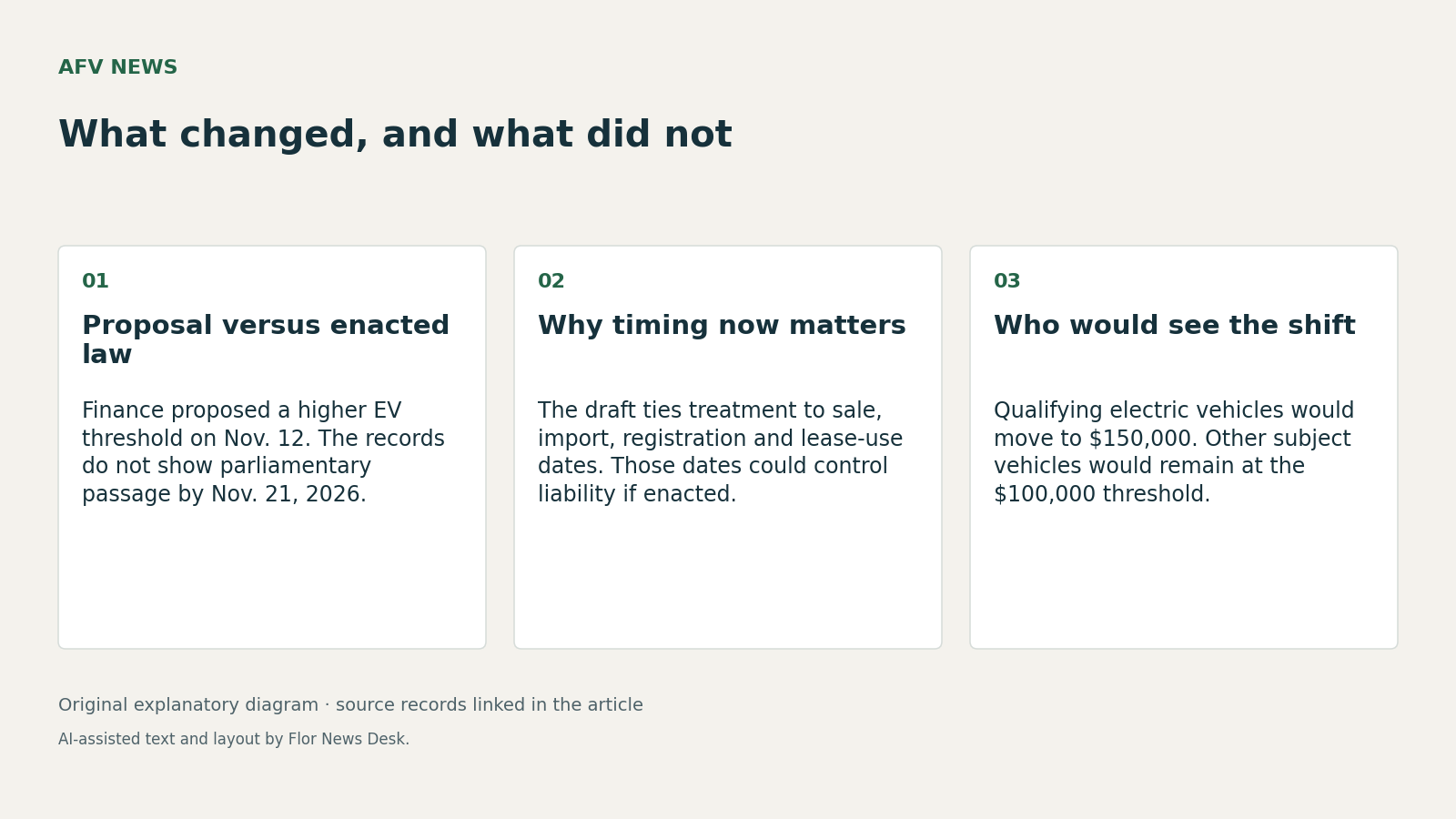
The key distinction is between proposed effect and current law. Finance Canada said the measure would be effective the next day after the announcement, subject to subsequent parliamentary approval. But by the current date, November 21, 2026, the supplied records still show only a news release and draft legislation, not a bill number, passage record or enacted text. That stale future-tense wording cannot prove the threshold has already changed in law. What it does show is the government’s intended retroactive design if Parliament later approves the measure as drafted. Finance news release Draft legislative proposals
That design matters because the draft does not hinge only on a future implementation date. It says the new definition and threshold are deemed to have come into force on the day after the Announcement Date, and it applies the amended threshold through specific triggers including sale completion, importation, registration, the first right to use under a lease, and an owner ceasing to be a registered vendor. As analysis, that means administrative timing may matter as much as vehicle price. In a hypothetical transaction signed earlier but completed later, the completion or import date could determine whether the higher threshold is available if the proposal becomes law. Draft legislative proposals
The proposal is also narrower than a broad EV tax break. The draft would set the threshold at $150,000 only for a defined “qualifying electric vehicle,” a category the record says includes fully electric vehicles, hydrogen-powered vehicles and prescribed motor vehicles. The same draft keeps the $100,000 threshold for subject vehicles that are not qualifying electric vehicles. Since the briefed record does not define which vehicles would be “prescribed,” businesses near the line cannot rely on marketing labels alone; the classification question remains part of the commercial risk. Draft legislative proposals
The economic effect, if enacted as proposed, would be concentrated rather than universal. Finance Canada’s quick facts say the luxury tax generally applies to passenger vehicles and is imposed on sales, importations, leases and certain improvements, using the lesser of 10% of full value and 20% of value above the threshold. Raising the threshold would therefore matter most for qualifying vehicles priced above $100,000 but at or below $150,000, and for some improvement cases where the draft says no tax would be payable if the higher threshold would have eliminated tax at the earlier trigger. Finance news release Draft legislative proposals
For Canadian businesses, the immediate takeaway is procedural, not celebratory. The records support treating November 13, 2026 as the draft’s intended deemed-effective date if Parliament later enacts the measure, because the draft uses “Announcement Date” and the release identifies the announcement as November 12. They do not support treating the amendment as already in force, and they do not provide Canada Revenue Agency administrative guidance. That leaves a practical but unresolved window: companies with affected sales, imports or leases may need to map their transaction dates carefully while waiting for parliamentary and compliance certainty. Finance news release Draft legislative proposals
Read our editorial standards or send a correction to the editorial desk.