

Statistics Canada’s release on Nov. 19, 2026 of third-quarter 2026 Commercial Rents Services Price Index data gives Canadian businesses a more relevant public benchmark for lease planning than headline rent measures built for households or listings. The agency said the quarterly index tracks changes over time in net effective rent for occupied commercial building space in Canada. Statistics Canada Daily release
That definition matters for budgeting. Statistics Canada says the underlying prices are average rents per square foot from a sample of commercial buildings, and that the data are available for aggregated retail, office, and industrial building and warehouse categories across 13 selected census metropolitan areas, all provinces, and the three territories combined. It also publishes building-type indexes nationally, for Ontario, Quebec, Alberta and British Columbia, and for Montréal, Toronto, Calgary and Vancouver. Net effective rent, as Statistics Canada defines it, includes inducements but excludes operating costs, taxes and additional rents. The series is not seasonally adjusted, and the previous quarter can be revised. Statistics Canada Daily release
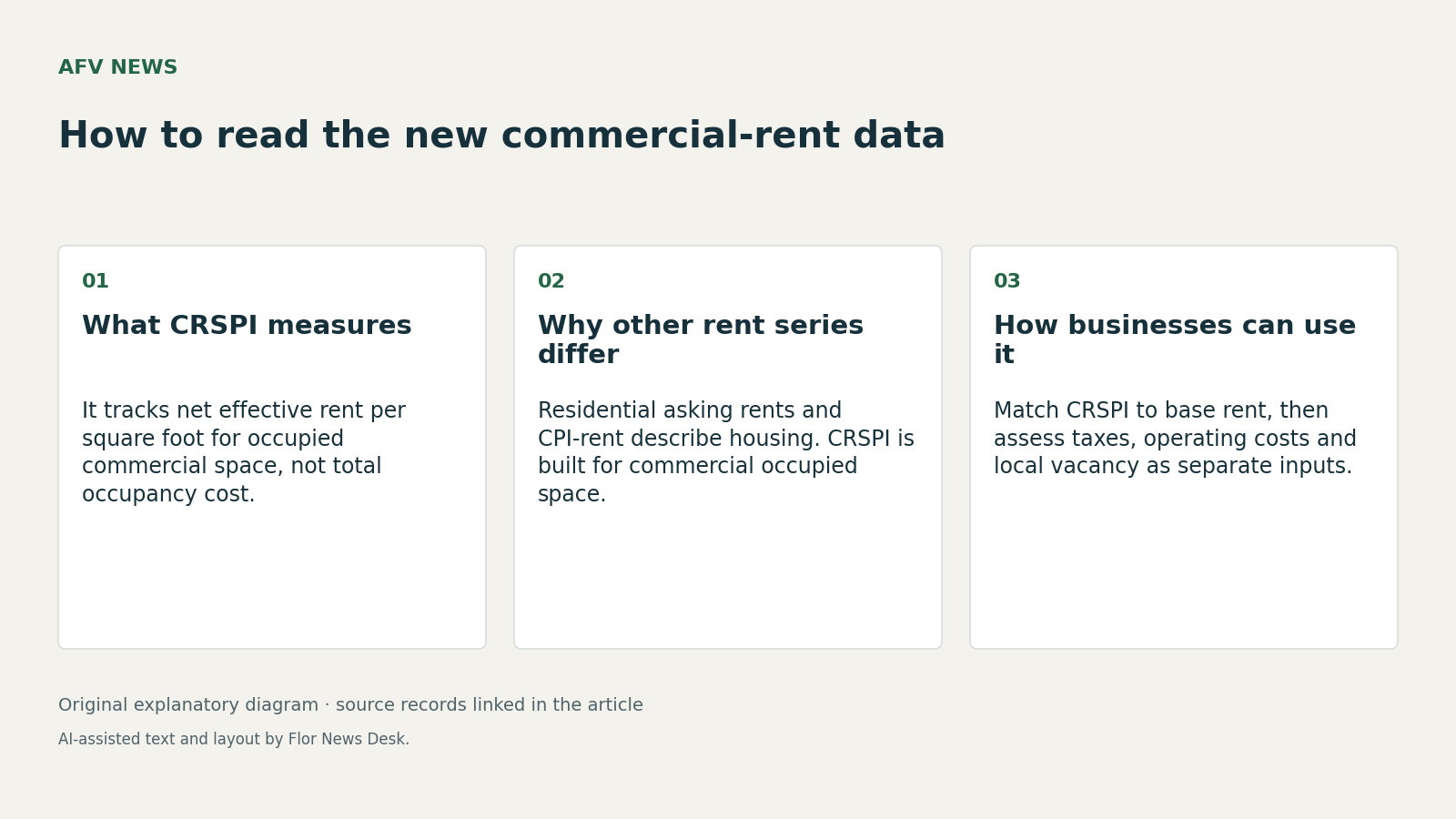
The analytical point is that CRSPI answers a different question from rent indicators many managers already know. In a September 2026 Sparks at Bank article, Benjamin Straus wrote that residential asking rents measure advertised prices for vacant units, while CPI-rent reflects the average rent paid by all residential tenants and adjusts gradually as people move and sign new leases. That article concerns housing, not commercial property, and the page says Sparks at Bank articles are produced independently from the Bank of Canada’s Governing Council. Even so, it usefully shows why firms should not lift a household rent series and treat it as a proxy for negotiated commercial occupancy costs. Sparks at Bank
CRSPI also should not be read on its own. The Bank of Canada’s capacity-and-inflation dashboard, updated on Oct. 28, 2026, lists an office vacancy rate of 15.6% for 2026 Q3 and an industrial vacancy rate of 5.4% for 2026 Q3, both sourced to Cushman & Wakefield. Those figures do not measure rent directly, but they can change how a rent benchmark is interpreted. A tenant comparing its own office renewals with CRSPI may read the same index differently if vacancy is elevated than if space is scarce. The Bank also notes that reference dates differ across indicators, so the page’s update date does not make every number current to Nov. 19. Bank of Canada indicators page
For finance and real-estate teams, the practical use is narrower but still valuable. First, compare CRSPI only with the base-rent portion of your lease economics, because Statistics Canada says operating costs, taxes and additional rents sit outside the measure. Second, line up the right geography and building type before drawing conclusions from a movement in the series. Third, keep a record of quarter matching and later revisions, since the series is quarterly, unadjusted for seasonality and subject to prior-quarter change. Those steps will not tell a business what a landlord must accept, but they can show whether an internal forecast is anchored to a public measure of occupied commercial rent rather than to residential inflation headlines or listing anecdotes. Statistics Canada Daily release
What the source record cannot establish is just as important. The available records here do not show third-quarter 2026 CRSPI values in this brief, do not measure pass-through occupancy charges, and do not identify submarket concessions or lease clauses in any specific transaction. The Bank dashboard adds vacancy context, not a negotiated rent outcome. Used that way, CRSPI is a disciplined benchmark for checking assumptions, not a substitute for a lease review or a complete picture of occupancy cost risk. Statistics Canada Daily release Bank of Canada indicators page
Read our editorial standards or send a correction to the editorial desk.