
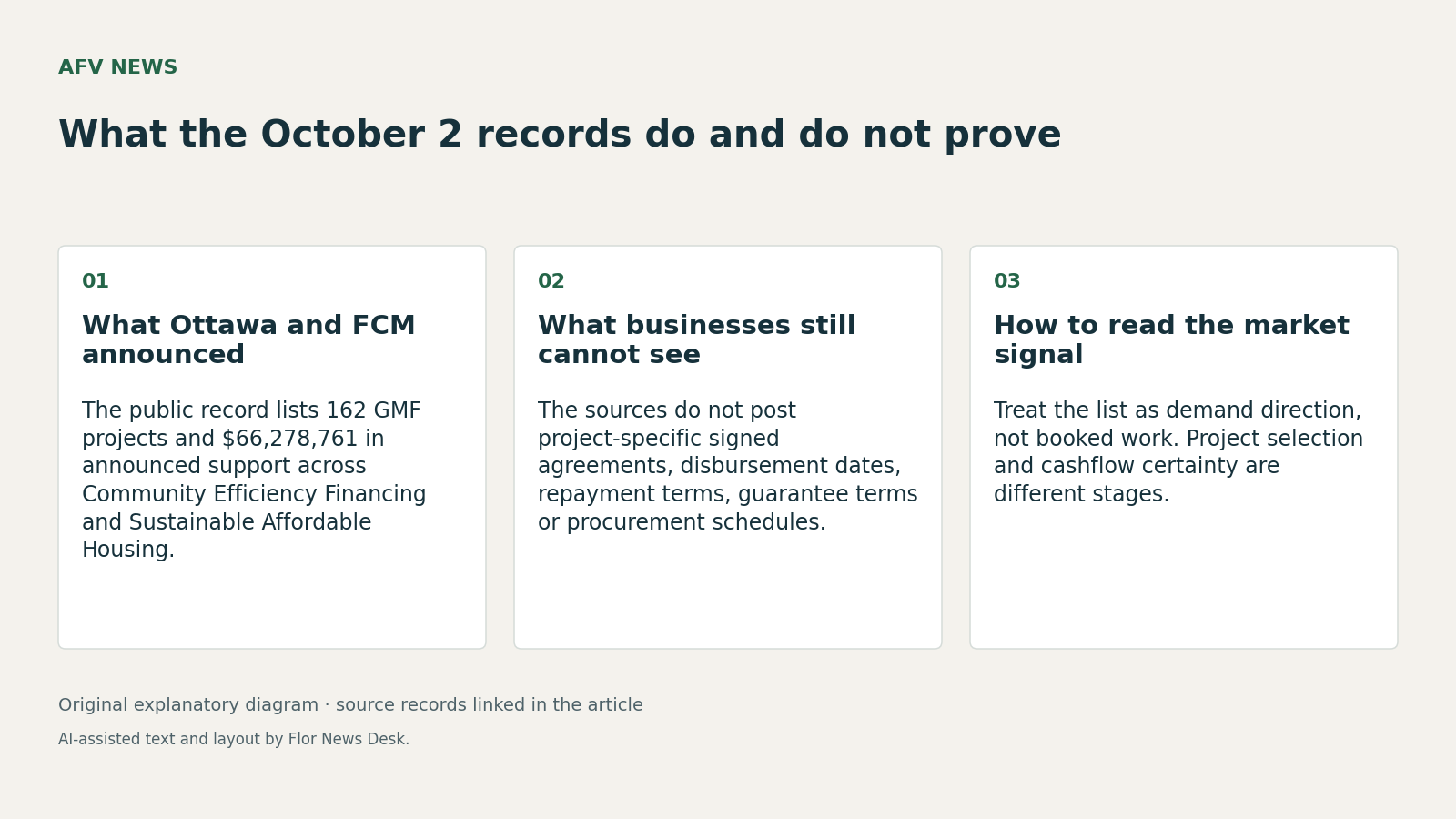
Environment and Climate Change Canada and the Federation of Canadian Municipalities gave Canadian retrofit and affordable-housing suppliers a more precise pipeline on October 2, 2026, but not a bankable order book. ECCC said 162 projects were announced under the Green Municipal Fund’s Community Efficiency Financing and Sustainable Affordable Housing initiatives, with combined support of $66,278,761 (backgrounder, news release). The same records do not post executed agreements, tender dates, repayment schedules or proof that money has already been disbursed.
The funding split is $34,595,956 for Community Efficiency Financing and $31,682,805 for Sustainable Affordable Housing, according to the October 2 backgrounder. It lists 12 projects in Atlantic Canada, 36 in Quebec, 39 in Ontario, 36 across the Prairies, 38 in British Columbia and one in Nunavut (backgrounder). For contractors and lenders, that is a useful map of where municipal demand may emerge. Ontario has the largest count in the published regional breakdown and several large named examples, including BetterHomes Huntsville at $7,999,920, the Regional Municipality of Waterloo’s on-bill financing project at $7,928,392, BetterHomes London at $5,318,788, and Peel Region’s Weaver’s Hill retrofit at $10,000,000.
The two streams point to different kinds of commercial activity. In its quick facts, ECCC says Community Efficiency Financing supports municipalities, utilities and other local delivery organizations that provide financing solutions for residential efficiency upgrades. Sustainable Affordable Housing supports the planning, study, retrofit and development of low-carbon affordable housing projects (news release). That distinction matters. A financing platform can stimulate future retrofit work without creating an immediate construction contract, while a feasibility-study project such as Banff’s 85-unit affordable-housing example with $250,000 in announced funding is not the same as a shovel-ready retrofit or new build. The public records reviewed here do not identify the funding instrument for that specific Banff project.
Natural Resources Canada’s program record adds context, but not project-level terms. NRCan describes the Green Municipal Fund as a revolving fund administered by FCM at arm’s length from the federal government, using grants, loans and loan guarantees. For exceptional eligible projects, NRCan says GMF may offer fixed-rate loans of up to 30 years at least 2 percent below the equivalent Government of Canada bond rate, and grants may not exceed 50 percent of eligible costs (NRCan departmental plan entry). But that March 13, 2026 departmental-plan page does not connect those terms to any named October 2 project. It therefore does not show which announced amounts are grants, which may be repayable, or whether any specific project includes a guarantee.
That same NRCan page says planned NRCan funding for GMF is $0 in 2026-27, 2027-28 and 2028-29, and that the most recent NRCan payment to FCM for GMF was made in July 2019 (NRCan departmental plan entry). Read carefully, that does not negate the October 2, 2026 announcement. It does suggest the announcement is better understood as an allocation within an existing fund structure, not proof that new federal cash reached recipients that day.
Program history supports that cautious reading. NRCan’s evaluation summary says FCM had received $1.625 billion for GMF since 2000, including $950 million through NRCan in 2019 for Community Efficiency Financing, Community Buildings Retrofit and Sustainable Affordable Housing. The evaluation found GMF performed well on annual funding targets and on moving plans, studies and pilot projects toward capital projects, but said GMF had not yet fully implemented a comprehensive method to measure economic and social results (evaluation summary). That evaluation covered April 1, 2017 to March 31, 2022, so it cannot establish outcomes for the October 2, 2026 project list.
For AFV News readers, the practical takeaway is narrow. The October 2 records are solid evidence of project selection, program intent and regional concentration. They are not enough to assume revenue timing, procurement opening dates, financing terms or measured energy savings. Before hiring, ordering equipment or counting backlog, suppliers and municipal finance teams still need the missing records: executed agreements, project-specific funding instruments, milestone conditions and tender documents.
Read our editorial standards or send a correction to the editorial desk.