

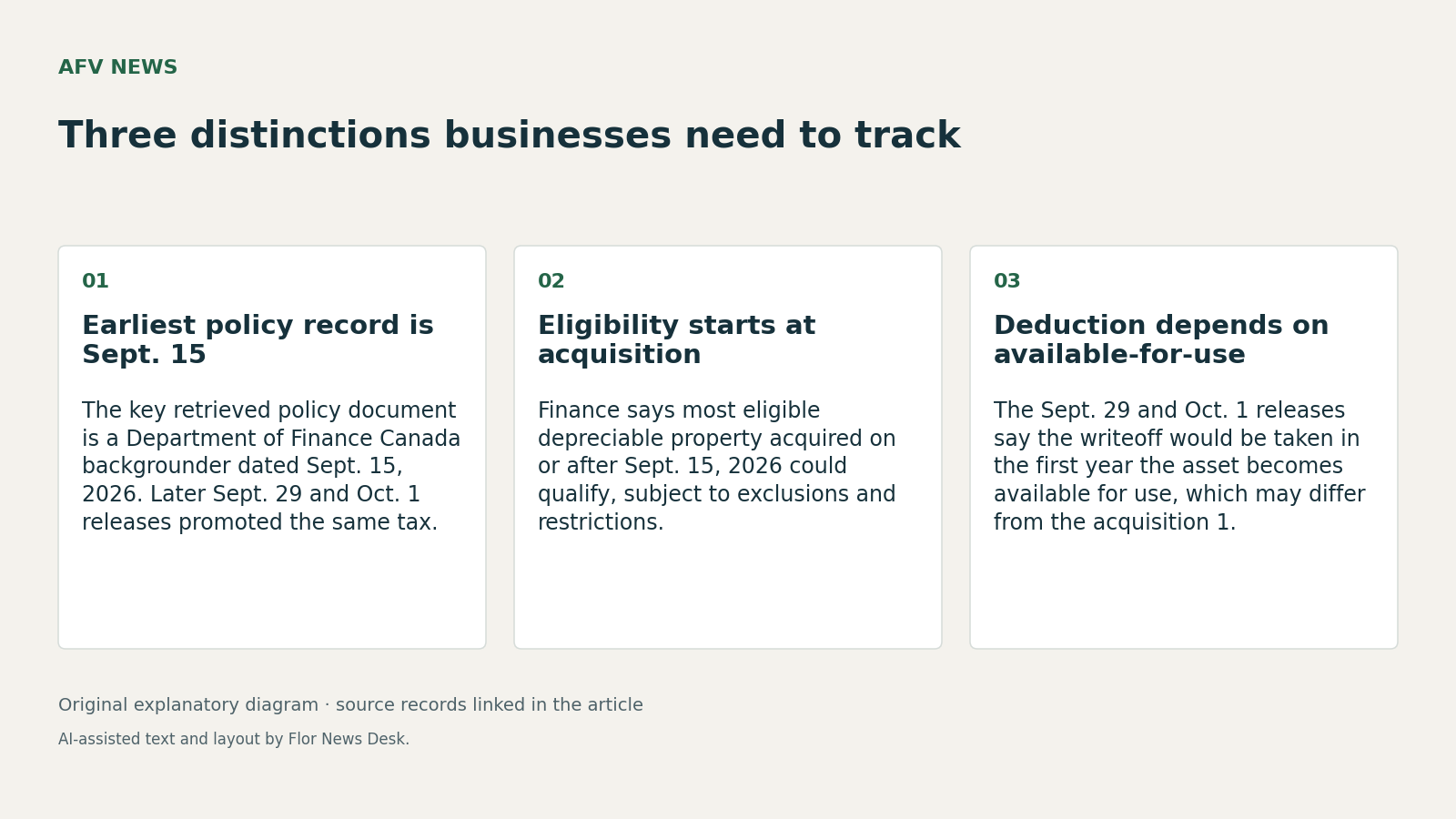
The clearest public record for Ottawa’s proposed Productivity Mega Deduction starts on September 15, 2026, when the Department of Finance Canada published a backgrounder setting out the measure’s core terms. That matters because the policy details predate the later publicity push on September 29 and October 1. In the September 15 record, Finance says the government proposes permanent immediate expensing for most depreciable property acquired on or after September 15, 2026, and says Canadian development expenses incurred on or after that date would also qualify. As of October 5, 2026, the retrieved federal records show a proposal, not confirmed enactment. (Department of Finance Canada backgrounder, September 15, 2026)
The headline number is a government projection on tax competitiveness. Finance says accelerated capital cost allowance measures announced in Budget 2025 reduced Canada’s marginal effective tax rate on new business investment to 13.0% from 15.4%, and says the proposed Mega Deduction would lower it again to 6.4%. Separate releases from Employment and Social Development Canada on September 29 and Finance on October 1 repeat that projected 6.4% rate and say immediate expensing would expand from roughly 15% of assets to more than 65%. Those are institutional claims about expected effects, not measured outcomes in the retrieved record. (Department of Finance Canada backgrounder, September 15, 2026, Employment and Social Development Canada news release, September 29, 2026, Department of Finance Canada news release, October 1, 2026)
For businesses planning capital spending, the most useful distinction in the record is timing. Finance ties eligibility to when property is acquired, starting September 15, 2026. The September 29 and October 1 releases describe immediate expensing as a deduction taken in the first year an asset becomes available for use. Those are not necessarily the same year for long-lead equipment or infrastructure. The retrieved record therefore supports scenario modelling, but not a simple assumption that every eligible acquisition produces an immediate deduction in the same taxation year. (Department of Finance Canada backgrounder, September 15, 2026, Employment and Social Development Canada news release, September 29, 2026, Department of Finance Canada news release, October 1, 2026)
The proposal is also narrower than a blanket writeoff. Finance’s September 15 backgrounder says the exclusion list would include Class 1 and 3 buildings and additions, property in Classes 14 and 14.1, Class 51 property, certain vehicles in Classes 10 and 10.1, and property depreciated under Schedules V and VI of the Income Tax Regulations. It also says assets outside the new deduction would remain under the existing temporary Accelerated Investment Incentive. The same backgrounder describes restrictions for previously used property, non-arm’s-length ownership, tax-deferred rollovers, and some loss creation by individuals and certain partnerships. (Department of Finance Canada backgrounder, September 15, 2026)
Just as important is what these four retrieved records do not establish. They are all federal government materials: one Finance backgrounder, two departmental news releases and one media advisory. None is enacted legislation, CRA forms or CRA administrative guidance. The September 29 Finance advisory only shows that an October 1 event was scheduled; its future-tense wording cannot prove legal implementation. The October 1 Finance release shows the event was later presented as having taken place, but it still functions as promotion, not proof that the tax measure was already in force as law. The retrieved federal records also do not address provincial or territorial conformity. (Department of Finance Canada media advisory, September 29, 2026, Department of Finance Canada news release, October 1, 2026)
That leaves Canadian businesses with a narrower but still useful takeaway. The public record supports modelling around a proposed September 15 acquisition threshold, a deduction timing test based on when an asset becomes available for use, and a defined set of exclusions and restrictions. It does not yet, on these retrieved records alone, settle the legislative or administrative details that many capital-intensive projects would need before treating the measure as fully operational.
Read our editorial standards or send a correction to the editorial desk.