
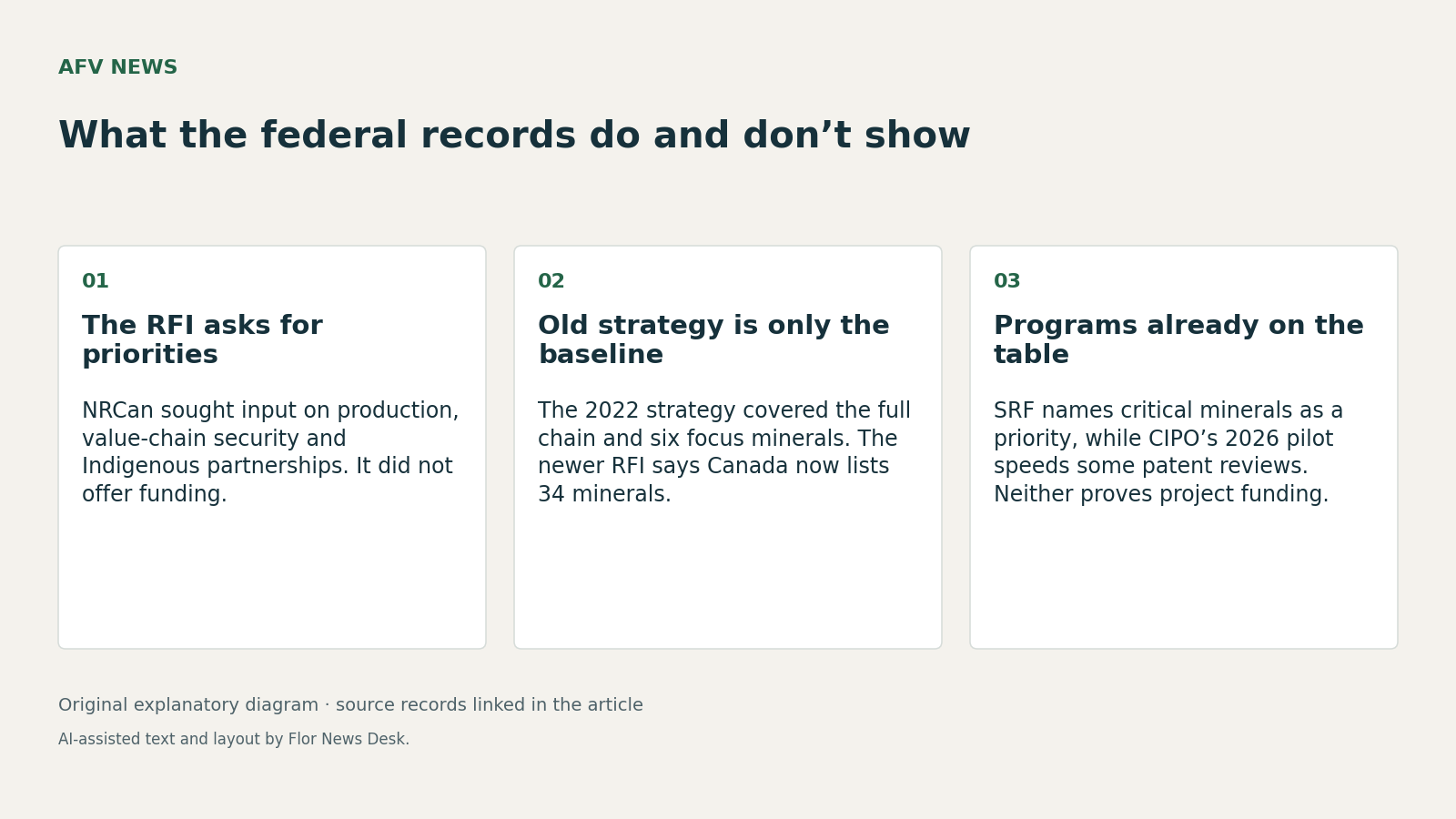
Natural Resources Canada’s Critical Minerals Centre of Excellence used a request for information that opened on June 29, 2026 and listed August 14, 2026 as its end date to solicit views on an updated Canadian Critical Minerals Strategy. The page says Indigenous groups, organizations or governments could seek an extension to October 2, 2026, although the same page was marked closed on retrieval and does not disclose the cutoff time or whether responses were still being accepted then. What the record does establish is narrower: Ottawa asked for input on domestic production and processing, safeguarding value chains, Indigenous partnerships, and other gaps or opportunities, and said the exercise was not a formal consultation for any current or future funding opportunity. NRCan RFI
That matters because the 2022 strategy was designed as a full-chain framework, from exploration to recycling, and said Ottawa would revisit both the critical-minerals list and priority value chains every few years. The baseline document said Canada had 31 critical minerals and singled out lithium, graphite, nickel, cobalt, copper and rare earth elements for an initial federal investment focus, backed by nearly $4 billion in Budget 2022. The newer RFI page says Canada currently lists 34 critical minerals. On its own, that does not prove a new hierarchy, but it is enough to tell companies not to assume the 2022 list or six-mineral emphasis is the last word. Canadian Critical Minerals Strategy NRCan RFI
For project sponsors, the practical question is not whether policy language may change, but which existing instrument a revised strategy could steer. Innovation, Science and Economic Development Canada’s Strategic Response Fund says Budget 2023 set three priorities: clean technologies, critical minerals and industrial transformation. Yet the same page’s May 15, 2026 data snapshot aggregates 159 projects, $12.23 billion in total SRF funding and $80.96 billion in project costs across sectors, and it says the list includes both funded projects and projects merely announced. That means the source is useful for identifying the program’s scale and priority areas, not for proving how much critical-minerals money has actually flowed. Strategic Response Fund investments
The newest concrete federal tool in the source set is not a grant at all. On September 2, 2026, the Canadian Intellectual Property Office launched a Key Technology Expedited Program pilot whose first open stream covers patent applications for technologies that support Canada’s critical minerals supply chain, including extraction, processing and refining. Approved requests avoid the $744.10 advanced examination fee in 2026 and can expect a first office action within seven months, subject to a 50-request annual capacity for that stream. That does not show commercial success or easier permitting, but it does mean developers with patentable process innovations have a newly time-defined federal process to weigh alongside capital programs. CIPO pilot announcement
Three checks follow from those records. First, confirm which federal lane your project actually fits: strategy update, SRF capital support, or patent acceleration. Second, test whether internal materials still describe the right minerals, value-chain stage and Indigenous-partnership case, because those are explicit themes in the RFI and the 2022 strategy says the framework can be refined with partners as conditions change. Third, separate announced envelopes from cash received and from policy consultation, since the RFI is not a funding call and the SRF page does not show disbursement timing by critical-minerals project. NRCan RFI Canadian Critical Minerals Strategy Strategic Response Fund investments
The near-term business signal, then, is procedural rather than fiscal. As of October 2, 2026, the retrieved records show Ottawa has either just closed or is at the end of accepting input for a strategy update, while leaving unanswered which priority areas or program criteria might change next. Until a revised strategy or program notice is published, the disciplined comparison is against the 2022 baseline and the existing program pages, not against assumptions about new money or approvals. NRCan RFI Canadian Critical Minerals Strategy Strategic Response Fund investments CIPO pilot announcement
Read our editorial standards or send a correction to the editorial desk.