

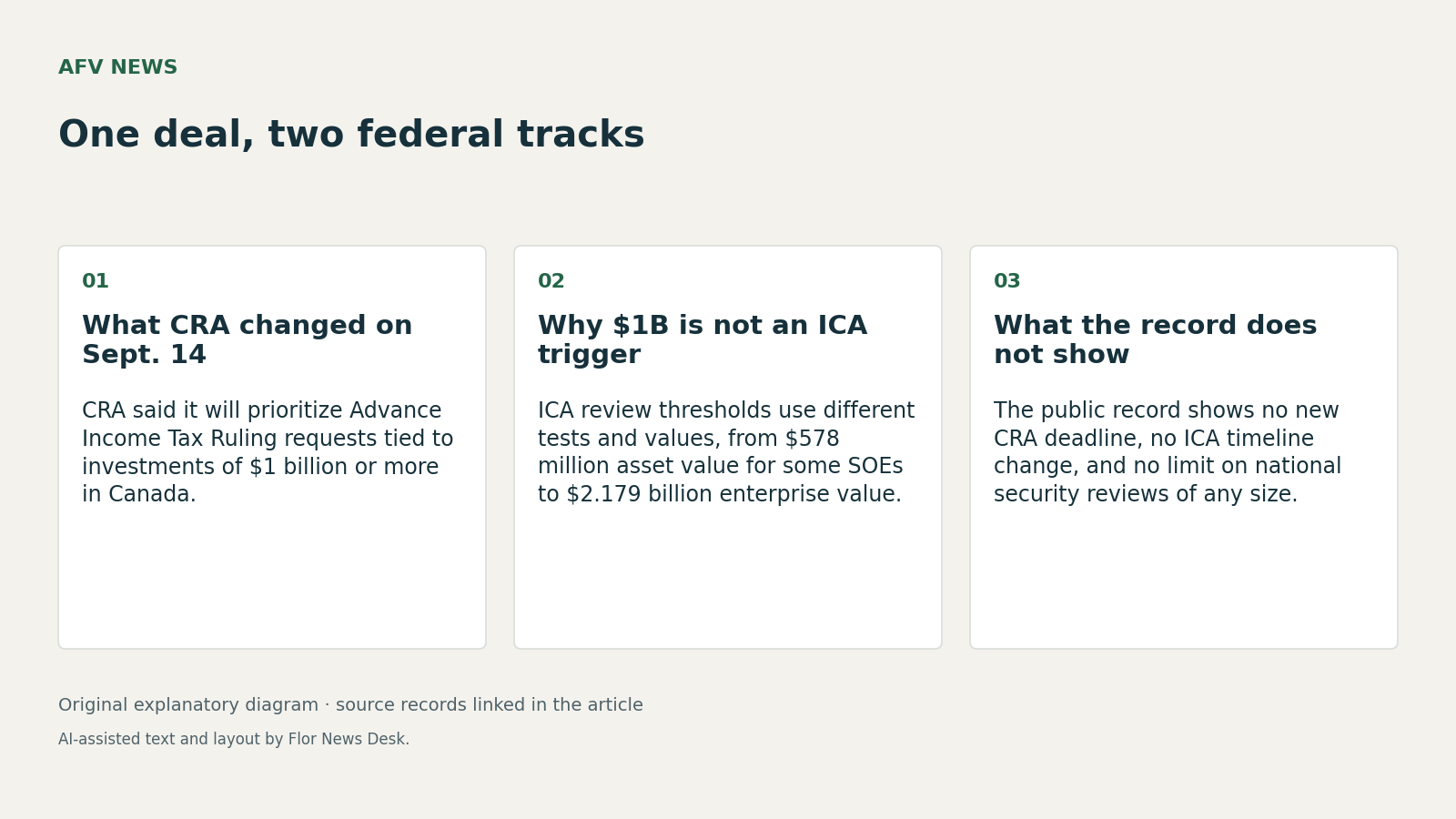
The Canada Revenue Agency’s decision on Sept. 14, 2026 to prioritize Advance Income Tax Rulings requests tied to investments of $1 billion or more creates a new federal fast lane for tax certainty before capital is committed, but it is only a tax-administration change. The same public record does not show any change to Investment Canada Act filing duties, net-benefit reviews or national-security powers. CRA release Investment Canada Act overview
What the CRA has actually confirmed is narrower than a broad promise of faster approvals. The agency said its rulings program provides a binding decision on how Canadian income tax law will apply to a proposed transaction before capital is committed, and that the prioritization measure took effect on Sept. 14, 2026. But the release did not publish a separate turnaround time for priority files. For requests that do not qualify, the stated service standard remains 90 business days or a mutually agreed target date, and the CRA said 91% of rulings were issued within that standard or agreed date in the fiscal year from April 1, 2024 to March 31, 2025. The practical gain, based on this record, is queue priority rather than a guaranteed deadline. CRA release
That matters because the CRA’s $1 billion trigger does not match the thresholds used under the Investment Canada Act. Innovation, Science and Economic Development Canada lists the 2026 review threshold for direct acquisitions of control by qualifying private-sector WTO investors that are not state-owned enterprises at $1.452 billion in enterprise value, while qualifying private-sector trade agreement investors that are not state-owned enterprises face a $2.179 billion enterprise-value threshold. For WTO investors that are state-owned enterprises, the threshold is $578 million in asset value. Non-WTO investments and investments in a cultural business use still lower asset-value thresholds in some cases. Thresholds page
The analytical point for sponsors is that one dollar figure does not answer both questions. A project can fit the CRA priority lane without crossing an Investment Canada review threshold, because the systems use different tests and, in several categories, different valuation bases. The reverse is also possible. A state-owned enterprise could face a review threshold well below the CRA’s $1 billion priority mark. Treating the CRA announcement as a proxy for foreign investment review risk would therefore collapse two separate federal regimes into one number that the sources do not support. CRA release Thresholds page
The same separation applies to timing. ISED says non-Canadians who acquire control of an existing Canadian business or establish a new Canadian business must submit either a Notification or an Application for Review unless an exemption applies, and the government may review foreign investments of any size for possible national security harm. Nothing in the CRA release says those obligations changed, and the Investment Canada pages do not describe any coordination protocol with the CRA’s rulings queue. That means the public record supports planning for parallel processes, not assuming one federal step shortens the other. Investment Canada Act overview CRA release
For Canadian businesses and foreign investors, the immediate use of the Sept. 14 change is disciplined scoping. First, determine whether the transaction actually reaches the CRA’s $1 billion investment mark for priority access. Then test the same deal against the correct Investment Canada category and valuation method. The source record does not establish a new CRA fee schedule, a special service commitment for priority files, or any completed investment outcome under the new measure. So the clearest conclusion is modest but important: Ottawa has added earlier access to binding tax certainty for some very large investments, not a new shortcut through foreign investment review. CRA release Investment Canada Act overview
Read our editorial standards or send a correction to the editorial desk.