

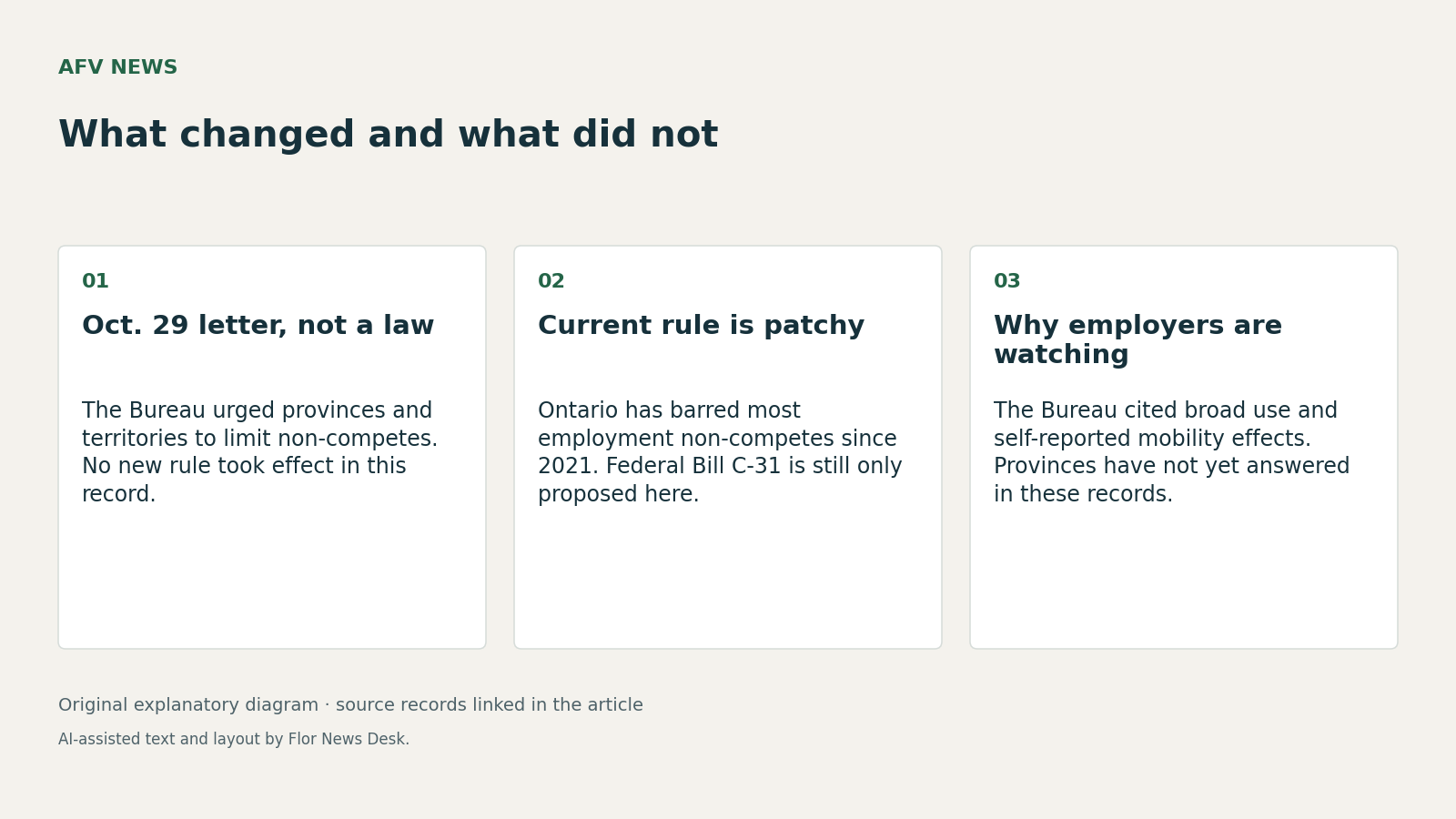
The Competition Bureau turned non-compete clauses into a live policy file for employers on October 29, 2026, when it published an open letter urging provinces and territories to limit their use across Canada. That matters because employment standards are largely provincial, but the letter itself is advocacy, not a legislative change or an enforcement order. The Bureau’s own news release and the letter both stop short of claiming any province has agreed to act. Competition Bureau release, Oct. 29, 2026 Open letter, Oct. 29, 2026
What the Bureau asked for was broader than a simple ban. Interim Commissioner of Competition Jeanne Pratt called on ministers responsible for labour and employment standards to consider provincial and territorial reforms limiting non-competes, and the letter also pointed to the need for guidance, education and enforcement resources if new rules are adopted. It further urged passage and implementation of Bill C-31 for federally regulated workplaces, but the record describes that as a requested future step, not as something already enacted. Open letter, Oct. 29, 2026
The Bureau’s case rests on prevalence and reach. It cited 2025 OECD survey work estimating that 29% to 39% of Canadian private-sector employees may be covered by non-competes. In the same survey material, 20% of Canadian workers said they definitely had such a clause and another 21% said they probably did. The letter also said the OECD found non-competes well beyond workers with obvious access to trade secrets, including non-managerial or non-professional jobs, fixed-term contracts and workers earning less than $3,000 per month. Open letter, Oct. 29, 2026 Competition Bureau release, Oct. 29, 2026
The strongest business implication is not that the Bureau proved economy-wide harm in this record, but that it presented survey evidence of a chilling effect that lawmakers may find actionable. According to the letter, about 23% of Canadian workers who reported having a non-compete said it stopped them from changing jobs, and 12% said it stopped them from starting a business. The letter also said that among workers whose clause was unlikely to be upheld in court, 44% would still decline a competing job and 27% said they had already been prevented from moving to or starting a competing business. Those are self-reported survey results, not adjudicated findings. Open letter, Oct. 29, 2026
For employers, the immediate legal picture is still uneven. The Bureau noted that Ontario has prohibited most employment non-compete agreements since 2021, subject to limited exceptions. It also said Bill C-31 would generally prohibit non-competes in federally regulated workplaces if passed, again with defined exceptions. The important distinction is timing: Ontario is cited as existing law in these records, while Bill C-31 remains proposed and any broader provincial shift remains speculative until legislatures or regulators act. Competition Bureau release, Oct. 29, 2026 Open letter, Oct. 29, 2026
That is why the main near-term issue for Canadian businesses is governance, not immediate compliance. As analysis from the record, a coordinated provincial push would matter most to employers that rely on standard form employment contracts across multiple jurisdictions, because the Bureau is pressing for statutory limits plus implementation support rather than case-by-case court fights. Yet the present record cannot establish whether provinces will move together, move unevenly or not move at all.
A separate Bureau release from October 28, 2026 helps frame that distinction. In that case, the agency said it had reported to the Minister of Transport that a proposed Air Canada-United Airlines arrangement would likely harm competition on 10 Canada-U.S. routes under the Canada Transportation Act review process. Put simply, the Bureau is active on both transactional competition matters and labour-mobility advocacy, but the non-compete file is still in the persuasion stage. Air Canada-United release, Oct. 28, 2026
For AFV News readers, the practical takeaway is narrow but important: watch provincial labour ministries and Parliament, not just Competition Bureau headlines. The October 29 letter creates pressure for reform and supplies survey evidence for it, but it does not by itself change what employers may include in contracts outside jurisdictions that already restrict those clauses.
Read our editorial standards or send a correction to the editorial desk.