
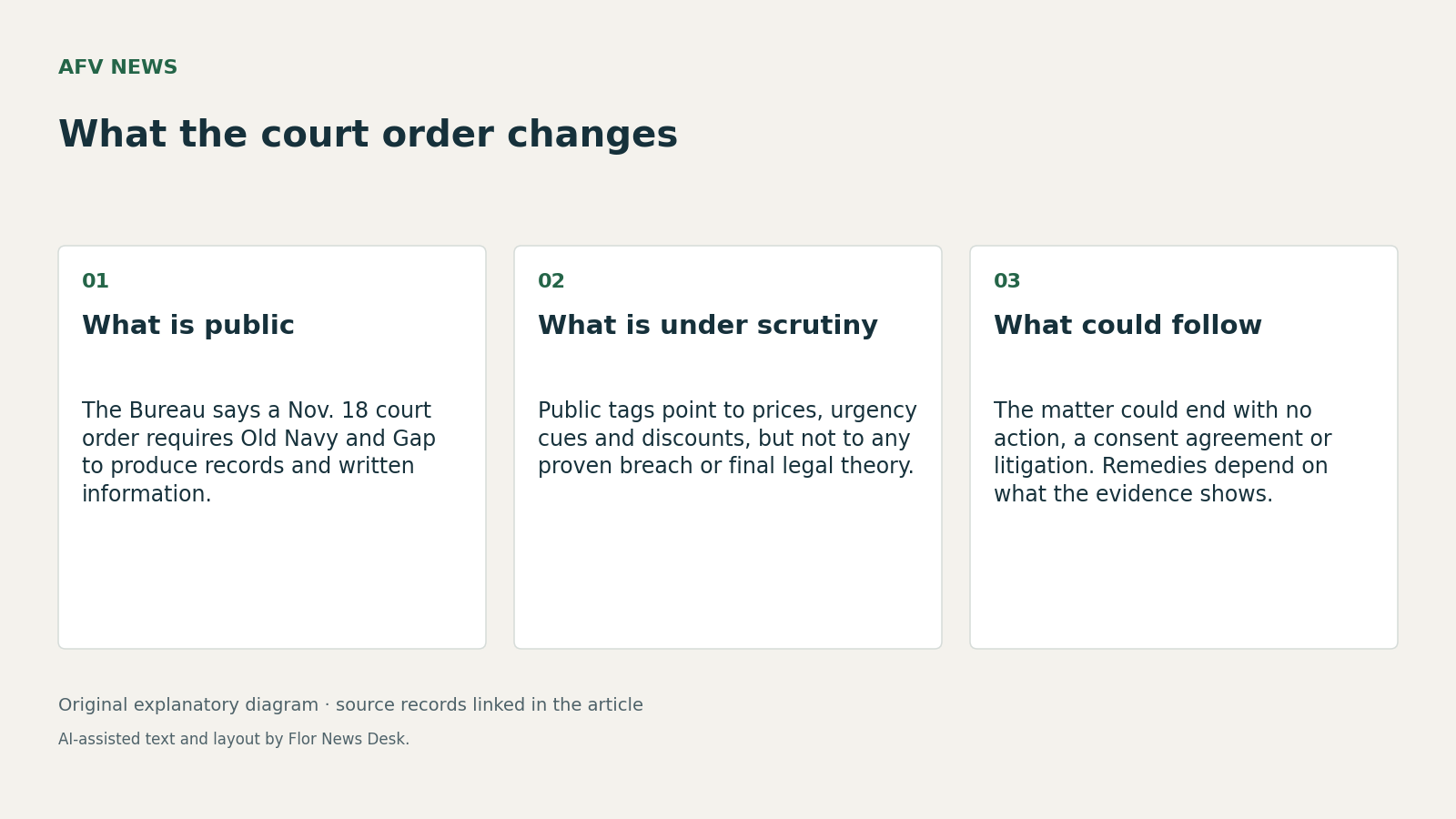
The concrete development is procedural, not a liability ruling. On 2026-11-18, the Competition Bureau added an Old Navy and Gap entry to its deceptive-marketing cases table saying it had obtained a Federal Court of Canada order requiring the companies to produce records and written information for an ongoing investigation, and that there has been no finding of wrongdoing at this time. Cases and outcomes
That matters because it moves the file from public scrutiny to compulsory evidence collection. The Bureau’s enforcement-process page says it may seek court orders in civil cases to compel records, written information and oral testimony, and that it generally publishes a news release when a publicly accessible order is granted. Its news-release index separately lists a 2026-11-18 item on the Old Navy and Gap investigation advancing after a court order. Communicating on enforcement matters News releases As of 2026-11-19, the retrieved public record still does not include the order text, a file number or the statutory provision used, so outsiders cannot yet test the Bureau’s theory against the actual court papers.
The narrowest reading of the public record is that the Bureau is testing how these retailers presented promotions, not simply what price appeared on a page. The case-table tags mention prices, urgency cues, past prices, discounts, the digital economy and fake sales. Cases and outcomes The Bureau’s general guidance says deceptive-marketing analysis turns on both the general impression and literal meaning of a representation, that a claim is material if it could influence a purchase, and that regular-price or sale claims need factual support that fine print may not cure. False or misleading representations and deceptive marketing practices The analytical implication is that a probe framed this way can reach countdown language, struck-through prices and the records behind them.
What readers should not infer is just as important. The Bureau has not published a finding, a statement of alleged facts or any company response in the records retrieved here. Cases and outcomes News releases Its communications page says investigations are generally confidential except for limited public steps such as court proceedings. Communicating on enforcement matters That means the current record cannot establish whether the issue is a short-lived campaign, a broader pricing system, or conduct that the Bureau may ultimately conclude does not justify a case.
The downstream possibilities are real but still conditional. The Bureau says civil deceptive-marketing matters may end through a consent agreement or through litigation before the Competition Tribunal or a court. Communicating on enforcement matters Its remedies page says a court can order conduct to stop, require a corrective notice and impose administrative monetary penalties in civil false-or-misleading representation matters; some provisions can also lead to restitution, while criminal offences carry a higher burden of proof and can involve fines and imprisonment. Penalties and remedies for non-compliance None of that shows what will happen here, because the retrieved case entry does not say whether any eventual proceeding would be civil or criminal, or whether the Bureau will proceed at all.
For Canadian retailers and the agencies or software vendors that support them, the business lesson is about proof architecture. If an enforcement step is aimed at records and written information, the operational risk sits in whether a company can reconstruct the basis for regular-price, sale or urgency messaging across site code, pricing logs and campaign approvals. That is analysis, not a legal conclusion, drawn from the Bureau’s explanation of compelled evidence gathering and its guidance on discount claims. Communicating on enforcement matters False or misleading representations and deceptive marketing practices
The timing also suggests the Bureau continues to treat promotional pricing as an active enforcement theme. Its release index separately includes a 2025-11-25 item about making sure Black Friday deals are real, although that earlier post is not evidence against Old Navy or Gap. News releases On the evidence now public, the Nov. 18 order tells the market one thing clearly: a price-promotion investigation has advanced to court-backed information collection, while the merits remain unproven.
Read our editorial standards or send a correction to the editorial desk.