
Budget 2026 became a business planning document on November 5, 2026, not just a date on the calendar. The Department of Finance said it released the budget with direct program spending growth lowered from 8% to 2%, $400 billion in capital investments over six years, and $22 billion in new affordability measures, while keeping fiscal anchors tied to 2027-28 operating balance and a declining deficit-to-GDP ratio. Those figures matter, but the sharper question for companies is which parts change investment models immediately and which remain only proposals. Finance release
The clearest near-term planning signal is tax. The Department of Finance backgrounder says the proposed Productivity Mega Deduction would cut the marginal effective tax rate on new business investment to 6.4% from 13%. It also says the proposed Canada Growth Incentive would create a capital-gains exemption on up to $15 million from eligible investments and would enhance the small business rollover, while Budget 2026 would put $930 million toward expanding the Scientific Research and Experimental Development incentive to include certain commercialization expenses. For finance teams, that is enough to start scenario work on project timing and structure. It is not enough to book savings, because the source record does not include enacted tax law, eligibility detail or Canada Revenue Agency guidance. Budget 2026 key measures
The same distinction applies to Ottawa’s new capital-mobilization pitch. The backgrounder says Canadians would be able to invest directly in a $25 billion Canada Strong Fund through Canada Strong Notes. That creates a potentially important financing channel if the government wants domestic investors participating in major projects. But the record here shows a policy design and marketing concept, not a launched investment product. There are no terms in these sources on pricing, distribution, investor protections, project selection or the legal steps needed before retail money can actually flow. Budget 2026 key measures
Energy and industrial suppliers get a similarly strong signal, but still only a signal. The Finance release says the budget funds a Canada Electricity Strategy aimed at doubling grid capacity by 2050 and includes investments in nuclear energy and critical minerals. The backgrounder goes further, saying Budget 2026 would invest over $50 billion toward that electricity goal and just over $634 million to support more than 55,000 additional electric vehicle chargers where infrastructure is most needed. For transmission, charging, nuclear and grid-services firms, that starts to define a federal pipeline. It does not establish procurement calendars, signed contribution agreements, approved projects or money disbursed. Finance release Budget 2026 key measures
The Bank of Canada record released the same day matters mostly for what it does not change. In a joint statement with the federal government, the Bank said the monetary policy framework was renewed to December 31, 2031, with the 2% inflation target retained and policy continuing to be conducted independently. The statement also says inflation had returned to target after the recent period of elevated inflation. That gives businesses one useful anchor: Budget 2026 lands under the same inflation-targeting framework, not a new monetary regime. But this source is not a rate decision, a forecast or an assessment of how the budget will affect borrowing costs. Bank of Canada joint statement
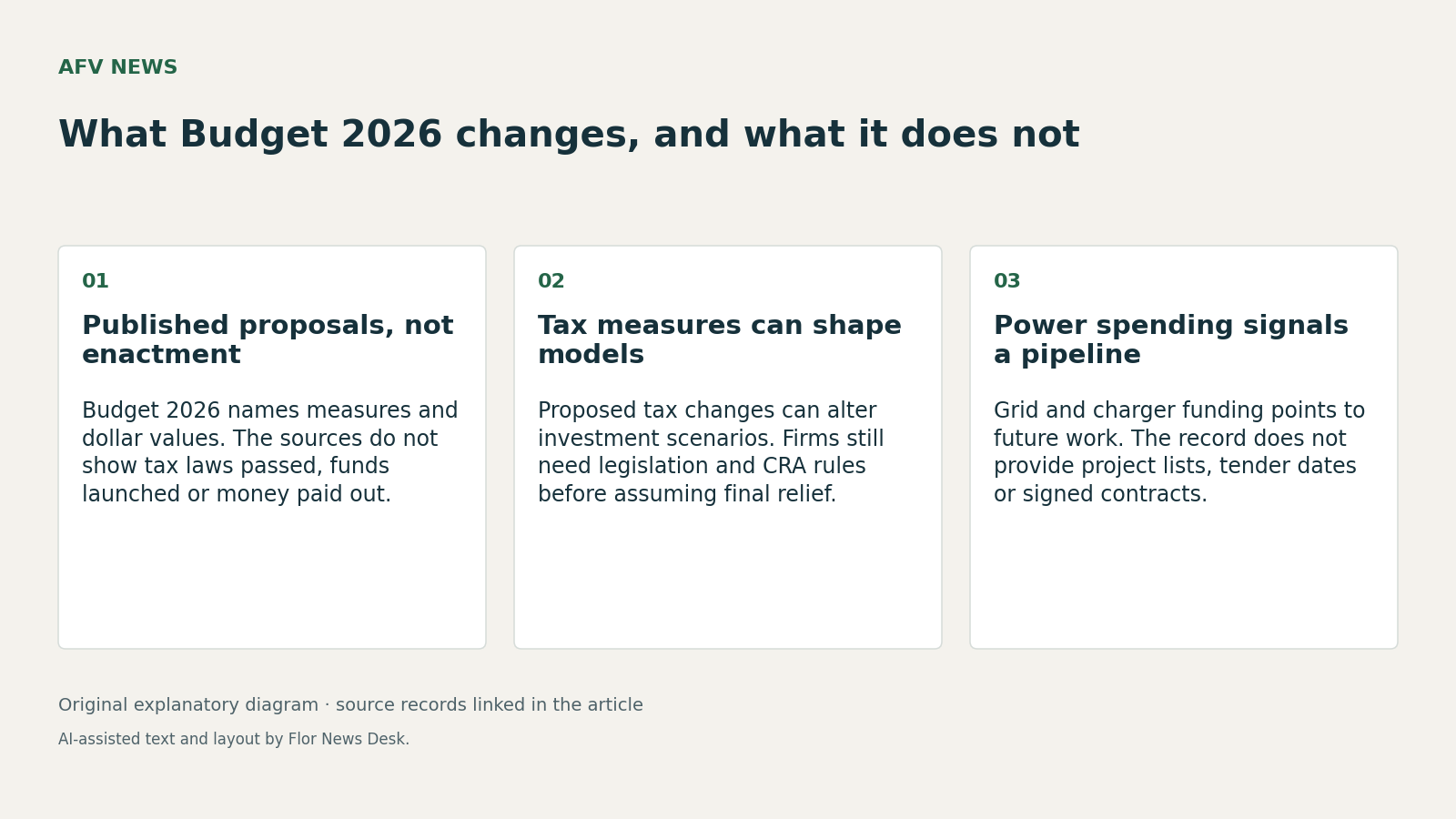
The practical reading of Budget 2026 is to sort measures into three buckets. First are tax proposals that may justify immediate modelling. Second are funds and incentives that still need legal and administrative design. Third are infrastructure ambitions that matter most as future procurement and financing watchlists. Ottawa has published enough to change boardroom discussions. It has not yet published enough to prove when relief, capital or contracts will actually arrive.
Read our editorial standards or send a correction to the editorial desk.