Finance Canada’s Nov. 9 changes to tariff remission do two things at once: they extend broad relief for many U.S. imports to June 30, 2028, and they make that relief more conditional for some goods and companies. The department said the horizontal remission period was extended by one year, and its guidance says amendments to the United States Surtax Remission Order (2025) entered into force on Nov. 9, 2026. That combination matters because it gives businesses a longer planning horizon, but not a simpler one. Finance Canada release Finance Canada guidance
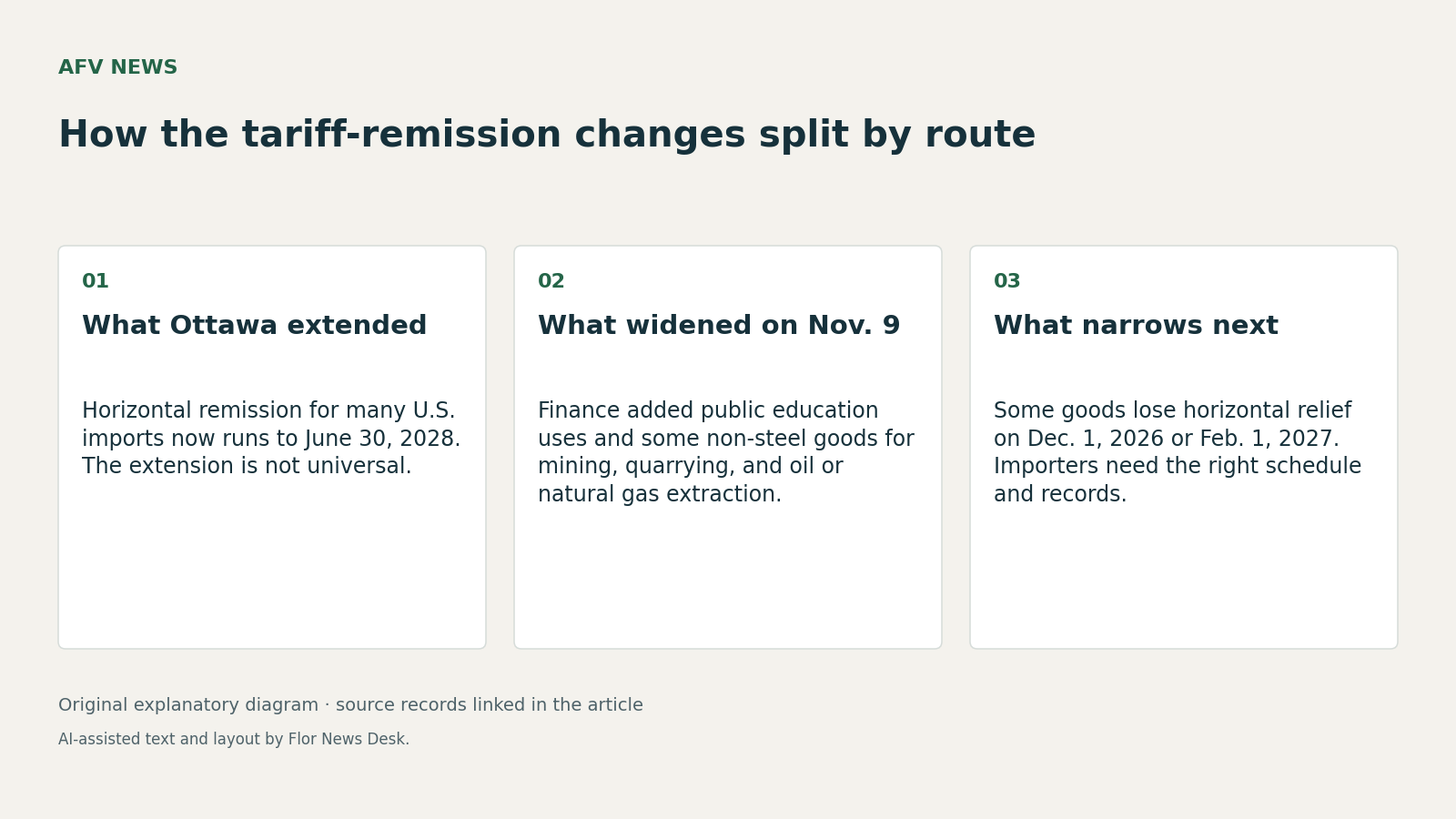
The most important operational point is that horizontal remission still turns on use, not a blanket list of approved products. Finance Canada’s guidance says it is available retroactively and prospectively until June 30, 2028 without a remission request to Finance Canada, but importers must keep records showing the goods were used for prescribed purposes. On Nov. 9, the department also widened that relief to cover all goods for use in public education and non-steel goods for use in mining, quarrying, or the extraction of oil or natural gas, alongside previously described end uses such as manufacturing, processing, agriculture and food or beverage packaging. For a business, that means the key evidence is often internal: what the imported good was actually used for, by whom, and when. Finance Canada release Finance Canada guidance
The narrowing matters just as much. Finance Canada said horizontal relief will be removed for some goods identified as having domestic production, with certain trailers losing that path on Dec. 1, 2026 and certain aluminum wire, extrusions and paperboard products following on Feb. 1, 2027. The guidance adds that Schedule 7 now lists goods that are not eligible for section 3 horizontal remission on or after the expiry date shown there, although other remission routes may still exist. The practical implication is analytical rather than rhetorical: companies can no longer treat remission as one policy decision for all U.S. inputs. They need a product-by-product matrix that ties each import to an end use, a schedule and a date. Finance Canada release Finance Canada guidance
The Nov. 9 package also suggests Ottawa is trying to separate broad relief from exceptional relief. The department said it granted targeted tariff relief for some goods described as short in Canadian supply and for some companies facing exceptional circumstances, including pre-existing contractual obligations. The guidance says product- and company-specific remission was expanded under Schedules 2, 3, 4 and 4.1, and that Schedule 4.2 was added for company-specific relief for goods imported on or after Sept. 8, 2026. That does not prove a company will qualify, but it does mean firms shut out of horizontal remission should not stop their review at section 3. Finance Canada release Finance Canada guidance
There is one more useful change for compliance teams: the guidance says an importer now has four years after importation, rather than two, to make a remission claim to the Minister of Public Safety and Emergency Preparedness. That is not the same as automatic relief. It is a longer claims window, and the same page says importers still need documents supporting eligibility. Businesses that imported after Sept. 8, 2026, or that expect goods to move into a Schedule 7 exclusion, have a reason to review records now rather than wait for year-end. Finance Canada guidance
The limits of the record are also important. The Nov. 9 release is not the legal order text, and the guidance page carries dating ambiguity because it contains a Nov. 9, 2026 “What’s New” update while also showing a different modified date elsewhere. Neither record in this source set provides a complete product list in the article text, names all affected companies, or shows measured business take-up. So the immediate takeaway for Canadian importers is narrow and concrete: confirm the end use, check the relevant schedule on Finance Canada’s tariff-relief page, preserve evidence for the claim path you are using, and do not assume an extension through June 30, 2028 applies unchanged to every U.S.-sourced input. Finance Canada release Finance Canada guidance
Read our editorial standards or send a correction to the editorial desk.