
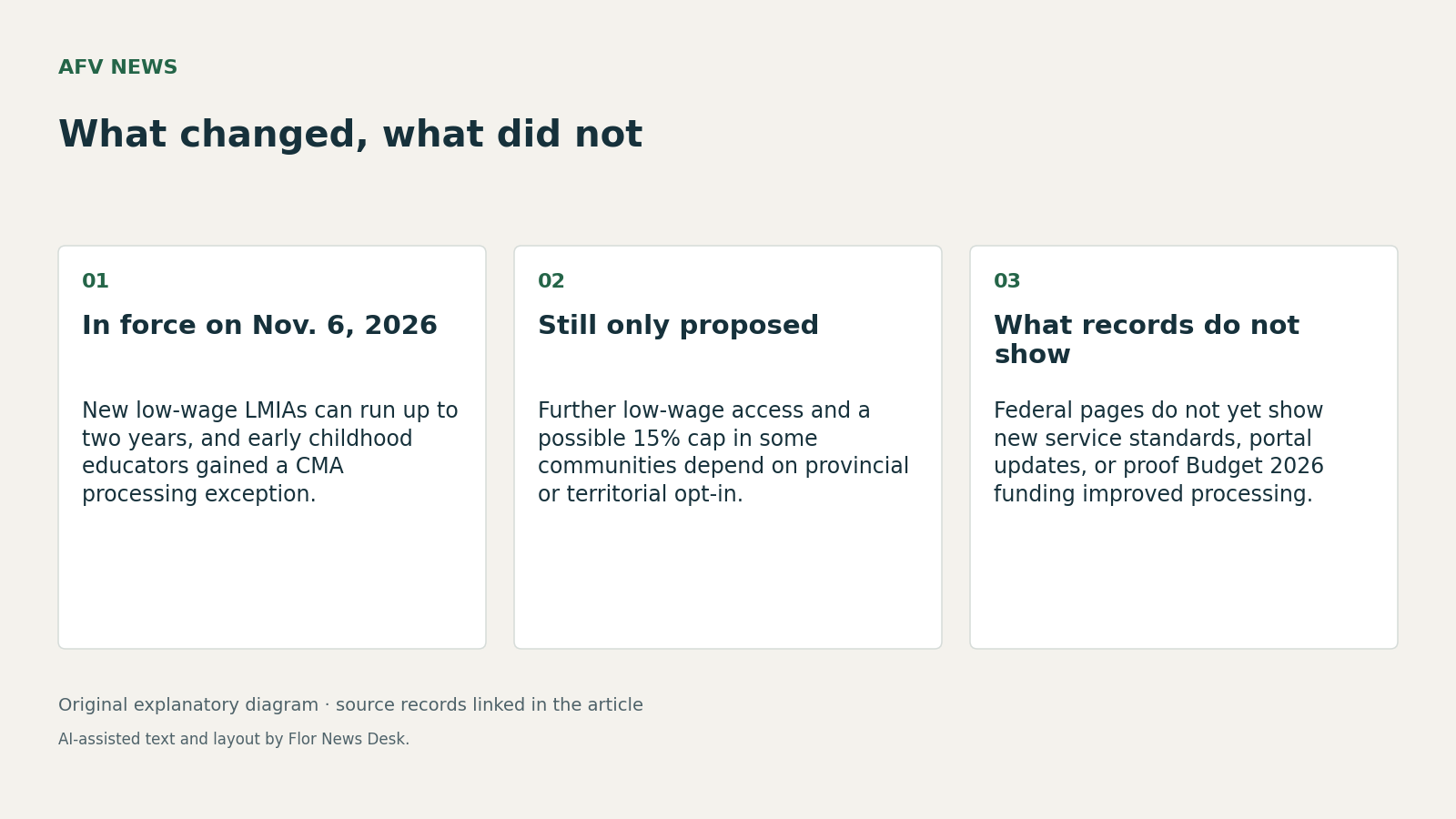
Employment and Social Development Canada made one immediate change to employer planning on November 6, 2026: Low-wage Stream Labour Market Impact Assessment applications submitted on or after that date can carry a maximum duration of up to two years, up from one year. The same announcement added early childhood educators to the exceptions list for LMIA processing in Census Metropolitan Areas with unemployment of 6% or higher. Both are presented as in-force changes, not future intentions, in ESDC’s November 6 news release. ESDC news release
For employers, the practical effect of the longer LMIA window is narrow but meaningful. It can extend the planning horizon for eligible low-wage hires and may reduce how often some firms need to reapply. It does not, by itself, prove faster processing, easier approvals or more flexible worker mobility. Immigration, Refugees and Citizenship Canada says ESDC decides LMIA applications while IRCC decides the associated work permits, and IRCC’s 2026 transition binder says work permits under the Temporary Foreign Worker Program are employer-specific. That means a longer LMIA duration is a planning change, not evidence of a broader loosened system. IRCC transition binder ESDC news release
The early-childhood-educator exception also matters because it reverses part of a restriction that had blocked LMIA processing in higher-unemployment metropolitan areas except for priority sectors. IRCC’s binder describes that earlier refusal policy as part of the program’s previous recalibration. ESDC’s November 6 release now says early childhood educators have been added to the exceptions list. The business implication is specific: some employers in urban child-care markets regain access to the LMIA process even where the local unemployment threshold would otherwise stop the file. What the release does not establish is the detailed occupation matching, screening method or any broader reopening for other roles. IRCC transition binder ESDC news release
The bigger risk for business readers is treating the rest of the announcement as already usable. ESDC says the minister is proposing additional Low-Wage Stream changes for March 1, 2027, and that they depend on provincial or territorial opt-in. Those proposals include targeted occupation access tied to CMA size and unemployment, plus an option for provinces and territories to request a 15% low-wage workforce cap for eligible employers in identified communities, up from the current 10%, while priority sectors would remain at 20%. Until opt-ins and operating rules are published, those are planning scenarios, not bankable capacity. ESDC news release
The public record is also thin on implementation mechanics. ESDC’s LMIA Online page, last dated May 19, 2026, still describes the portal’s existing submission requirements, file-size limits, status tracking and the listed low-wage form version, but it predates the November 6 reform and does not mention the new two-year duration or the early-childhood-educator exception. So employers have evidence of policy direction without proof that forms, portal workflows or decision-letter templates were updated by November 8. LMIA Online resources
Funding signals should be read just as carefully. ESDC’s release says Budget 2026 provides $151.5 million over five years to support and enhance service delivery, but announced funding is not proof that businesses will now see shorter queues or lower administrative friction. At the same time, ESDC says employer non-compliance can bring administrative monetary penalties of up to $1 million per year and temporary or permanent program bans, while the department’s 2025-26 results report emphasizes stronger oversight and expanded compliance activity. The sensible reading is that Ottawa has lengthened part of the hiring runway without easing enforcement. Firms updating labour plans should separate what changed on November 6 from what still needs operational confirmation. ESDC news release ESDC departmental results report
Read our editorial standards or send a correction to the editorial desk.