
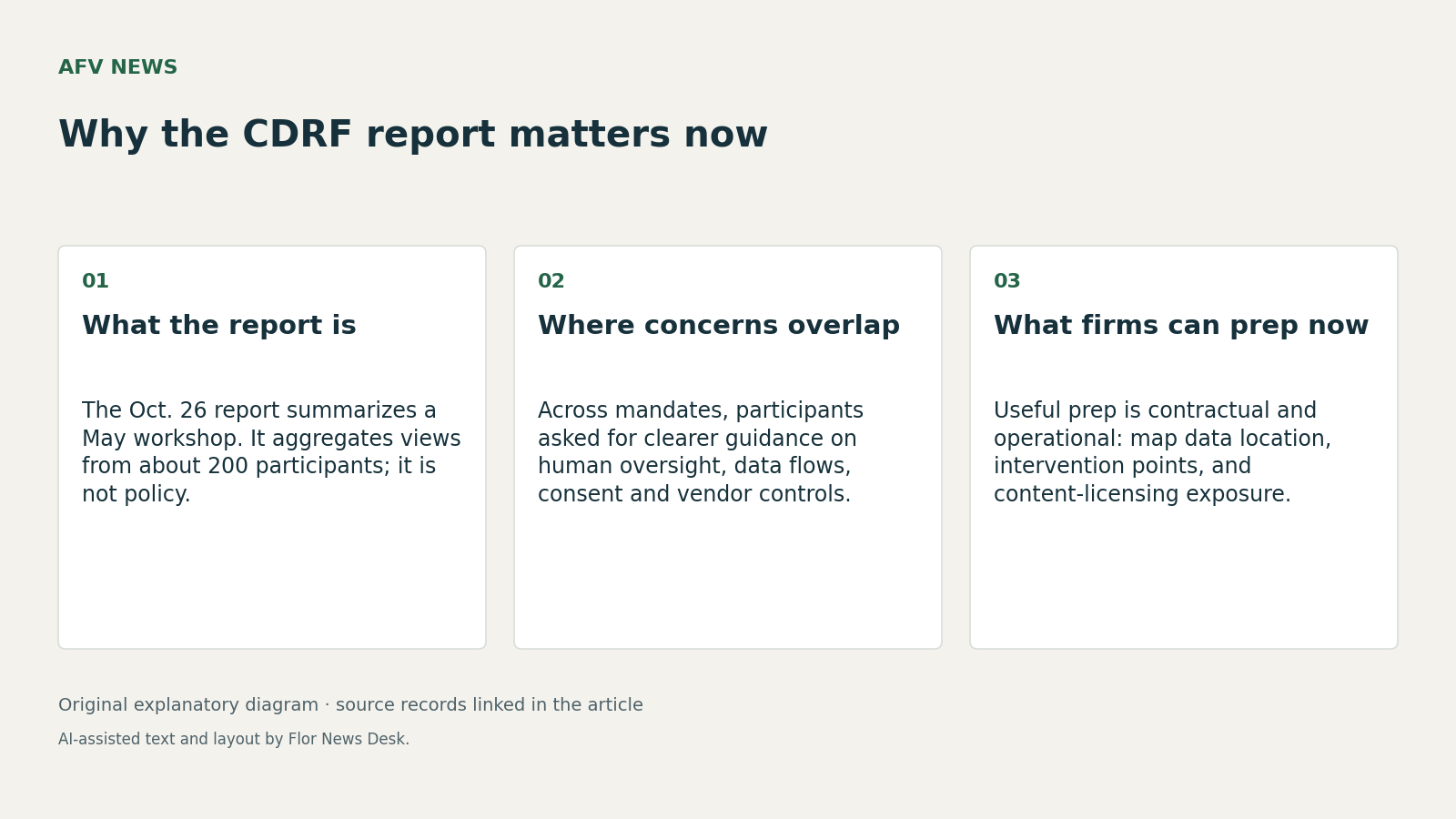
The clearest new signal for Canadian businesses is not a fresh AI law. It is the October 26, 2026 stakeholder synthesis from the Canadian Digital Regulators Forum, which pulls together concerns heard across communications, competition, privacy and copyright mandates in one place. Because the Forum spans the Canadian Radio-television and Telecommunications Commission, Competition Bureau Canada, the Office of the Privacy Commissioner of Canada and the Copyright Board of Canada, the report matters less as a policy announcement than as a map of overlapping regulatory pressure points. What We Heard report
The limits are important. The Forum says the report summarizes nine breakout sessions from a May 2026 virtual workshop with about 200 participants, that discussions were not recorded, and that the published views are aggregated rather than a consensus. That means the document does not establish regulator decisions, sector majorities or enforcement plans. Still, the Forum’s October 29 third-term review says the workshop was one of its public priorities and that the group plans deeper working-level collaboration in its next term, which makes the synthesis more than a one-off event note. What We Heard report Third Term in Review and Fourth Term Preview
The practical pattern across the sessions is that businesses may face the same basic questions from different angles. In communications-focused discussions, participants raised cross-border data storage and access, and said AI used in network operations and accessibility services still needs human oversight. In competition- and privacy-focused sessions, participants asked for clearer sector guidance on high-risk AI models, consent, privacy-by-design, vendor management and cross-border data flows. Read together, those points suggest that the next compliance burden may arrive first as documentation: where data sits, who can access it, when a person can intervene, and what a supplier is contractually promising. What We Heard report
The content industries have a more specific warning. In sessions focused on news, media and creative work, participants raised AI training on copyrighted material, along with consent, compensation and the risk that AI-generated summaries or substitutes could weaken monetization of original content. That does not prove a coming rule or a settled licensing model. It does indicate that, for firms buying or selling AI tools that ingest or summarize content, commercial terms may become as important as model performance. What We Heard report
This also helps explain where the Forum fits in Ottawa’s broader AI agenda. Innovation, Science and Economic Development Canada says the Prime Minister’s National Council on Artificial Intelligence was launched on October 2, 2026 to advise on AI for All goals such as adoption, sovereign AI infrastructure, safety and democracy protections. That is strategic advice, not regulation. The Bank of Canada, in a September 18 explainer, likewise described AI’s economic effects as uncertain, even while saying there is some evidence of time savings and that systems such as large language models still need human oversight and judgment. The CDRF report sits between those two levels: more operational than national strategy, but far short of a rulebook. Advisory councils on artificial intelligence The AI transformation
For businesses, the useful near-term response is not to guess the final law. It is to assemble records that would be reusable across several possible reviews: data-location and access maps, named human-oversight points, vendor-management controls, consent and privacy-by-design documentation, and, for publishers and creative-sector firms, clear terms on training, summaries and compensation. The source record cannot show which of those issues will move first or whether the Forum’s collaboration will produce joint guidance. It does show that these are the questions regulators say stakeholders are already pressing them to address. What We Heard report Third Term in Review and Fourth Term Preview
Read our editorial standards or send a correction to the editorial desk.