

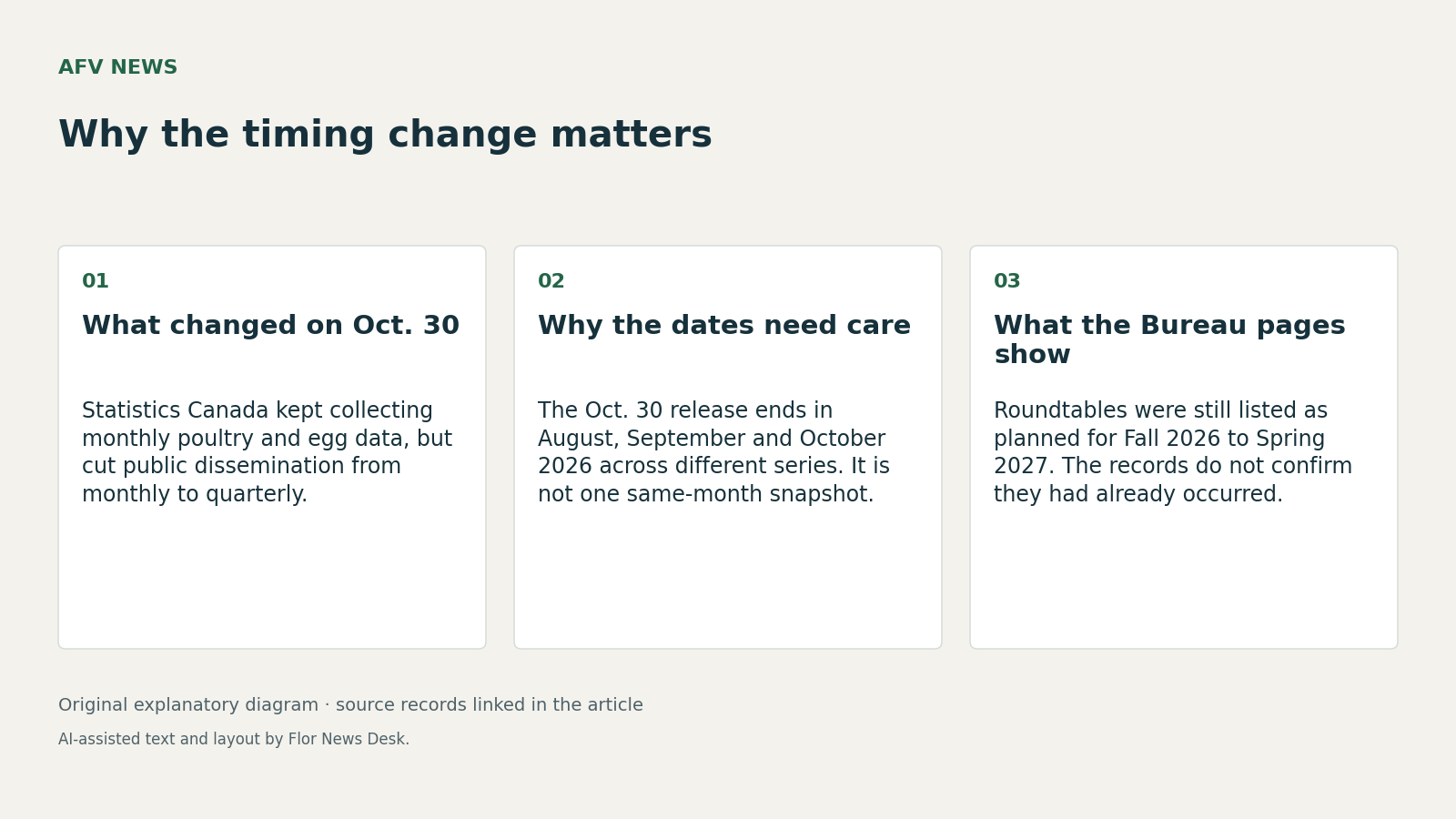
Statistics Canada’s Oct. 30, 2026 Poultry and Egg Statistics release changed one practical input for Canadian food businesses: the agency said dissemination for the program has been reduced from monthly to quarterly as part of fiscal realignment, even though monthly data collection continues. The timing matters because, as of Nov. 1, 2026, the Competition Bureau’s examination of Canada’s food supply chain still lists stakeholder roundtables and market calls for Fall 2026 to Spring 2027 rather than confirming they have already occurred. See the Statistics Canada release and the Bureau’s examination page.
What changed is narrower than it may first appear. Statistics Canada described the Oct. 30 publication as the program’s second quarterly release, and said monthly data will still be collected but published quarterly. That means the main loss is not measurement itself, but public timing. The same release also shows why users need to read dates closely: it combines stocks of frozen eggs, poultry meats and edible dried egg products for August to October 2026, hatchery chick and turkey poult placements for July to September 2026, and egg production for June to August 2026. Those are related indicators, but they are not a single same-month snapshot. See the Oct. 30 release.
That creates an evidence problem, not because the data are unusable, but because the Bureau’s process is still in motion. The Bureau says it launched the food-supply-chain examination on June 16, 2026. Its pages say the comment period ended on Sept. 4, 2026, and they continue to describe public roundtables and market calls as intended for Fall 2026 to Spring 2027, with a public report planned for Spring 2027. The same records also say this is not a law-enforcement investigation and is not examining specific allegations of wrongdoing. As of Nov. 1, those pages establish a plan, not a completed roundtable calendar. See the Bureau’s overview page and the dated June 16 notice.
The practical implication is that a November 2026 submission or presentation can easily mix three different official end dates without saying so. A processor citing egg production from the Oct. 30 release is relying on data only through August. A hatchery argument based on placements reaches September. Frozen stocks extend through October. That distinction matters most in the Bureau’s production-and-processing lane, which the notice lists as one of three examination areas alongside transportation and distribution, and retail pricing. The Oct. 30 statistics can inform upstream supply discussion, but they do not settle later-stage pricing questions by themselves, including the Bureau’s Sept. 28 call for information on minimum advertised pricing policies. See the Statistics Canada release and the Bureau’s examination page.
For businesses, the sensible response is methodological rather than rhetorical. If company records are monthly or weekly, they are now more current than the latest published official series in some categories. That does not make private data better by default, but it does mean any comparison with the quarterly Statistics Canada release needs a clear note about the periods being matched. Otherwise, a business risks presenting a like-for-unlike comparison at exactly the moment the Bureau is still gathering market input. That inference follows from the dates in the Oct. 30 release and the Bureau’s still-planned timetable on the June 16 notice.
One more limit matters. Statistics Canada’s general release schedule, produced on Oct. 30, 2026, only lists upcoming releases for Nov. 2 to Nov. 13 and says it is compiled for planning purposes and may be updated online. In other words, that calendar cannot be used to infer a new monthly poultry publication or a confirmed next-quarter date beyond the short window it covers. Until Statistics Canada publishes another poultry release or the Bureau posts firmer event records, the safest reading is simple: official poultry-and-egg visibility is now less frequent, while the policy discussion that may rely on it is still unfolding. See the release schedule and the Oct. 30 poultry release.
Read our editorial standards or send a correction to the editorial desk.