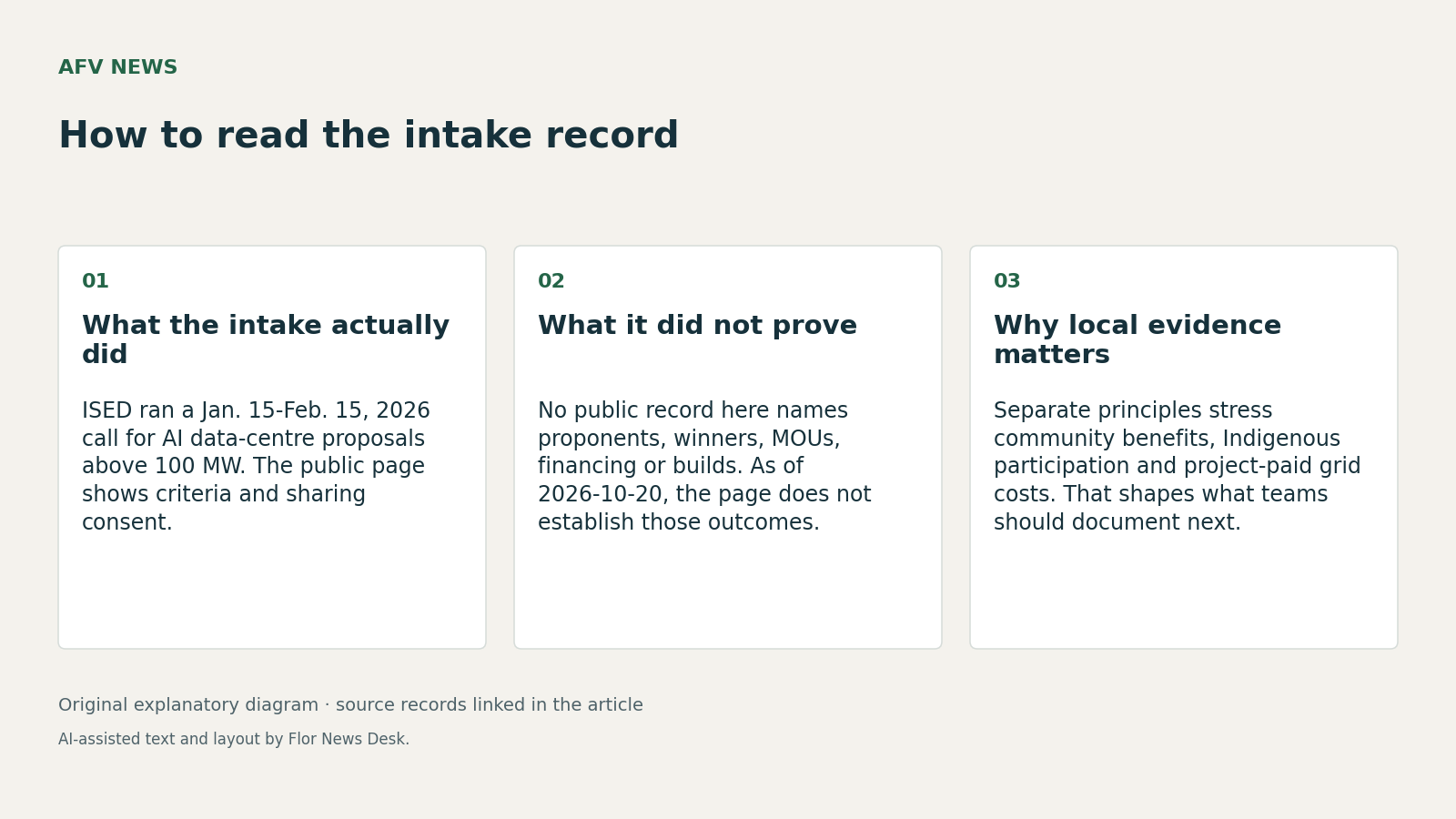
Innovation, Science and Economic Development Canada’s call for sovereign AI data-centre proposals closed on February 15, 2026, but the most important published fact is not who won. It is that the intake page says proposals for projects above 100 megawatts could be shared, through the intake-form consent, with named federal partners including Invest in Canada, Canada Development Investment Corporation, Canada Infrastructure Bank, Export Development Canada and the Major Projects Office, as well as provincial and municipal bodies ISED considers necessary (ISED intake). That is a documented referral path. It is not, on its own, evidence of financing, approval or construction.
The same page shows what Ottawa says it wanted screened at the front end. ISED says eligible Canadian firms and consortia were invited to submit projects with total planned capacity above 100 MW, aimed at a broad range of Canadian clients, and it lists seven criteria: economic and ecosystem benefit, Indigenous participation, sovereignty factors, energy considerations, performance capabilities, readiness level, and project cost and structure (ISED intake). Preference factors also matter. ISED says it would favour a clearer path to completion, Indigenous participation, lower environmental impacts, and stronger use of Canadian partners and supply chains (ISED intake).
What the public record does not establish is just as important for Canadian municipalities, utilities and suppliers. The intake page, last modified June 4, 2026, does not publish the intake form, a proponent list, selected projects, referrals, memoranda of understanding, financing commitments or build results (ISED intake). As of 2026-10-20, even forward-looking language on that page about future engagement or MOUs cannot prove whether any MOU was later signed. Readers should treat the intake as an administrative step with undisclosed outcomes, not as a proxy for federal backing.
A separate federal page helps explain why that distinction matters locally. Canada’s Responsible Data Centre Development Principles are presented as a national framework, not a permit rule, and the page does not establish legal force or measured outcomes (Responsible principles). Still, the principles sharpen the practical questions around any large proposed facility: host-community benefits, early engagement with Indigenous rights holders, project-driven electricity costs not being shifted onto households and existing businesses, minimized freshwater use, transparent reporting of impacts, and strategic value for Canada with suitable legal and cybersecurity protections where sensitive functions are involved (Responsible principles).
That leads to a useful inference for project teams. If a proposal could move from ISED screening into conversations with federal financing or project partners, the strongest preparation is not a general AI pitch but an evidence package built around the published criteria and principles: documented community benefits, Indigenous participation, energy demand and who pays associated grid costs, local environmental impacts, Canadian partner roles, sovereignty controls, readiness milestones, and capital structure. That inference comes from the overlap between the intake criteria and the principles pages, not from any published federal checklist (ISED intake; Responsible principles).
For suppliers and local officials, the practical reading is equally narrow. Participation in the February 2026 intake may signal ambition, but the public record still requires harder milestones before anyone can reasonably speak of an advancing project: a disclosed referral, a signed MOU, a financing announcement, a permit decision or a construction start. Until one of those appears, Ottawa has shown the screening architecture for sovereign AI data centres, not the result of that competition (ISED intake).
Read our editorial standards or send a correction to the editorial desk.