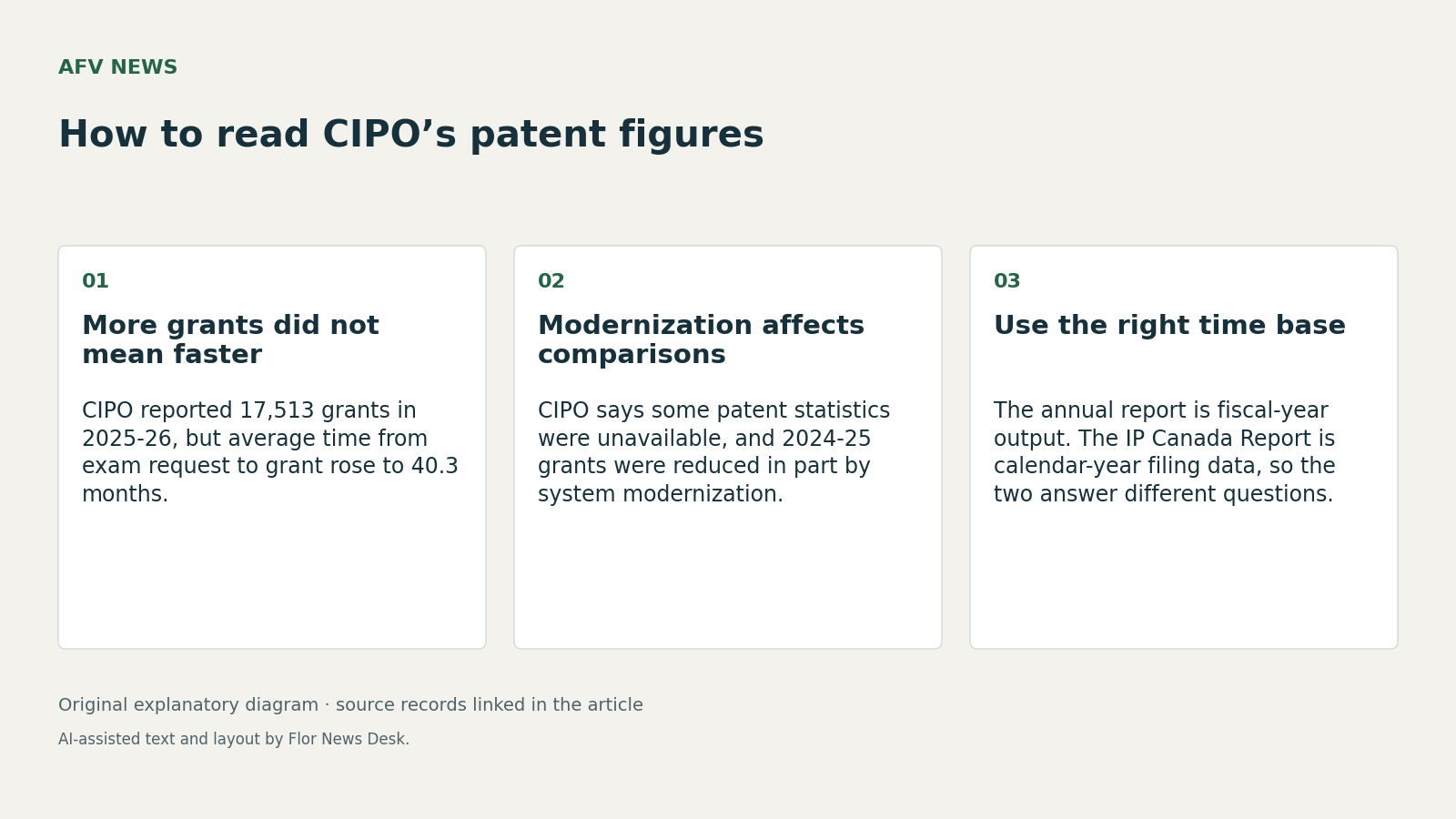
The clearest new signal from the Canadian Intellectual Property Office’s 2025-2026 annual report is not that patenting got faster. It is that production and applicant timing moved in different directions. In the fiscal year from April 1, 2025 to March 31, 2026, CIPO reported 17,513 patent grants, up 151% from 2024-2025, while the average time from request for examination to grant rose to 40.3 months from 30.8 months. The same report says some patent statistics were unavailable because of modernization of CIPO’s patent information systems, and notes that the jump in grants was partly due to a decline in 2024-2025 grants linked to that modernization (CIPO annual report).
That combination matters for Canadian technology companies because a higher annual grant count is an office output measure, not a promise about any one file. The annual report also shows 36,149 patent applications in 2025-2026, up 0.6%, and 29,394 requests for examination, up 11.3% (CIPO annual report). A reasonable reading is that CIPO processed more grants over the year even as the average examined file reaching grant had spent longer in the system. What the report does not establish is how much of that reflects backlog clearing, cohort effects or measurement changes tied to modernization.
The timing figure has another limit businesses should keep in view. CIPO’s measure starts at the request for examination, not at the initial patent filing (CIPO annual report). That makes it useful for comparing one examined cohort with another, but it is not a full filing-to-grant clock. A startup planning a product launch, licensing discussion or financing round should not read 40.3 months as the total expected life of a fresh application from day one.
CIPO’s October 29, 2026 release adds an important nuance. The office said patent examiners began offering interviews for applications with minor defects, and that digital modernization included improvements to the Next Generation Patents system (CIPO release). Those are process changes that could matter at the file level. But the release does not quantify their effect on patent grant timing, and its turnaround claims are stated more clearly for trademarks and industrial designs than for patents. That makes the annual report’s caveat about patent data more important, not less.
The source record also shows why readers should cross-check before drawing a trend line. CIPO’s statistics landing page says its IP data there are organized by fiscal year, points readers seeking calendar-year data to the IP Canada Report, and links to monthly production statistics (Canadian intellectual property statistics). But the retrieved landing page text did not itself show the 2025-2026 patent values discussed in the annual report, so it cannot resolve whether the annual shift was sustained after March 31, 2026.
The calendar-year filing picture is steadier. The IP Canada Report 2026 says 36,047 patent applications were filed in Canada in 2025, up 2% from 2024, including 5,435 resident filings and 30,612 non-resident filings; 73% came through the Patent Cooperation Treaty route (IP Canada Report 2026). Because that report tracks filings, not grants, and says its CIPO data were retrieved on April 28, 2026, it cannot confirm current grant performance. Still, paired with the annual report, it suggests demand was fairly stable while reported grant output and measured exam-to-grant timing both shifted.
For Canadian businesses, the practical conclusion is narrow but useful. As of November 23, 2026, CIPO has published evidence of more patent grants in fiscal 2025-2026, but not evidence that applicants broadly received patents faster. Until newer monthly production data or more detailed patent series show otherwise, companies should treat grant timing as uncertain, use wider planning margins and separate announcements about new processes from measured office-wide outcomes.
Read our editorial standards or send a correction to the editorial desk.