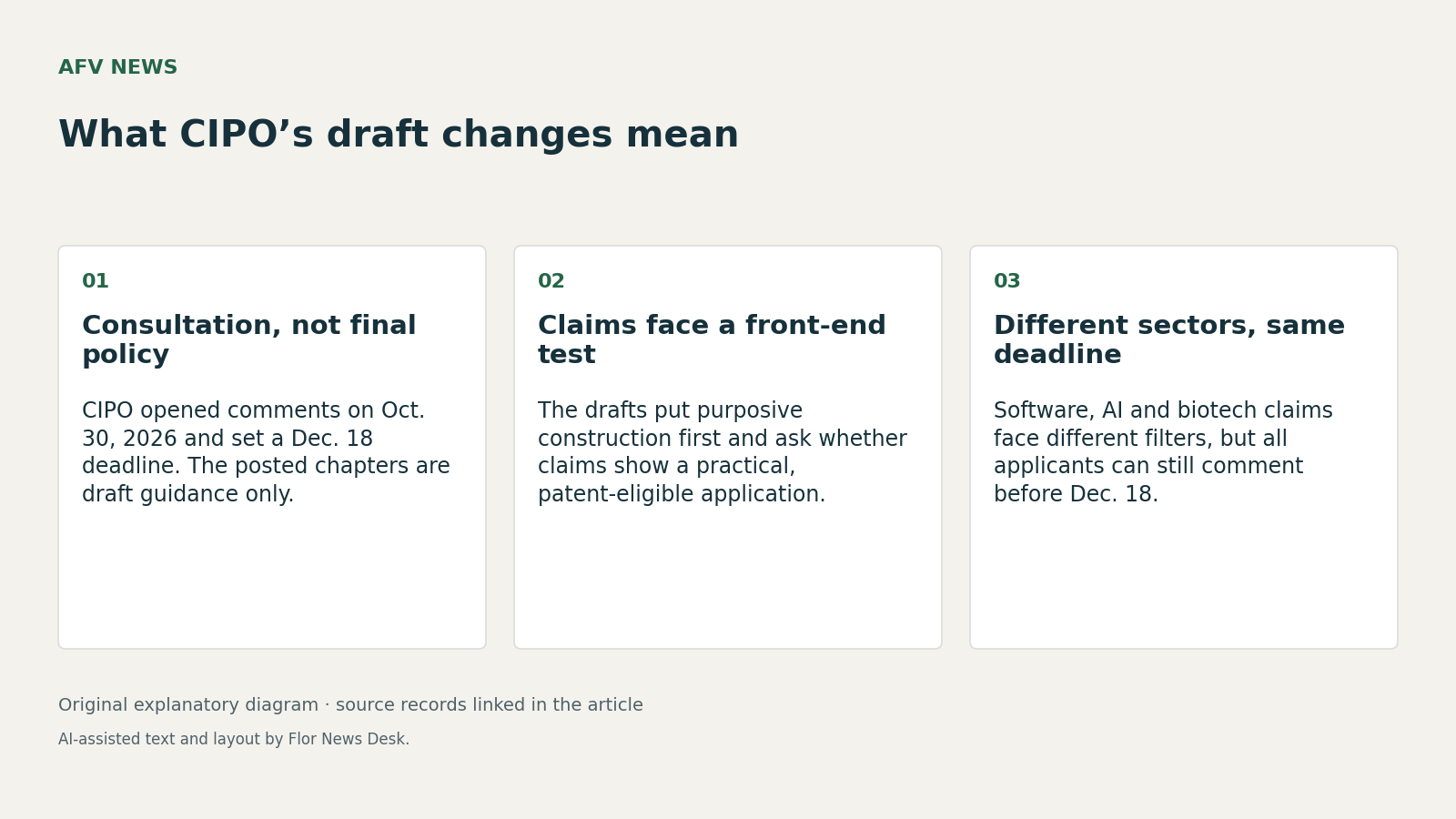
CIPO’s Oct. 30 consultation on patentable subject-matter is not a law change, but it is a live test of how Canadian patent examiners may be told to read claims in software, AI and life-sciences files. The Canadian Intellectual Property Office says comments on draft MOPOP chapters 12, 17, 22 and 23 are due by 11:59 p.m. ET on Dec. 18, 2026, and that submissions will later be published in the language received consultation page. As of Nov. 18, 2026, that makes the immediate business issue procedural rather than doctrinal: companies still have a short window to challenge wording that could shape examination practice.
Chapter 12 matters because it would push purposive construction to the front of subject-matter analysis draft chapter 12. CIPO’s draft says examiners should identify the person of ordinary skill in the art and common general knowledge before construing claims, using the publication date for that knowledge, and may give abbreviated reasoning when construction is straightforward or undisputed draft chapter 12. In practice, that would put more weight on how an application explains the problem, the technical context and which elements are essential, because later subject-matter objections could begin from the examiner’s construction instead of the applicant’s label for the invention.
Chapter 17 shows the broader filter CIPO is proposing. The draft says a purposively construed claim must fit at least one section 2 category of invention and cannot be a mere scientific principle or abstract theorem; it also says a disembodied idea may qualify only when it forms part of a practical application with physical existence or a discernible physical effect or change draft chapter 17. The same draft says methods or processes of surgery or therapy on living humans or animals fall outside patentable subject-matter, while medical uses may still qualify, and that merely adding a computer as an essential element is not enough draft chapter 17. For businesses, that points to a narrower distinction between a commercially important idea and a patent-eligible application of it under CIPO’s proposed framing.
Chapter 22 makes the software and AI stakes more concrete. CIPO’s draft says software claimed on its own is non-patentable subject-matter, a computer program product must be tied to a physical medium and machine-executable code, and a generic computer carrying out an abstract algorithm in a well-known way will not suffice draft chapter 22. It points to two routes for the needed physicality: non-generic physical inputs or outputs such as sensors or actuators, or an improvement in how the computer itself operates, with examples including better efficiency, latency, security, fault tolerance, reduced AI training-data needs or fewer AI hallucinations draft chapter 22. The draft does not show how often those arguments will succeed, but it does reveal what kinds of technical detail CIPO wants applicants to foreground.
Chapter 23 is narrower but important for biotech and medicinal companies. The draft says physicality is usually not the main issue for those inventions except in diagnostic methods and computer-implemented inventions, preserves the lower-life-form versus higher-life-form distinction, and treats some stem-cell categories differently based on developmental capacity draft chapter 23. It also says a use claim for a higher life form may be patentable even when the higher life form itself is not, and that a biological deposit does not automatically satisfy disclosure or enablement requirements draft chapter 23. That matters because it separates subject-matter eligibility from other patentability and disclosure questions that can still sink a filing.
The source record supports urgency, not certainty. CIPO says these revisions are needed to incorporate its March 2026 Practice Notice and to reflect the Supreme Court of Canada’s decision in Pharmascience Inc v. Janssen Inc., 2026 SCC 26 consultation page. But the materials provided here do not include that practice notice or the court judgment, and the draft chapter pages expressly say they are for consultation only and not official guidance draft chapter 12, draft chapter 17, draft chapter 22, draft chapter 23. So the measurable change on Nov. 18 is limited: businesses can compare the draft against pending Canadian filings and decide whether to comment before Dec. 18, but the record here cannot establish what final wording CIPO will adopt, when it would take effect or whether grant outcomes will change.
Read our editorial standards or send a correction to the editorial desk.