

Shared Services Canada has moved one part of Ottawa’s AI transparency agenda from discussion into procurement. Innovation, Science and Economic Development Canada’s Innovative Solutions Canada program opened a challenge on October 30, 2026 for “Artificial Intelligence (AI) decision-making process visibility, traceability and compliance governance,” with applications due by December 22, 2026 at 14:00 Eastern time. The challenge page identifies SSC as sponsor and says the funding mechanism is a contract, not a grant. AI challenge notice
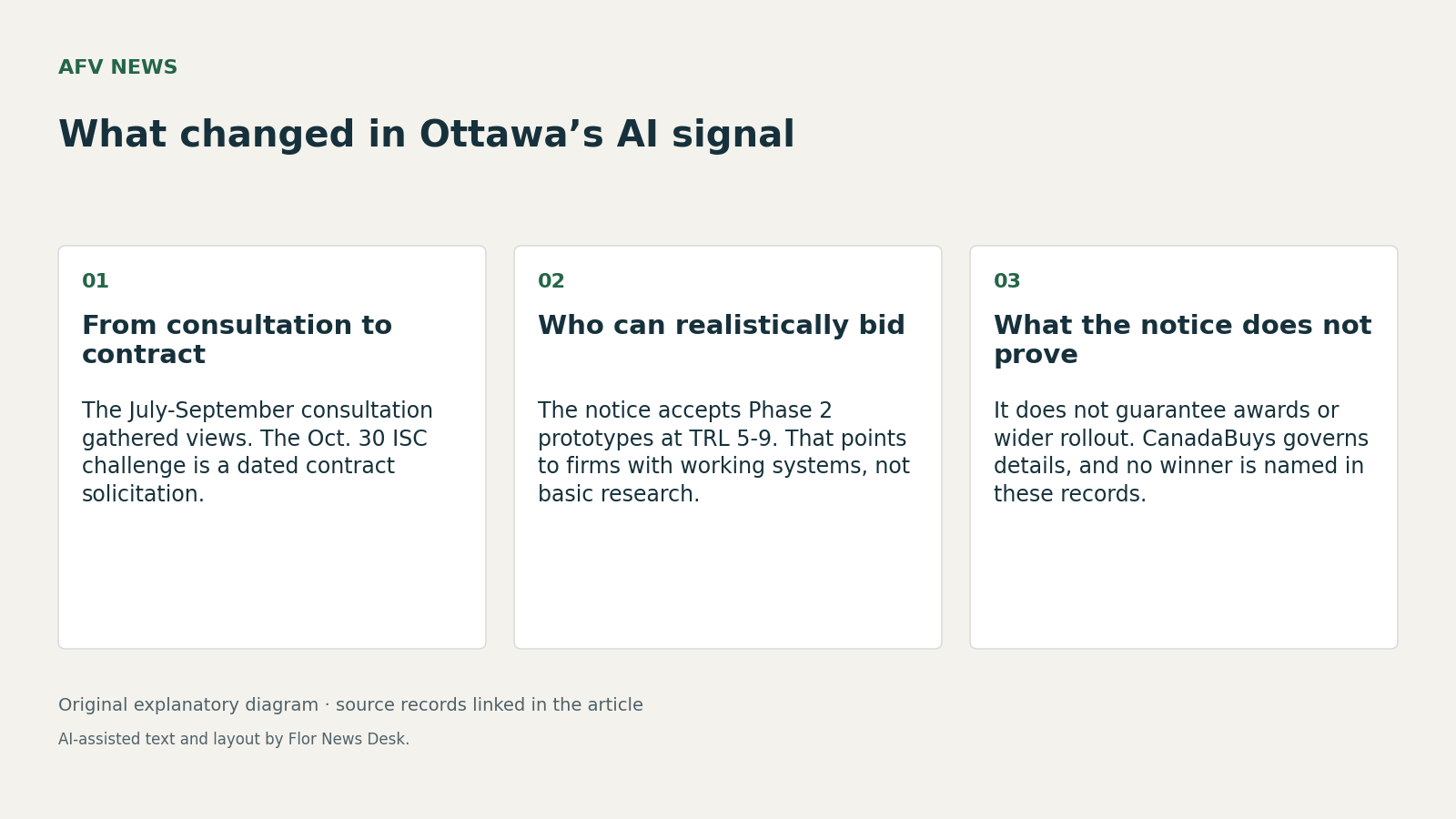
The commercial signal is real, but narrow. The notice says it is open only to Phase 2 prototype development proposals and accepts technologies at readiness levels 5 to 9. It also says Canada expects 1 to 2 Phase 2 contracts, each worth up to C$2 million, excluding applicable taxes, shipping, travel and living expenses, for terms of up to 20 months. That points to vendors with functioning prototypes and evidence they can support visibility into AI decision-making, trace outputs and address compliance with Canadian laws, international standards and government AI governance requirements. It is not evidence that Ottawa is buying basic research, nor that any contract will necessarily be awarded. The same notice says CanadaBuys takes precedence if terms differ. AI challenge notice
What changed for businesses is less about policy language than about timing and format. A separate federal consultation on advancing AI transparency ran from July 23 to September 23, 2026 and raised five possible areas for further action, including disclosure of AI use, clearer information about AI systems, serious-incident tracking and better tracking of AI agents’ activity. AI transparency consultation The new challenge does not prove what Ottawa decided from that consultation. As of the November 4, 2026 retrieval reflected in the brief, the consultation page still only says a What We Heard report would come later. But the two records together show a shift from general transparency questions to one specific buying problem: decision-process visibility, traceability and governance. AI challenge notice AI transparency consultation
Businesses should also avoid reading this notice as a new economy-wide rule. Ottawa already maintains a federal framework for automated decision systems, including the Directive on Automated Decision-Making, the Algorithmic Impact Assessment tool and related guides. Automated decision-making page In analysis, that means the challenge looks more like a procurement test inside an existing governance architecture than a stand-alone regulatory change.
A second practical implication comes from Ottawa’s own procurement-side guidance. ISED’s implementation guide for managers of artificial intelligence systems, tied to the Voluntary Code of Conduct on the Responsible Development and Management of Advanced Generative AI Systems, says managers who procure AI should use due diligence, ask vendors for documentation on development and limitations, and require evidence of compliance with relevant frameworks and standards. Implementation guide That guide is not the solicitation, and it predates this challenge. Still, as analysis, it suggests why mature documentation and auditability could matter commercially even before any broader policy outcome is published.
The program page reinforces the immediate takeaway: this is an open Innovative Solutions Canada Challenge stream opportunity, and ISC says departments set challenge parameters and fund development of the innovation. Innovative Solutions Canada homepage For Canadian tech companies, that is a near-term bid window with defined maturity and funding limits. What the records do not establish is equally important: no winner is named, no contract is yet confirmed, and no source here shows broader adoption across departments or any measured improvement in AI governance outcomes.
Read our editorial standards or send a correction to the editorial desk.