

The Bank of Canada’s September 18 explainer on artificial intelligence makes a distinction that matters when a business measures productivity: a system can perform individual tasks without completing an entire job. The Bank also identifies unreliable output as a reason human oversight remains necessary. Bank of Canada
For a business testing an AI assistant, that suggests measuring the time needed to deliver usable work. A fast first draft is one component of that calculation.
Count checking and correction time
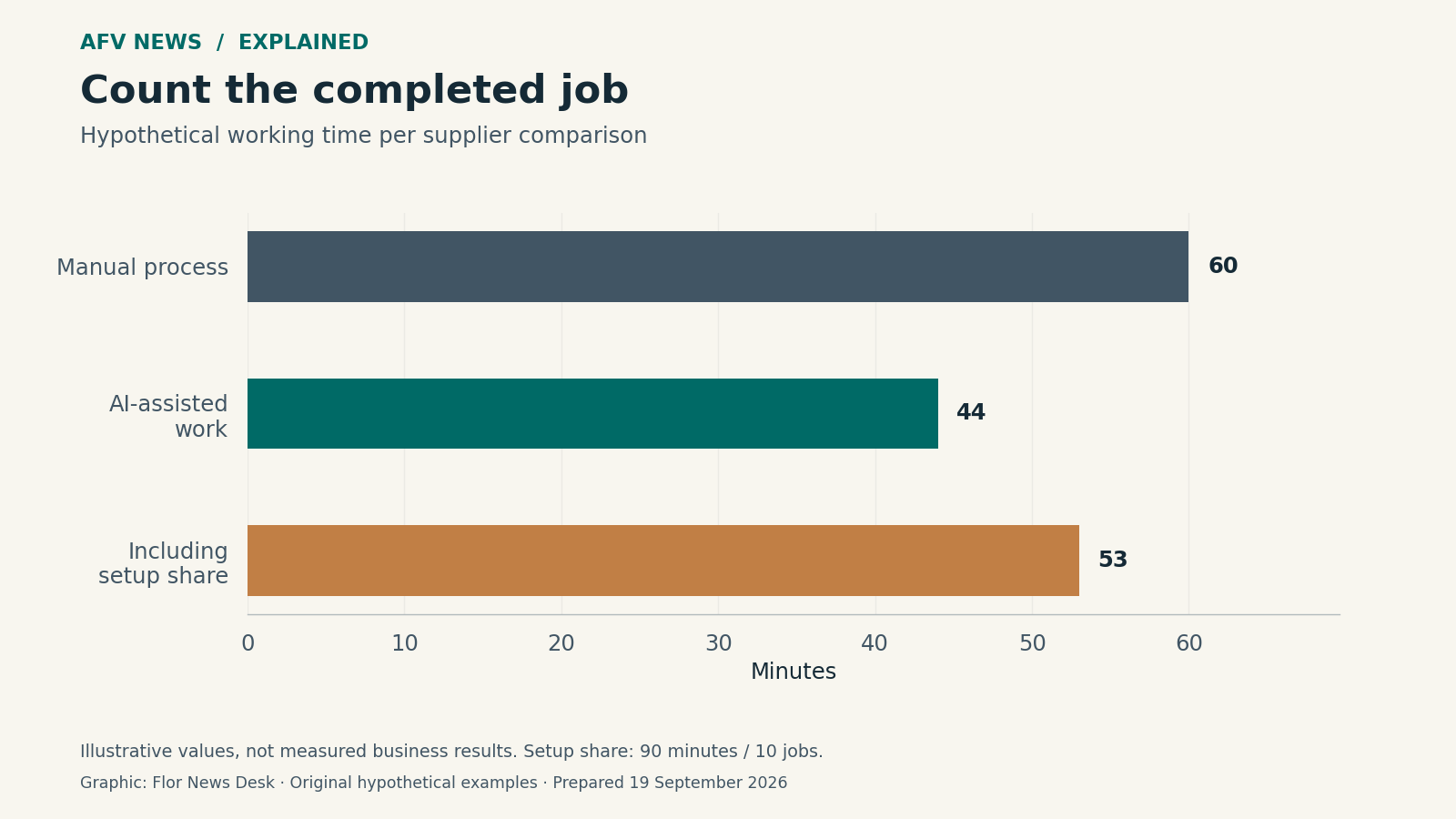
Consider a hypothetical supplier comparison that normally takes 60 minutes, including checking prices and preparing a recommendation. With an AI assistant, suppose preparing the initial comparison takes 10 minutes. Checking it takes another 20, and correcting errors takes 14. The completed comparison therefore takes 44 minutes.
That saves 16 minutes, or about 26.7% of the original working time. Comparing the 10-minute draft with the entire 60-minute manual process would wrongly report a saving of about 83.3%. Those measurements have different endpoints.
Include setup and a consistent quality standard
Setup changes the result again. Suppose the team spends 90 minutes configuring its process and learning the tool, then uses it for 10 comparisons. Allocating that time evenly adds nine minutes per comparison. The average becomes 53 minutes, leaving a saving of seven minutes, or about 11.7%. These figures are an illustration, not measurements of a company or estimates of Canadian productivity.
The comparison also needs a consistent quality standard. A summary that omits delivery charges has not achieved the same result as one that includes them. Counting both as a completed comparison would hide a difference in the work delivered.
Measure the finished work
A useful trial log would record the assignment, total working time, time spent checking and correcting, and whether the result met the agreed standard. Rejected outputs should remain in the record. Otherwise a trial could appear faster simply because its unsuccessful attempts disappeared from the calculation.
Time released is not automatically money saved. If a salaried employee finishes sooner, the immediate result may be capacity for other work. Whether that capacity produces additional sales, better service or lower costs requires a separate observation.
The practical question is therefore specific: how much effort did an acceptable result require, including the work that followed the first answer?
Read our editorial standards or send a correction to the editorial desk.