

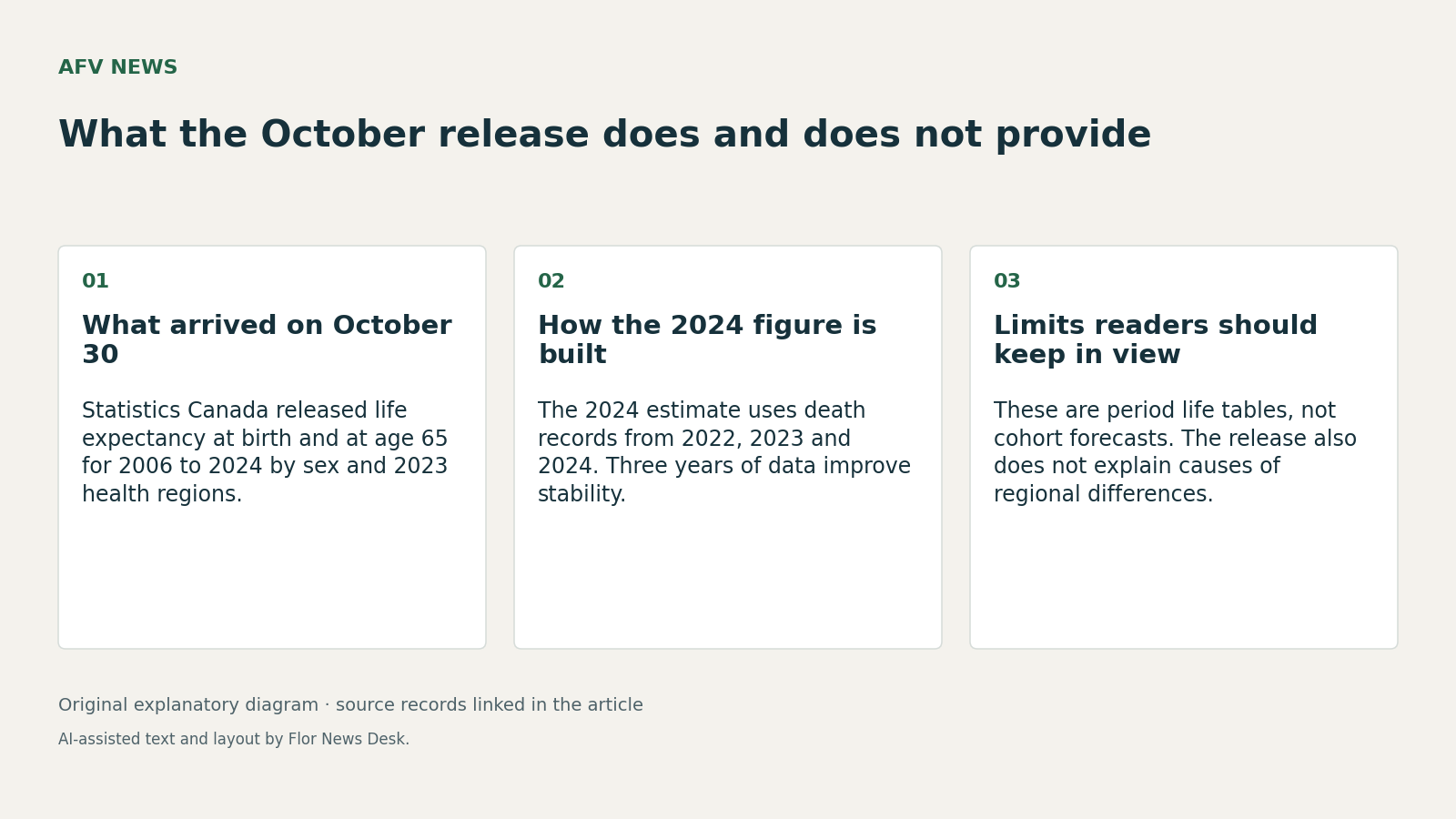
Statistics Canada’s October 30, 2026 release matters less as a headline trend call than as a fresh input set. The agency says it has published life expectancy at birth and at age 65 for 2006 to 2024 by sex, province, territory, health region and peer group, using 2023 boundaries and names. For organizations that price, reserve or plan against mortality and regional aging patterns, that is a concrete update to the official data available for year-end work, not proof of a new long-run direction in longevity Statistics Canada data-availability notice.
The key distinction is methodological. Statistics Canada says these are period life-expectancy estimates based on age- and sex-specific mortality rates observed during a given period, using death records from the Canadian Vital Statistics Death Database and Statistics Canada population estimates Statistics Canada data-availability notice. That means the release updates a snapshot of mortality conditions. It does not, by itself, establish how long a real birth cohort will live, and it does not supply a forecast for future liabilities or service demand.
The 2024 figure also needs careful handling. Statistics Canada says it uses three years of death records to improve stability, especially for smaller provinces and territories, and that the 2024 life-expectancy estimate is calculated from 2022, 2023 and 2024 death records Statistics Canada data-availability notice. In practical terms, that makes the latest number more useful as a stable benchmark than as a clean read on a single calendar year. An analyst can reasonably infer that it is suited to refreshing mortality inputs, but not to proving that a one-year swing has already become a lasting trend.
The regional detail is the other material change. Because the release is organized on 2023 health-region boundaries and names, firms that compare branch markets, service territories or labour pools across regions should first check whether their internal maps still align with that geography before drawing conclusions from older series and the new one Statistics Canada data-availability notice. A mismatch in boundaries can create an apparent shift that is really a classification change.
A second source in Statistics Canada’s catalogue helps show what this October release is not. On January 9, 2026, the agency published health-adjusted life expectancy estimates for 2019, 2020 and 2023, including national 2023 figures, and described that measure as combining longevity with health status using the Sullivan method and Health Utilities Index Mark 3 scores Statistics Canada health-adjusted life expectancy release. That page is relevant because some readers may treat it as interchangeable with life expectancy. It is not. It does not establish 2024 life expectancy, 2024 health-adjusted life expectancy, or October’s health-region results.
The immediate business checklist is therefore narrow. Pull the October release, confirm whether your current work uses period or cohort assumptions, document the data vintage behind any existing mortality basis, and test whether moving to Statistics Canada’s latest period tables materially changes sensitivity ranges Statistics Canada data-availability notice. If a decision depends on why regions differ, or on how long current conditions will persist, these records do not answer that. They provide updated official estimates and definitions, but not a cause-of-death decomposition, not a forward projection, and not an interpretation of what changed after 2024.
That leaves a disciplined conclusion. What changed on October 30 was data availability: official period life-expectancy estimates now run through 2024 and line up with 2023 health-region geography Statistics Canada data-availability notice. What has not been established by the release is a new national or regional mortality story. Businesses can use the dataset to update inputs; they still need separate modelling to convert those inputs into forecasts, pricing or staffing decisions.
Read our editorial standards or send a correction to the editorial desk.