
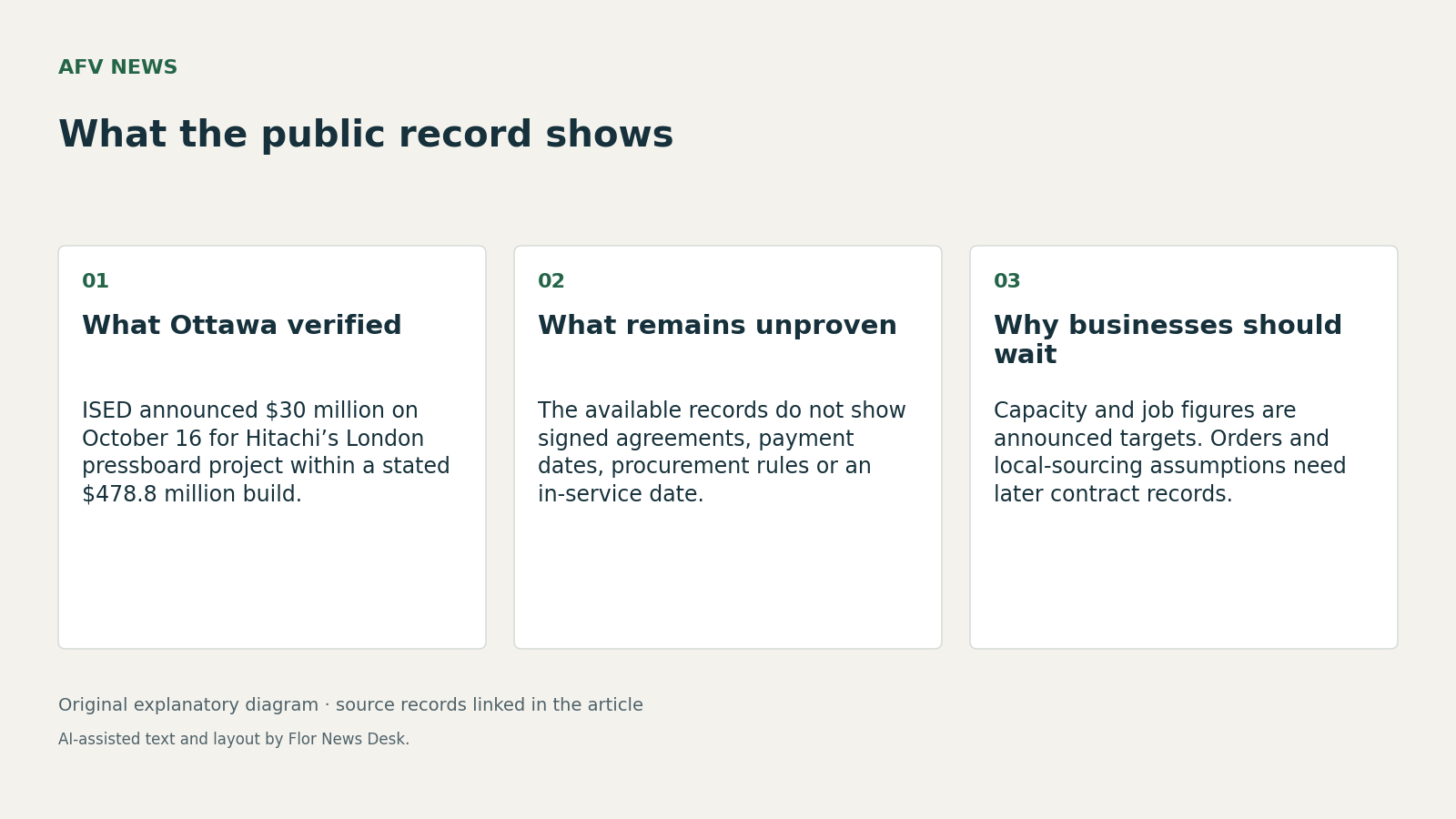
Ottawa said on October 16, 2026 that it will provide Hitachi Energy Canada Inc. with $30 million for a London, Ont., project to make electrical-grade pressboard, a transformer-insulation material. Innovation, Science and Economic Development Canada said the money is split between the Strategic Response Fund and the Investments in Forest Industry Transformation program, inside a broader project the department valued at $478.8 million. The same release said the plant is intended to be Canada’s first facility of this type and to produce up to 20,000 tonnes a year. ISED release
The most useful fact for businesses is not only the $30 million headline, but the scale difference between the federal contribution and the full project. Using the government’s own figures, Ottawa’s share would cover only about 6% of the stated cost. That suggests a policy role closer to anchoring a strategic manufacturing decision than paying for a complete build. Because the material is wood-fibre based and tied to transformer insulation, the file links two supply chains that are often discussed separately: forest products and grid equipment. The funding split itself makes that policy design visible. ISED release
ISED also said the planned output would supply Hitachi Energy’s transformer manufacturing operation in Varennes, Que., as well as other transformer and insulation manufacturers in North America and global markets. The department said Hitachi Energy would maintain about 1,250 existing Canadian employees and grow its Canadian workforce to 1,765, including more than 100 jobs in London. ISED release If those targets are reached, the larger commercial effect would be upstream: a domestic source for a specialized input that sits inside transformer production, rather than another announcement centred only on final assembly.
What the available record does not establish is when that strategic intent turns into contracts, deliveries or plant output. As of October 17, 2026, the public material summarized here does not show a signed contribution agreement, payment dates, milestone conditions, procurement rules, Canadian-content requirements, a construction start or an in-service date. Nor does it show that any portion of the $30 million has already been disbursed. That means capacity, sourcing and employment figures should be read as announced expectations, not measured 2026 results. ISED release
A second federal release from October 15, 2026 helps show why this distinction matters. In that case, Natural Resources Canada said Ottawa was committing $100 million to advance the Wind West offshore-wind initiative in Nova Scotia, while the same record still placed the Call for Bids in winter 2027 and identified specific early work such as FLiDAR-mounted buoys and transmission modelling. NRCan Wind West release The point is not that the projects are alike. It is that a federal funding commitment can be economically meaningful before procurement, construction or operating milestones are public.
For suppliers, utilities and large electricity users, the Hitachi announcement is therefore actionable mainly as a direction-of-travel signal. Ottawa has attached real dollars to a named company, city, material and capacity target. ISED release But until the public record adds a timetable and funding conditions, the announcement does not yet prove near-term buying opportunities, local-sourcing obligations or delivery dates for transformer-related projects.
Read our editorial standards or send a correction to the editorial desk.