Ottawa gave Canadian businesses a clearer number on Nov. 6, 2026, but not a final spending outcome. The Treasury Board Secretariat says Supplementary Estimates (B), 2026–27 seek Parliament’s approval for $22.1 billion in new voted spending across 71 organizations, including $841.2 million for seven organizations to deliver the Regional Tariff Response Initiative and $631.6 million for Employment and Social Development Canada to support training and recruitment of skilled trades workers. Backgrounder News release
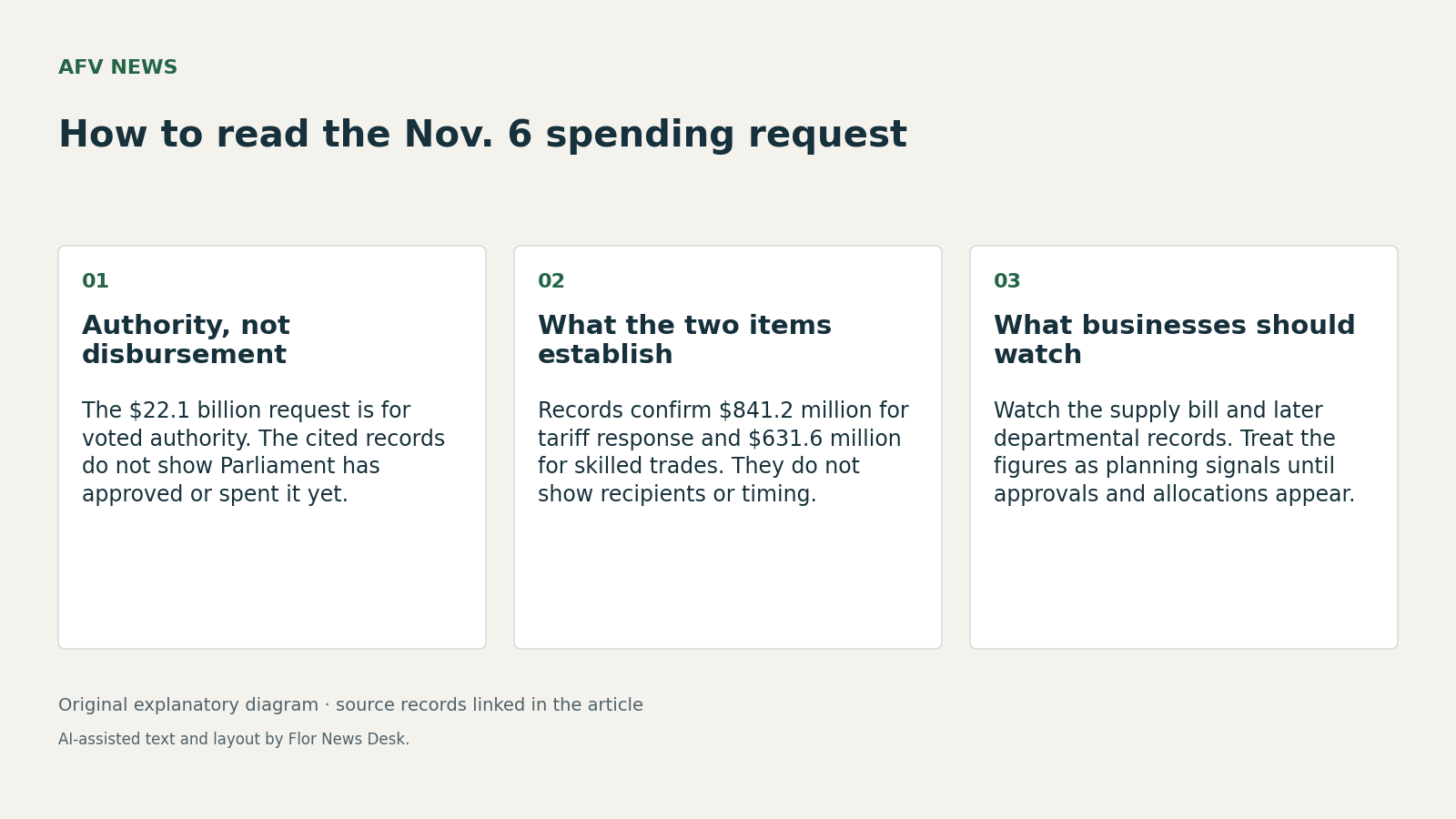
The practical distinction is that these figures are proposed voted authorities, not evidence that suppliers, employers or training providers have been paid. Treasury Board’s general guidance says voted spending requires parliamentary authority through an appropriation bill, and the Nov. 6 backgrounder says the government will introduce a supply bill no later than Dec. 10, 2026, to seek that approval. As of Nov. 7, 2026, the cited record shows a tabling and a timetable, not passage of the bill or completed disbursement. Supplementary Estimates overview Backgrounder
For manufacturers and suppliers watching tariff relief, that still matters. The public record cited here confirms a sizeable federal request for the Regional Tariff Response Initiative, which makes the item more concrete than a broad policy promise. But the same record does not establish which firms receive support, how the seven organizations divide the authority, when agreements are signed, or when any procurement tied to delivery would appear. The business implication is analytical, not speculative: an appropriation request can justify scenario planning, but it cannot yet support assumptions about contract timing or near-term revenue. Backgrounder
The $631.6 million skilled-trades item sends a similar signal to employers, colleges and training businesses. It shows Ottawa is seeking room in the fiscal plan for a large intervention through Employment and Social Development Canada, but the cited documents do not provide recipient lists, program terms, intake windows or measured labour-market results. That means the number is most useful as an indicator of likely federal activity in this area, not as proof that a provider can count on funding in a given quarter. Backgrounder
A second timeline matters after any supply bill. Treasury Board says Estimates are “up to” spending authorities, while actual spending is later reported in the Public Accounts. On the same day it tabled Supplementary Estimates (B), the government also tabled the 2026 Public Accounts of Canada and 2025–26 Departmental Results Reports. That pairing is useful for readers: Estimates show what Ottawa wants authority to spend; Public Accounts and later results documents are where businesses can look for evidence of what was actually used and delivered. News release
For planning purposes, the best near-term reading is narrow. The Nov. 6 filing is a real federal decision point because it places both items inside the parliamentary spending process and attaches exact amounts to them. It is not yet proof of approved cash flow, program launch dates or procurement opportunities. Businesses that sell into federal programs should therefore separate pipeline planning from committed revenue, watch the supply-bill stage through Dec. 10, and then look for the department-level instruments that the aggregate Estimates do not provide, such as detailed allocations or later spending records. Treasury Board’s own process page also points readers to supporting tables for Supplementary Estimates (B), which are more useful for follow-up than the headline total alone. Supplementary Estimates overview
Read our editorial standards or send a correction to the editorial desk.