

Bill C-39’s immediate business impact is not that Ottawa has imposed a live one-year federal project deadline. It is that, on Sept. 21, the government formally put that deadline into proposed legislation and, the same day, told the Canada Energy Regulator to plan for a larger coordination role if Parliament passes the changes. For project sponsors, that is a reason to revisit filing readiness and permitting sequences, but not yet to assume faster approvals in contracts or financing models. Government release CER letter
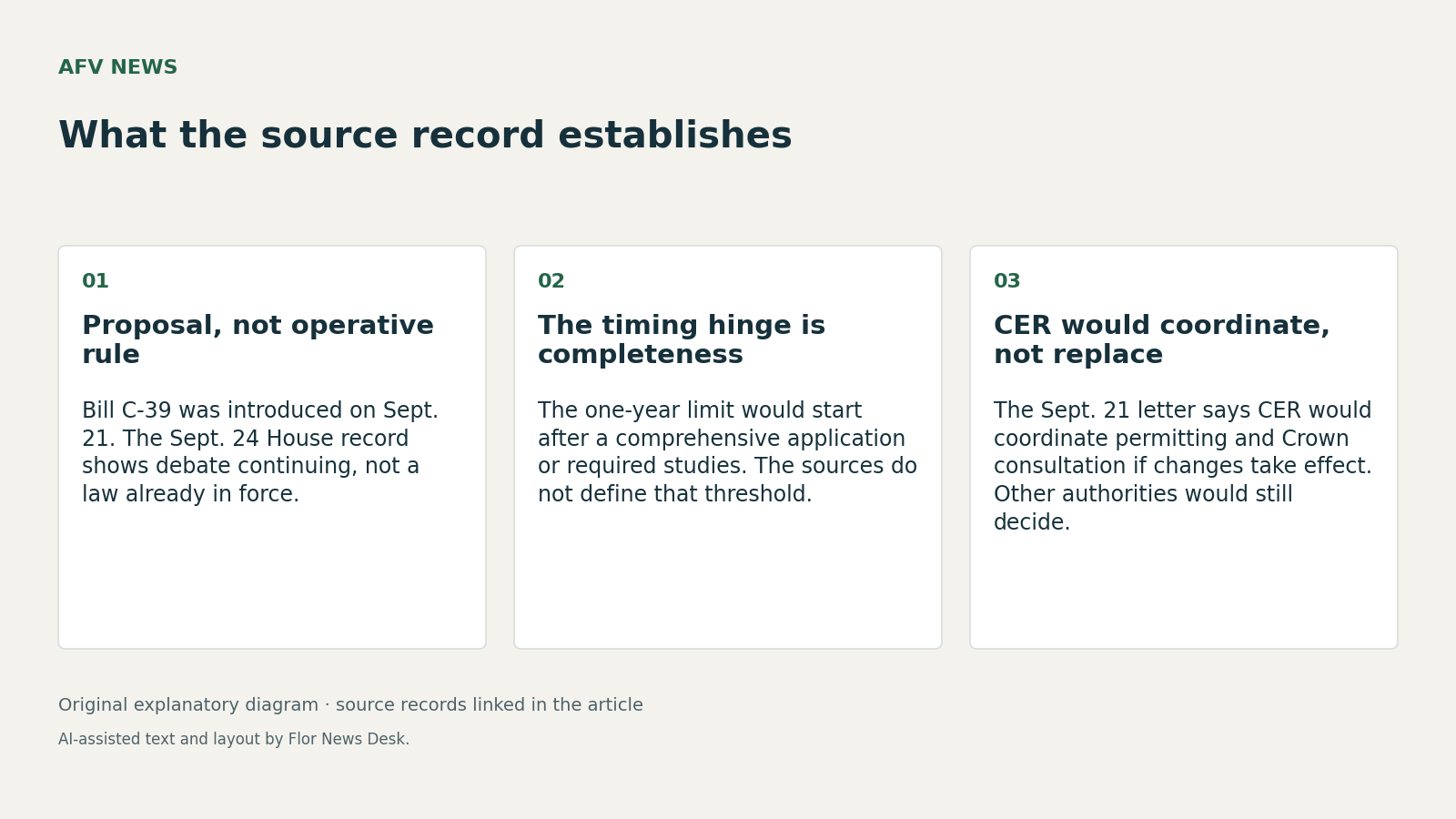
According to the federal release dated Sept. 21, Bill C-39 would set a one-year limit for federal reviews and decisions after a proponent submits a comprehensive application, and the government said it also issued a Cabinet Directive with the same one-year objective. But that same record describes Bill C-39 as proposed legislation, not enacted law. The latest parliamentary record in the source set, a House business statement dated Sept. 24, says second reading debate was continuing and would resume after the constituency week. That does not establish passage, Royal Assent or an in-force date. Government release House statement
The practical issue for sponsors is where the one-year clock starts. One government record uses the term comprehensive application; the Sept. 21 CER letter refers to the point when a proponent has provided the required information and studies. Neither record, as summarized in the source brief, defines those thresholds or gives a test for completeness. That matters because a shorter post-filing decision window can still leave substantial pre-filing work unresolved. As analysis, the government’s own wording suggests schedule pressure may move upstream into application assembly rather than disappear altogether. Government release CER letter
For CER-regulated projects, the Sept. 21 letter outlines a more centralized federal process, if the legislative changes take effect. It says the CER chief executive would coordinate federal permitting and Crown consultation, while other federal authorities would keep their own decision-making responsibilities and the Commission’s adjudicative independence under the Canadian Energy Regulator Act would be respected. That points to a narrower change than a single-regulator approval system. Sponsors could get one coordinating hub for process management, but still face multiple legal decision-makers. CER letter
The same letter also asks the CER to use existing reporting mechanisms, including annual counts of major-project regulatory and permitting decisions issued within the one-year objective and Crown consultation processes coordinated by the CER. That is important because it signals how Ottawa wants progress tracked. It is still a plan for future measurement, not evidence that agencies are already meeting a one-year standard. Businesses should distinguish an announced performance target from demonstrated results. CER letter
Some of the most commercially important details are simply not in the retrieved record. The Sept. 22 page about Part 1 of the Building Canada Strong Act is only a media advisory for a virtual technical briefing and says the session would be for background information only; it does not provide a transcript, slide deck or operative detail on consultation timing or delegated authorities. The Sept. 21 government release also does not supply bill clauses or a coming-into-force schedule, and the CER letter says a follow-up will be shared once relevant provisions come into force and may reflect legislative changes. Until those records exist, the prudent reading is limited: Bill C-39 is a significant policy direction for energy, transport and other major projects, but not yet a bankable one-year federal approval timeline. Technical briefing advisory Government release CER letter
Read our editorial standards or send a correction to the editorial desk.