
Natural Resources Canada’s joint readout confirms that Canada and China have now held their first ministerial dialogue dedicated to energy, co-chaired by China’s National Energy Administration head Wang Hongzhi and Canada’s Minister of Energy and Natural Resources Tim Hodgson by videoconference on November 4, 2026 Beijing time, equivalent to November 3 in Ottawa. The readout says the agenda for further exchanges and cooperation includes conventional energy, renewable energy, civil nuclear energy and uranium resources. That is the verified change in the public record: these subjects now sit inside a named ministerial channel, not just general trade diplomacy. NRCan readout
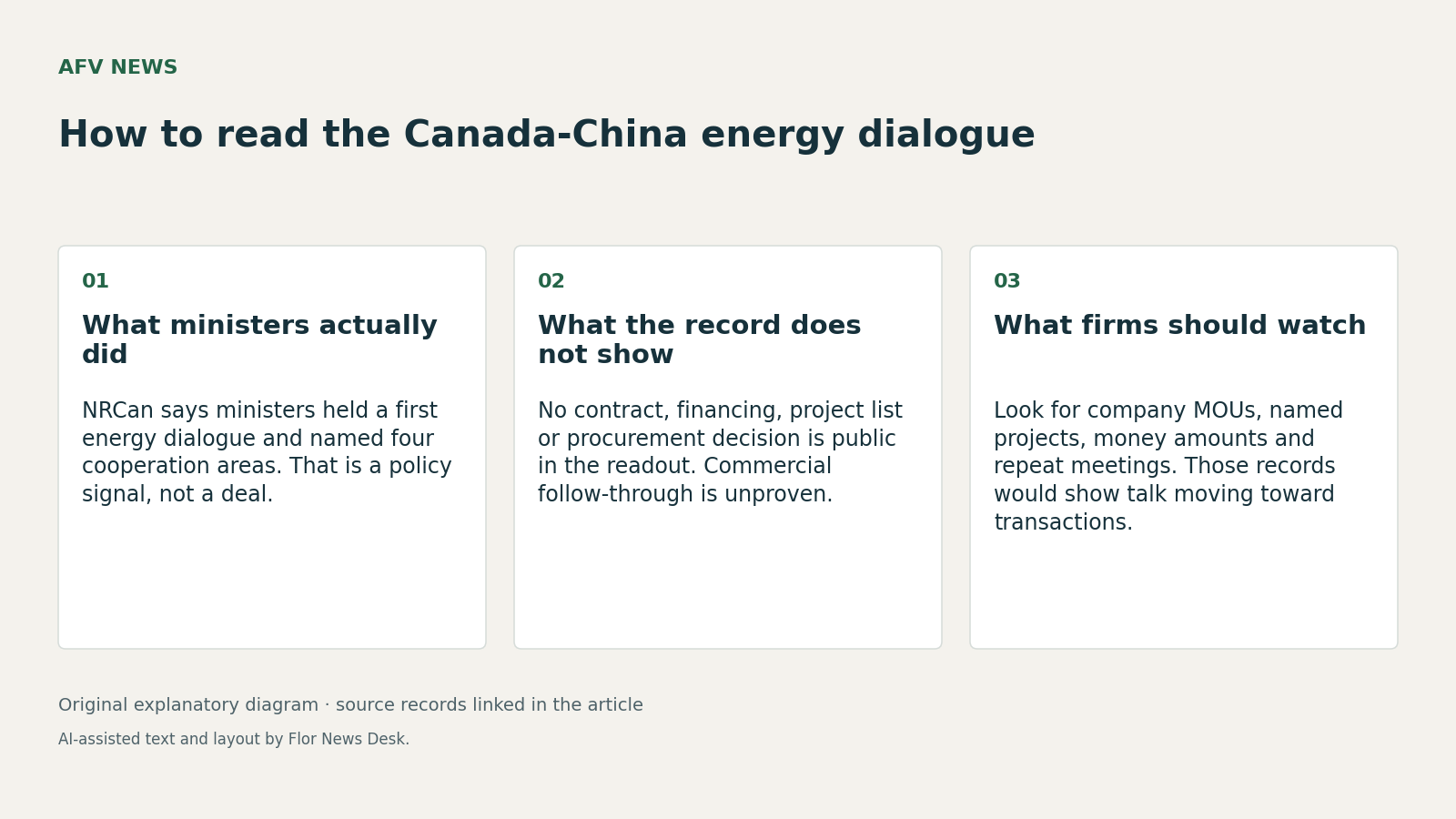
For Canadian businesses, the practical significance is narrower than the headline may suggest. According to Natural Resources Canada, both sides said they would expand policy dialogue and information exchanges and encourage practical cooperation between energy enterprises, and select energy enterprises plus Canadian provinces and territories took part. But the same page is only a government readout. It does not publish an agreement text, a project register, contract names, financing figures, procurement decisions or an implementation timetable. Businesses can reasonably read it as political permission for more conversations, not as evidence that revenue-generating work has been assigned. NRCan readout
The explicit mention of civil nuclear energy and uranium resources is the sharpest commercial clue, because it identifies sectors that may get early follow-up attention. Even there, the public record remains thin. Natural Resources Canada also maintains a “Uranium Resource Potential” map layer, but its metadata points to a 2015 source database and says some deposits or occurrences may only become economic after exploration, economic evaluation and environmental assessment. That means the federal mapping record shows geological potential, not a current list of operating mines, approved projects or China-linked transactions. NRCan uranium layer
The timing matters because the energy dialogue arrived during a broader ministerial push in Canada-China economic relations, but that context should not be overstated. On November 4, 2026, Global Affairs Canada said a ministerial-level Joint Economic and Trade Commission meeting in Beijing produced an extension to the end of 2028 for favourable market access covering Canadian canola meal, peas, lobsters and crab, while Canada would extend certain remission measures for some Chinese steel and aluminum products not made in Canada. The department also reported $125.7 billion in two-way merchandise trade in 2025 and said exports to China reached $21.5 billion in the first half of 2026. Those figures show the scale of the relationship and the return of ministerial engagement, but they are not energy commitments. Global Affairs Canada release
The cleanest inference, then, is limited but useful. After November 3-4, 2026, a Canadian firm in the named sectors can point to a current federal record showing that enterprise-to-enterprise cooperation in energy is an endorsed topic of bilateral discussion. What the same record cannot establish is whether any Chinese counterpart has committed to buy, invest, build or finance anything. That distinction matters because a dialogue changes the policy atmosphere before it changes a balance sheet. NRCan readout
The next documents to watch are straightforward: any published agreement text or memorandum, any named company pairings or project list, any financing amount, any procurement or offtake disclosure, and any follow-up readout that creates working groups or a second meeting. Until those records appear, the best reading is that Ottawa and Beijing have opened an energy lane that could matter for Canadian exporters and developers, especially around uranium and civil nuclear, but have not yet shown that it carries transactions. NRCan readout Global Affairs Canada release
Read our editorial standards or send a correction to the editorial desk.