

The Canada Energy Regulator has given energy companies something more useful than a general promise of future reform: a dated work plan. Its Regulatory Framework Plan: 2026 to 2029 says the agency intends to amend or develop regulations, guidance and enterprise projects over three years, with annual updates, and it assigns estimated completion months to several items that matter to filings and trade. As of 2026-11-12, that includes November 2026 drafting targets for two filing-guidance updates, December 2026 for the Export and Import Regulatory Framework at the stage “Preparing Final Publication,” and September 2027 for phased implementation of the Regulatory Asset Data project. The important business point is that this is a timetable, not a legal change record.
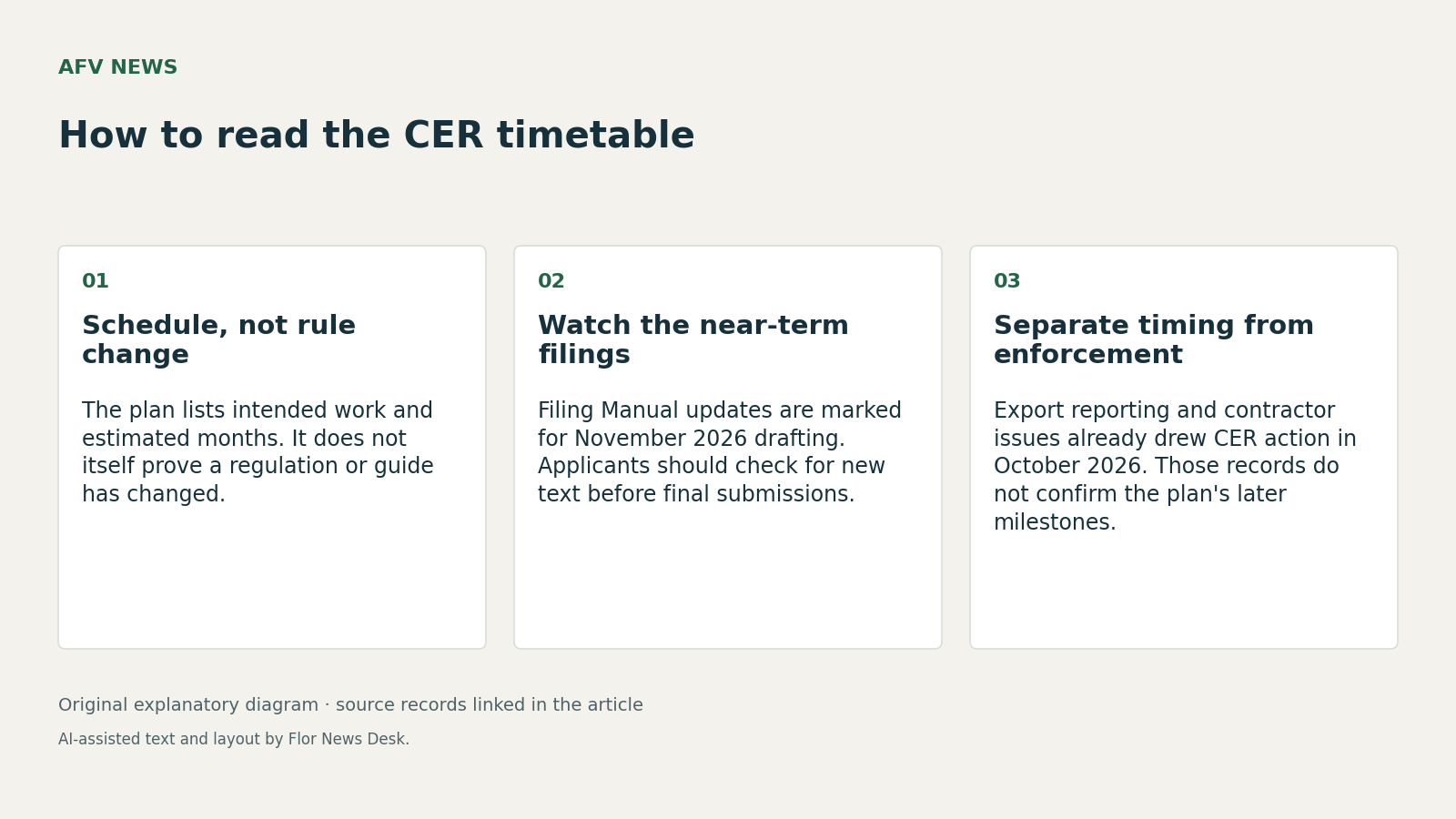
That distinction matters because the public chronology is not clean enough to treat any date as proof of completion. The CER’s What’s New index lists “Regulatory Framework Plan from 2026 to 2029” on 2026-09-11, while the plan page also carries an October 16, 2026 update note and a site modified date of 2026-10-21. Those records show the plan was being surfaced and revised in the fall, but they do not establish when each project status first appeared or whether a November or October milestone has since been met. For businesses, the operational lesson is to use the plan for scheduling and internal preparedness, then wait for the underlying publication before changing compliance positions.
The most immediate effect is on applications already being assembled. The plan lists November 2026 drafting work on updates to Filing Manual Guide A2 and Guide A4 plus Electricity Filing Manual Chapter 6, and separate November 2026 drafting work on Filing Manual Chapter 3 Section 4 and Guide L plus Electricity Filing Manual Guide E. It also lists the Remediation Process Guide at the engagement stage with estimated completion in December 2026, all on the same plan page. That does not tell applicants what wording will change. It does tell them that any filing expected to move through late 2026 should be checked twice: once against the current manuals, and again before submission or evidence close if the CER posts new guidance.
The same logic applies to contractor oversight, but here the compliance record makes the issue harder to dismiss as paperwork. The plan says Contractor Oversight Guidance reached the implementation stage with estimated completion in October 2026 on the plan page. Separately, the CER said in an October 16, 2026 order summary involving NorthRiver Midstream NEBC Connector GP Inc. that inspectors found gaps in workplace noise-hazard control and said the company could not demonstrate effective contractor supervision for hearing-protection compliance. The order summary set an October 30, 2026 corrective deadline, and the posted record did not report any follow-up outcome as of 2026-11-12. That does not prove the new guidance caused the order, or the reverse. It does show that contractor oversight was both a guidance workstream and an active enforcement topic in the same period.
Exporters should read the schedule with similar discipline. The plan’s December 2026 target for final publication of the Export and Import Regulatory Framework sits beside a current enforcement record: a warning letter to CNOOC Trading (Singapore) PTE. LTD., dated October 22, 2026, where the CER said the company had 15 late monthly export reports under existing orders. The CER said the reports were later filed and warned that further non-compliance could lead to stronger action, but no administrative monetary penalty or Commission order was imposed in that record. The practical takeaway is narrow but important. Companies should not wait for the planned framework publication to clean up current export-reporting controls, because the existing obligations remain enforceable now.
The longer-dated item, the Regulatory Asset Data project with phased implementation estimated for September 2027 on the plan page, has a different implication. It is too early to infer specific new data fields or mapping duties. It is not too early for sponsors to inventory where asset, geospatial and filing data are stored, because a phased rollout usually means preparation work arrives before the final endpoint. The plan gives companies a calendar for governance and budgeting. It does not yet give them the final text that would justify changing what they file.
Read our editorial standards or send a correction to the editorial desk.