
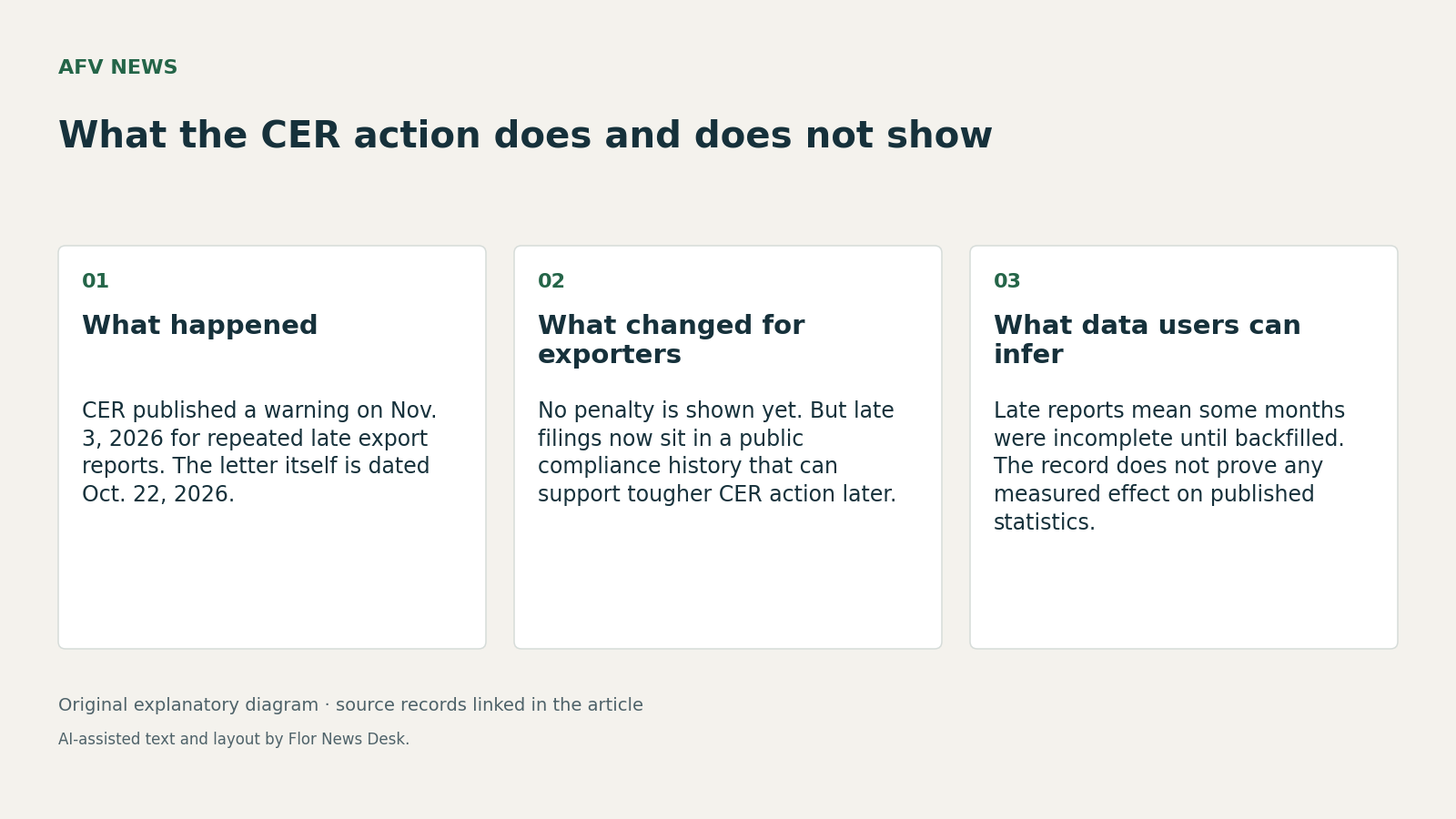
The Canada Energy Regulator has moved CNOOC Trading (Singapore) PTE. LTD. from general reporting reminders into a named enforcement record. The regulator said on November 3, 2026 that it had issued a warning letter for late import and export activity reports, after earlier reminding companies in January 2024 that filing on time is mandatory under the reporting rules. The underlying letter is dated October 22, 2026. The public record so far does not show a penalty, a Commission order or a revocation for CNOOC, but it does show a formal escalation beyond routine follow-up. CER notice warning letter enforcement index
The warning letter matters because it is specific. The CER said CNOOC Singapore held Order ROE-127-2025 for calendar 2025 and holds Order ROE-150-2026 for calendar 2026, authorizing exports of light and heavy crude oil and refined petroleum products. Those authorizations required monthly reports through the Commodity Tracking System under the National Energy Board Export and Import Reporting Regulations and the order conditions. The regulator listed nine late filings before April 2026 and six more after April 2026, spanning reporting periods in January, March, August, October and December 2025, plus January, June, July and August 2026. It also said the late reports were later filed. warning letter
For exporters, the practical change is not about commodity eligibility or volumes. It is that repeated lateness is now part of a public compliance history. The CER’s enforcement page says warning letters are used either to publicize unresolved non-compliance or to warn about the seriousness of non-compliance that has already been addressed. That means filing the overdue reports does not erase the compliance issue. On the record available here, the regulator is signaling that timeliness itself is enforceable, not just whether a report eventually appears. enforcement index warning letter
The next risk is discretionary escalation. The letter says future non-compliance may lead to a Commission order, a direction or an administrative monetary penalty. The enforcement index shows that reporting-related matters have produced different outcomes in other cases: Monroe Trading and Acquisitions LLC appears in the warning-letter table with a March 31, 2026 entry, and the same index separately lists a July 24, 2026 revocation of Monroe’s gas export order. The index also lists an August 11, 2025 revocation of Riovic Services Ltd.’s electricity export permit for reporting-regulation non-compliance. That does not establish the same path for CNOOC, but it does show that reporting compliance can affect market access, not just back-office workload. warning letter enforcement index
For traders, shippers and analysts who use CER export data, the narrower takeaway is caution, not alarm. Because the required monthly reports feed the regulator’s reporting system, late filings mean the administrative record for the affected months was incomplete until it was backfilled. But the documents provided here do not give filing dates for each correction, export volumes or any measured effect on published statistics. So the record supports a process warning about timeliness and completeness around this authorization, not a quantified claim that public market data were materially distorted. warning letter CER notice
One timing limit is worth keeping clear. The October 22 letter referred to an October 31, 2026 reporting deadline, but that statement was forward-looking when written. As of November 8, 2026, the records in this source set do not establish whether that later deadline was met, and they do not include any response from CNOOC Singapore. That leaves the core conclusion intact: the verified development is a formal CER warning, based on repeated late filings after reminder emails and a referral to the regulator’s Audit, Enforcement and Investigations team. For other exporters, the sensible inference is to treat monthly CTS reporting controls and responses to CER compliance emails as an operational risk issue before it becomes an enforcement one. warning letter
Read our editorial standards or send a correction to the editorial desk.