

Statistics Canada’s September 18 update to the Survey of Household Spending concerns 2023. The agency says it has recalibrated survey weights to demographic projections based on the 2021 census, replacing weights based on the 2016 census in the previous release. Statistics Canada
For a business using the figures to understand its customer market, the two dates perform different jobs. The release date identifies when this version became available. The reference year identifies the spending being estimated. Publishing an update in 2026 does not turn it into a measurement of purchases made in 2026.
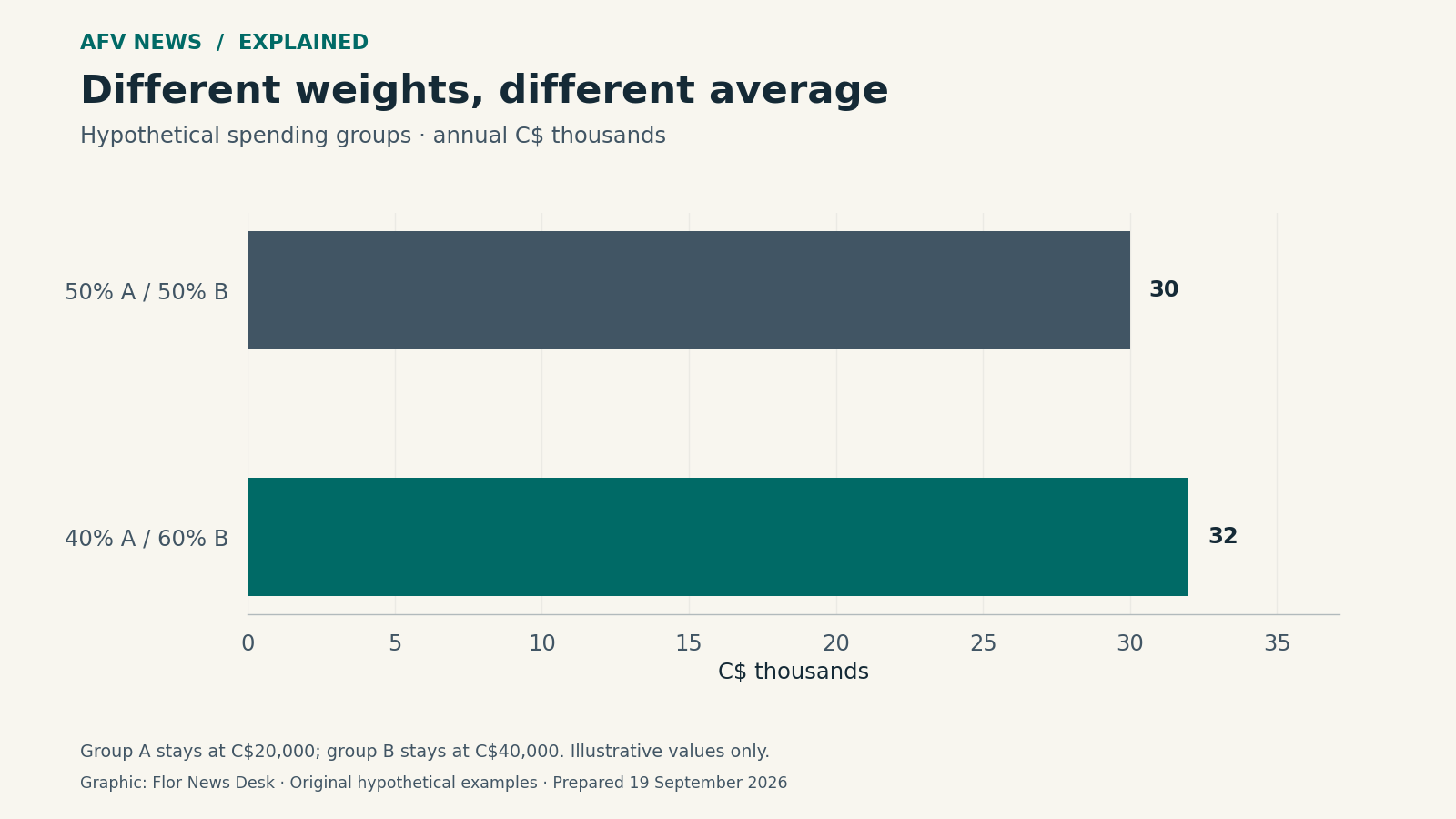
Weighting can be understood through a simplified, hypothetical example. Imagine two groups of households. Average annual spending is C$20,000 in group A and C$40,000 in group B. If each group represents half the population in the calculation, the weighted average is C$30,000: half of C$20,000 plus half of C$40,000.
Now change the assumed population shares to 40% for group A and 60% for group B. The weighted average becomes C$32,000. Neither group’s spending changed. Their influence on the combined result changed.
This is an illustration of weighted arithmetic, not a reproduction of Statistics Canada’s calibration procedure. The invented C$2,000 difference is not an estimate of the revision in the Canadian data.
That distinction prevents two mistakes in a market presentation. First, the difference between an old and revised estimate for the same year is not a year-over-year spending increase. Second, a weighted average does not show what every household spent. Even in this two-group example, the combined C$32,000 figure matches neither group’s average.
A retailer rebuilding a planning spreadsheet could keep a separate field for reference year, release date and retrieval date. Any existing chart based on an earlier download should be checked against the revised series before its change labels are reused.
Using several years also calls for consistent definitions and comparable data versions. An apparent movement is hard to interpret if one point uses a revised estimate and another retains a superseded one.
The update can improve a historical market benchmark. An assertion about current customer demand would require current evidence, such as a clearly dated sales series, rather than a new date on an older spending period.
Read our editorial standards or send a correction to the editorial desk.