
Ottawa’s September 18, 2026 life-sciences announcement is real money on paper, but not yet money-in-hand in the public record. Innovation, Science and Economic Development Canada said it was making a $67 million Life Sciences Fund investment through Health Emergency Readiness Canada, including support tied to Canada’s Defence Industrial Strategy, and it named five project recipients plus research hubs and grants in the same release (ISED announcement). For Canadian suppliers and investors, that distinction matters more than the headline total.
What the release establishes is narrower than a completed transaction. ISED said the five project contributions were up to $21.9 million for Applied Pharmaceutical Innovation, up to $10.9 million for Avivo Biomedical Inc., up to $6 million for Northern RNA, up to $12.5 million for Qidni Labs, and up to $2.8 million for STEMCELL Technologies (ISED announcement). The same page also said the fund would contribute $1.55 million over three years to each of five pan-Canadian research hubs, and listed four additional grants. Added together, those published amounts align with the advertised $67 million. That is evidence of an announced allocation framework, not of disbursement.
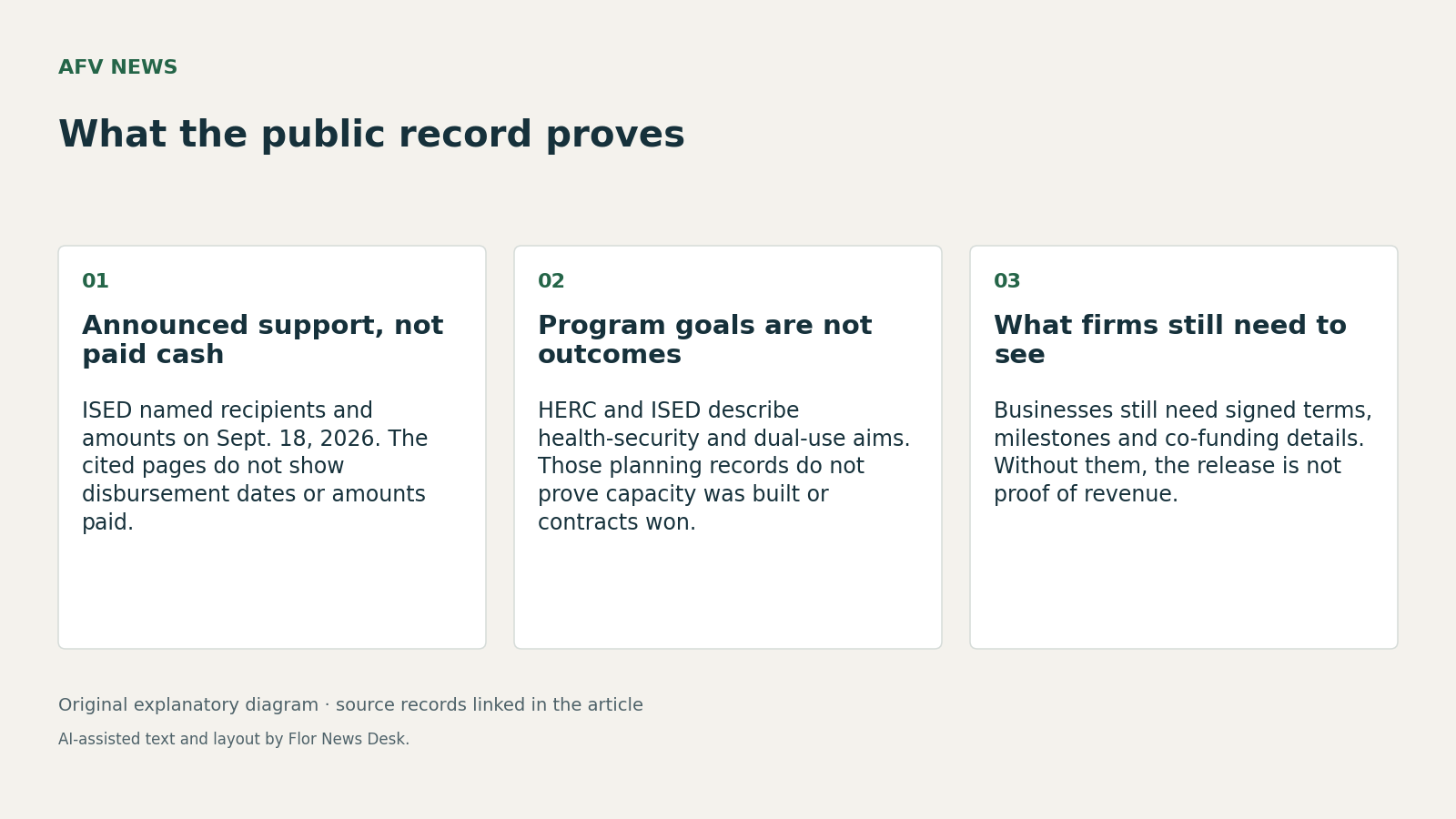
The missing documents are the practical story. The release, as summarized in the source record, does not attach contribution agreements, payment schedules, co-funding confirmations, procurement rules, intellectual-property terms, regulatory milestones or measured job and output targets (ISED announcement). Without those records, a company cannot reasonably treat the announcement alone as booked revenue, guaranteed demand or a settled supply-chain opportunity.
The program context does explain why Ottawa is putting defence language beside biomanufacturing. Health Emergency Readiness Canada describes itself as a special operating agency within ISED and says it works with federal partners including Health Canada and the Public Health Agency of Canada on key medical countermeasures for health emergencies; its program page lists the Life Sciences Fund as HERC’s funding vehicle for life-sciences projects (HERC overview). In ISED’s 2026-27 Departmental Plan, the department says HERC’s Life Sciences Fund is meant to advance health security and life-sciences innovation, while the Defence Industrial Strategy is intended to support Canadian supply chains, domestic procurement and dual-use technologies (2026-27 Departmental Plan).
That planning language is useful, but it should not be mistaken for proof of implementation. A departmental plan is forward-looking by design, and the HERC landing page is a program description, not a ledger of signed awards or payments (2026-27 Departmental Plan, HERC overview). For an affected manufacturer, the commercial question is not whether Ottawa wants more domestic resilience. It is whether any recipient now has enforceable funding terms, matched capital, and a timetable that turns policy intent into purchase orders or production capacity.
The advisory record shows the same gap between policy development and operational proof. Meeting summaries for HERC’s Council of Expert Advisors say members received updates on the operationalization of the Life Sciences Fund on January 19, 2026, and on the newly announced Defence Industrial Strategy on March 16, 2026; the March 16 meeting was described as the council’s final meeting (Council meeting summaries). Those summaries help explain the policy path to September’s announcement, but they do not show selection criteria, binding award terms or project-level conditions.
So the business takeaway is straightforward. Ottawa has now publicly named intended recipients and amounts, which is enough to identify where federal priorities are pointing. It has not, on the cited public pages, shown when money flows, what recipients must deliver before payment, whether any procurement preference follows, or how intellectual property and export-sensitive know-how will be handled. Until those records appear, the announcement is best read as a signal of direction and potential capacity building, not yet as verified operating revenue or confirmed domestic supply contracts.
Read our editorial standards or send a correction to the editorial desk.