
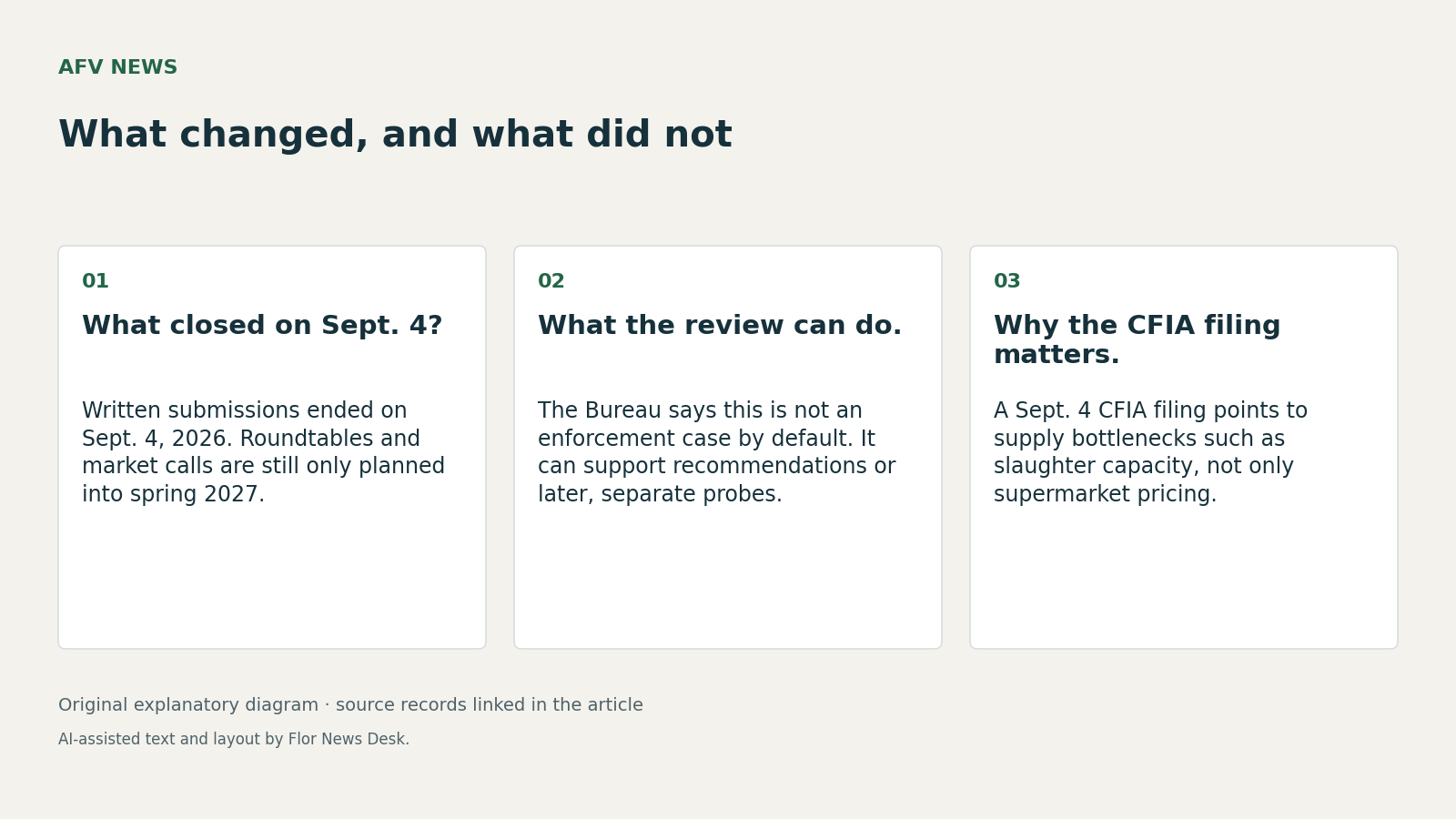
The Competition Bureau’s public intake for *Behind the price tag: An examination of the food supply chain* ended on September 4, 2026, moving the file from written submissions toward a planned roundtable phase. The Bureau’s overview page says the examination began on June 16, 2026 and spans harvesting, production, processing, logistics and transportation, not just checkout pricing. Its notice says public roundtables and market calls are planned from Fall 2026 to Spring 2027, with report drafting and publication planned for Spring 2027. Bureau overview Bureau notice
That timetable matters because the Bureau is broadening a conversation that started with retail grocery. In a September 3, 2026 progress paper on its 2023 grocery recommendations, the Bureau said grocery prices rose 22% from 2022 to 2025 versus 13% for other consumer prices, and that most Canadians still buy groceries from five companies. The same paper points to policy steps such as the Canada Grocery Code’s January 1, 2026 implementation and Manitoba’s grocery property-controls law, but it does not show that those steps lowered prices or reduced concentration. Progress paper
The immediate implication is not that a sector-wide enforcement case has begun. The Bureau says this exercise is neither a market study nor a law-enforcement investigation, although information gathered could lead it to examine conduct separately if evidence supports that. That distinction matters for producers, processors, carriers and retailers: participation in the policy discussion is one track, while reviewing whether pricing, contracting and distribution practices could draw later scrutiny is another. The Bureau’s timeline page also says it published a September 28, 2026 call for information on minimum advertised pricing policies in grocery, suggesting the examination can branch into narrower practices as it proceeds. Bureau notice Bureau overview
The public record also requires care on dates. One Bureau notice now says submissions ended on September 4, 2026, yet a lower section on the same page still invites views before July 31, 2026. That stale language does not establish an earlier closing date; later Bureau materials and the master timeline point to September 4 as the operative deadline. Just as important, the roundtables and Spring 2027 report remain plans, not achievements. As of September 29, 2026, the records cited here do not establish whether any roundtable has already been held or what recommendations will emerge. Bureau notice Bureau overview
A separate September 4, 2026 submission to the Canadian Food Inspection Agency shows the kind of bottleneck the Bureau may emphasize. In that filing, the Bureau backed reducing unnecessary interprovincial barriers to red-meat trade while preserving food-safety and public-health protections, and it highlighted unmet slaughter capacity, especially in rural and remote regions and for some species such as sheep. The CFIA proposal described there is a targeted, temporary exemption for eligible producers under specified conditions and provincial oversight. The filing does not show that the CFIA approved any change or that capacity improved. CFIA submission
For businesses, the practical preparation is evidentiary, not speculative. A producer, processor, logistics provider or retailer that wants the Bureau’s eventual report to reflect real constraints will need records that map onto the Bureau’s stated focus areas: production and processing, transportation and distribution, and retail pricing. That can mean showing where plant capacity, inspection rules, logistics terms or merchandising policies create measurable frictions, instead of offering general complaints. This is analysis drawn from the Bureau’s published scope and intervention record, not a prediction of any finding. Bureau notice CFIA submission
The main near-term change, then, is procedural. September 2026 closed the open comment portal and moved the file toward roundtables, market calls and, eventually, a planned Spring 2027 report. Canadian food businesses should read that as a chance to shape the record, not as evidence that the Bureau has already found wrongdoing or that policy steps will automatically translate into lower prices. Bureau overview Progress paper
Read our editorial standards or send a correction to the editorial desk.