

Statistics Canada released July 2026 credit aggregates on September 18, with revisions covering January 2025 through June 2026. The series describes outstanding liabilities at the end of a month. That makes it a measure of balances, rather than a direct count of all loans newly advanced during that month. Statistics Canada
The distinction matters when a business briefing describes credit as expanding or contracting. A higher closing balance does not identify the amount of fresh borrowing that produced it.
How repayments change the closing balance
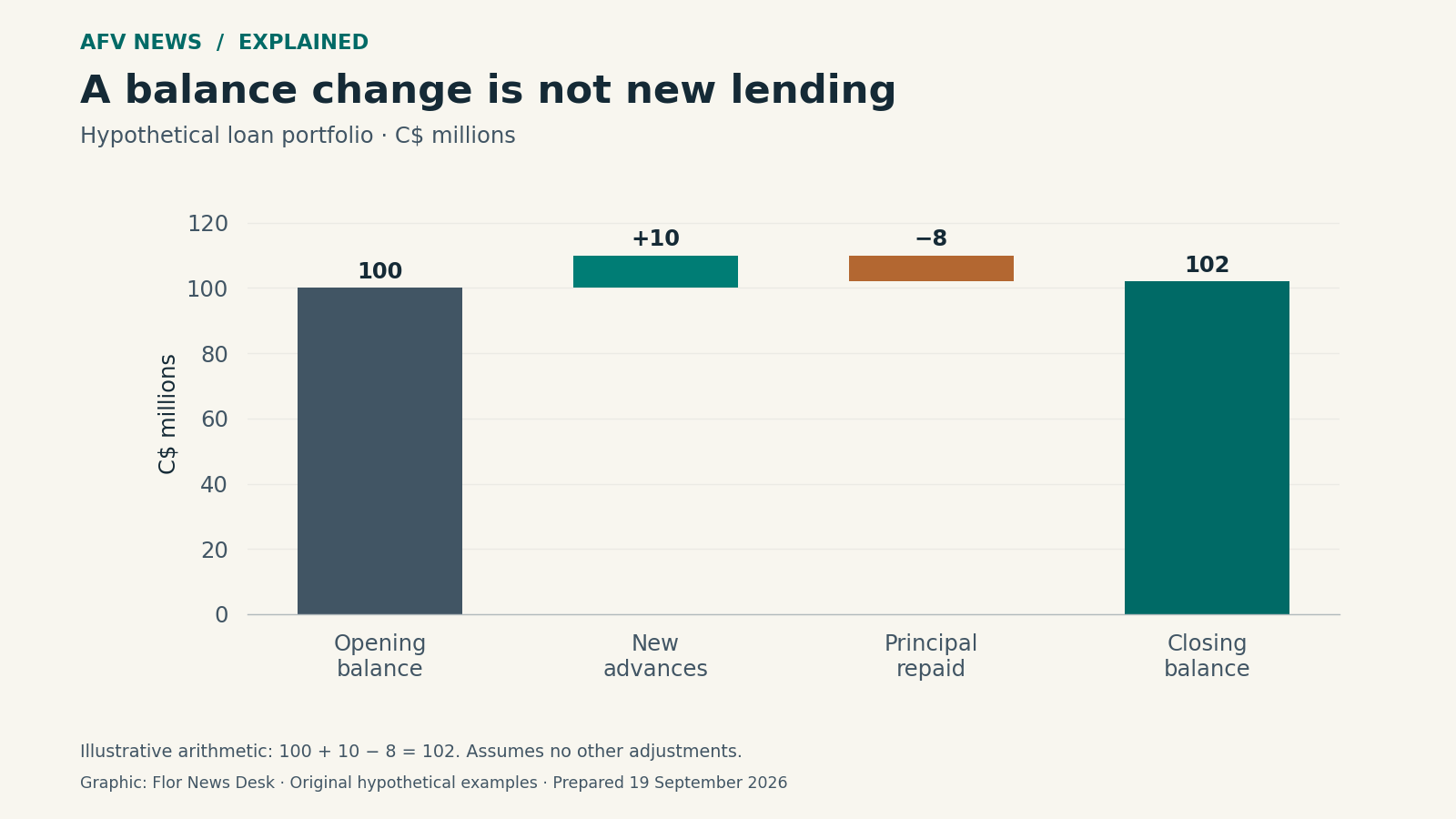
Take a hypothetical loan portfolio with an opening balance of C$100 million. Borrowers receive C$10 million in new advances and repay C$8 million of principal during the month. Assume there are no write-offs, valuation changes or other adjustments. The closing balance is C$102 million.
Outstanding debt has grown by C$2 million, or 2%. New advances were C$10 million. Calling the C$2 million increase “new loans” would erase the C$8 million of lending that was offset by repayments elsewhere in the portfolio.
The reverse example is equally useful. If advances were C$10 million but repayments were C$12 million, the balance would fall to C$98 million. Borrowing would still have occurred even though outstanding debt declined. Both examples are invented to explain the arithmetic; neither describes the July Canadian estimates.
Compare figures from the same data release
Revisions introduce a separate comparison problem. Suppose an analyst saved a hypothetical June balance of C$100 million in an earlier download. A later release revises June to C$101 million and reports July at C$102 million. The current month-to-month increase is about 0.99%, calculated from the revised June figure. Comparing July with the older June download instead produces 2%.
That difference comes from mixing versions of the data. It should not be presented as a change in borrowing behaviour.
What to record in a credit briefing
A reproducible briefing would retain the downloaded table, its retrieval date, the selected credit category and whether the series is seasonally adjusted. It would calculate adjacent months from that same version and describe the result as a movement in outstanding balances.
The next question, why those balances changed, needs additional evidence. A balance alone cannot distinguish stronger demand for credit from different repayment patterns, or show whether lenders made approval easier.
Read our editorial standards or send a correction to the editorial desk.