
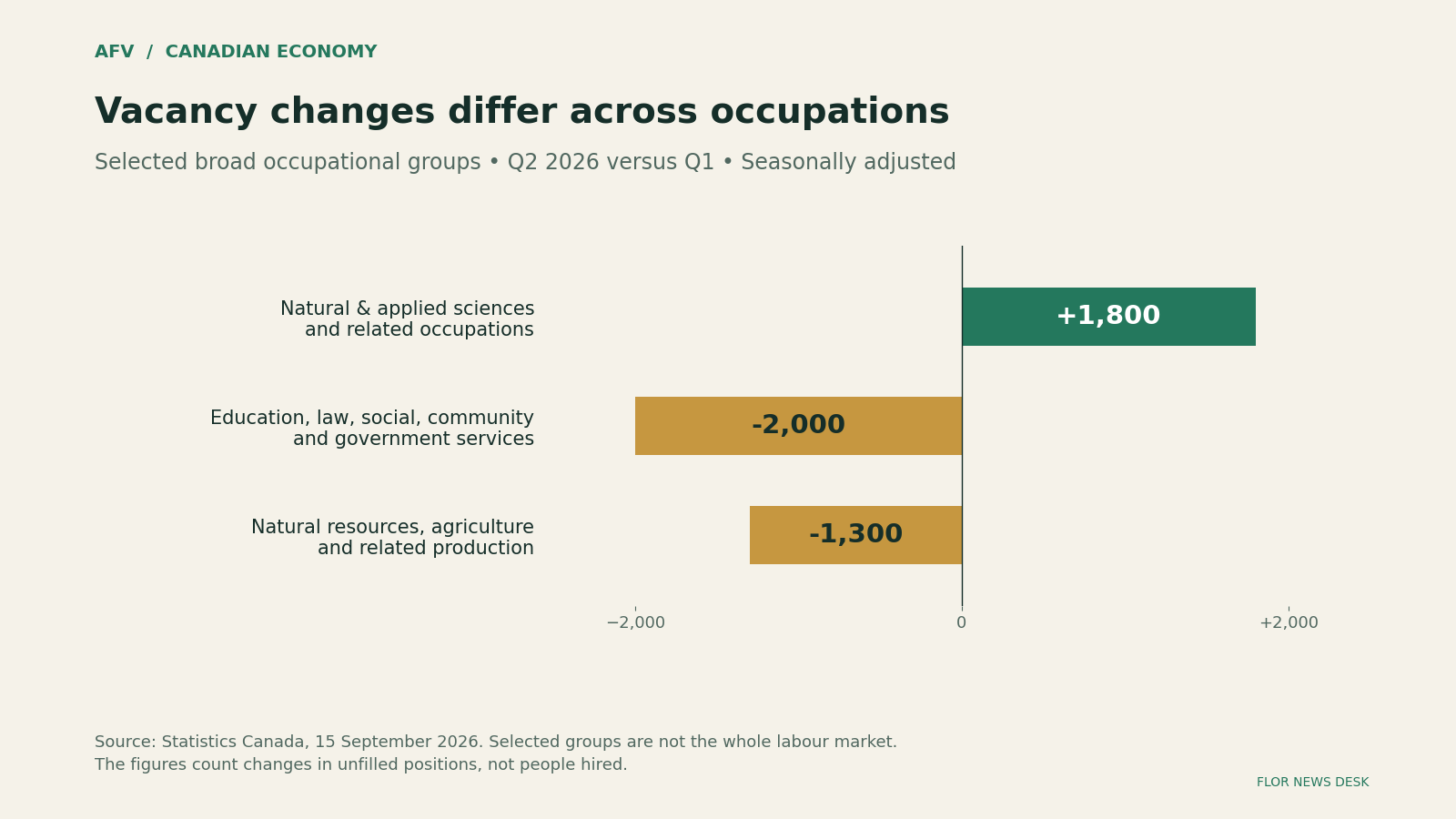
Canada's total job vacancies were little changed at 510,200 in the second quarter of 2026, but openings in natural and applied sciences and related occupations rose by 1,800, or 4.5%, to 42,300.
The Statistics Canada release published September 15 reports a second consecutive quarterly increase for that occupational group. Over the same quarter, vacancies fell by 2,000 in education, law and social, community and government services, and by 1,300 in natural resources, agriculture and related production occupations. Those broad occupational comparisons are seasonally adjusted.
The national vacancy rate held at 2.8%. It measures vacant positions as a share of filled plus vacant positions. A vacancy is an opening, so the reported increase in science-related vacancies should not be described as 1,800 people hired.
A national average has limited use for a specific opening
For an employer recruiting a particular skill, the national count supplies context but does not describe the pool of suitable candidates within commuting distance. An occupation group also covers more than a single job title. AFV's interpretation is that recruitment planning needs to become more specific before these figures can support a staffing decision.
A rise in openings can reflect several possible situations. Employers might be expanding, replacing departing staff or taking longer to fill positions. The reported vacancy total alone does not identify which explanation applies to a particular company.
The same caution works in the other direction. A broadly steady national total cannot establish that recruiting has become easy for every employer. Gains and declines in different occupations can coexist beneath it.
Keep the recruiting measures separate
A hiring team could track the date a role opened, applications meeting its stated requirements, interviews, accepted offers and actual starts. These are different events. An offer accepted late in a reporting period is not the same thing as a person already at work, and an advertised role does not establish a completed expansion.
The accompanying chart therefore shows changes in selected unfilled positions, without converting them into jobs created. It also identifies the three selected occupational groups rather than presenting them as the entire labour market.
The release describes the second quarter, not vacancies available today. A current hiring plan would need recent local evidence and the employer's own recruitment record alongside the published comparison.
Read our editorial standards or send a correction to the editorial desk.