
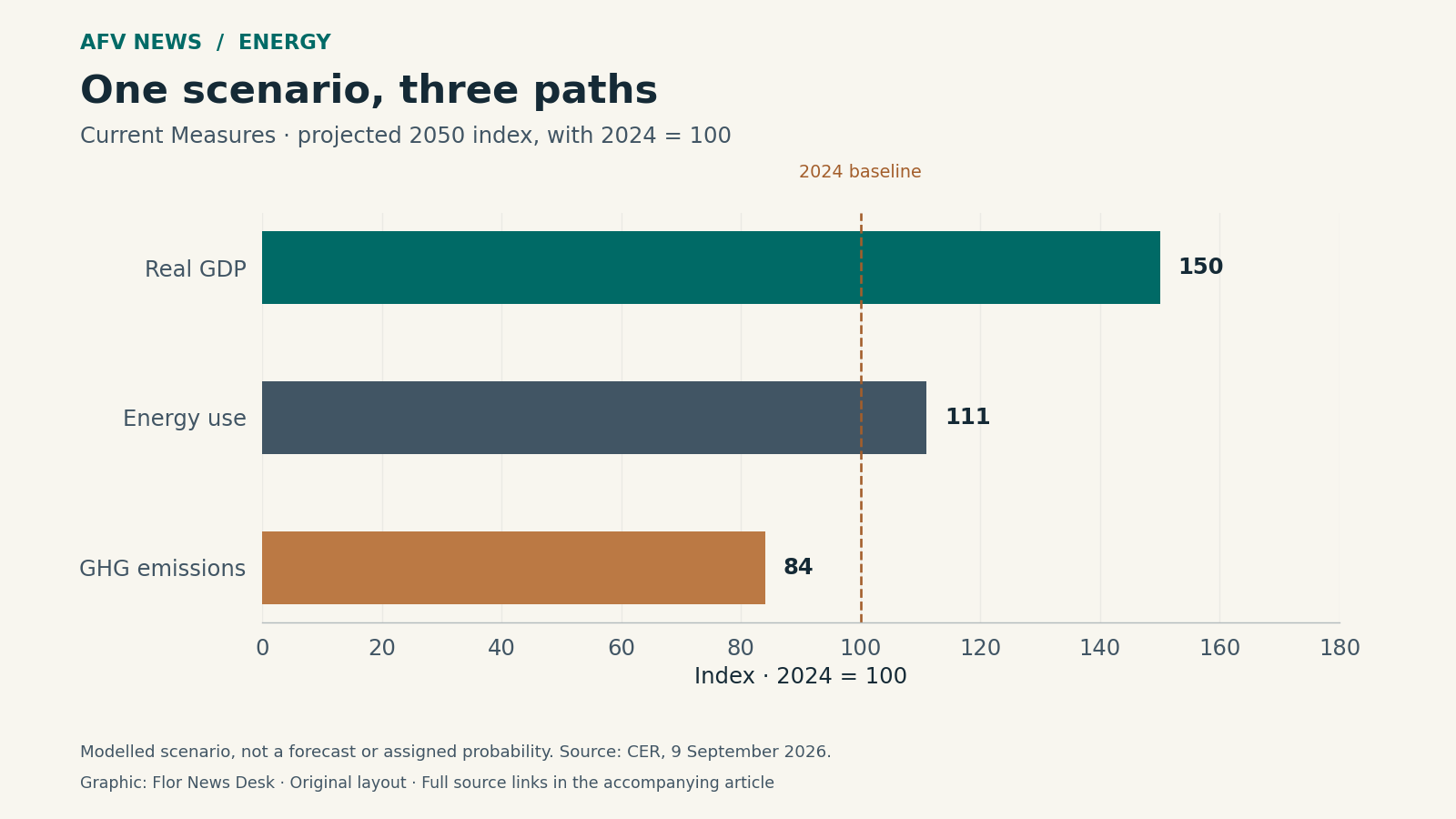
Canada’s economy could grow while its greenhouse gas emissions fall under the Canada Energy Regulator’s Current Measures scenario. Its September 9 snapshot describes a pathway with real GDP rising 50%, energy use increasing 11% and emissions falling 16% between 2024 and 2050. Those are modelled changes under specified assumptions. CER snapshot
A scenario is conditional
They should not become an unconditional forecast when copied into a company’s planning document. The report’s assumptions chapter explicitly says the regulator assigns no probabilities to its scenarios. Current Measures is a baseline for comparison, not its judgement of the most likely future. Scenarios and assumptions
The same chapter describes a policy cutoff at the end of November 2025 for Current Measures and the Higher and Lower cases. A publication date in 2026 therefore does not imply that every subsequent policy announcement is incorporated. The modelling record and current policy record answer different questions.
Keep business assumptions visible
For a business considering equipment with a long operating life, the useful exercise is to identify which assumptions its own plan depends on. A project relying on higher energy demand, lower equipment costs and a particular policy incentive should not silently combine the most favourable element of different scenarios.
A planning table can keep those dependencies visible: the external assumption, the company-specific consequence and the observation that would trigger a revision. For example, a manufacturer could distinguish an assumed market expansion from a signed customer order. The first informs a scenario; the second is evidence of a commitment.
National projections and individual facilities
Nor does lower national energy intensity establish that a particular plant will use less energy. The company still needs its own production volumes, equipment performance and operating schedule. Applying a national percentage directly to a facility would skip that work.
The regulator’s scenarios provide a structured set of possible conditions. A business plan becomes more useful when it preserves those conditions alongside the result, rather than presenting one distant-year number as a promise.
Read our editorial standards or send a correction to the editorial desk.