

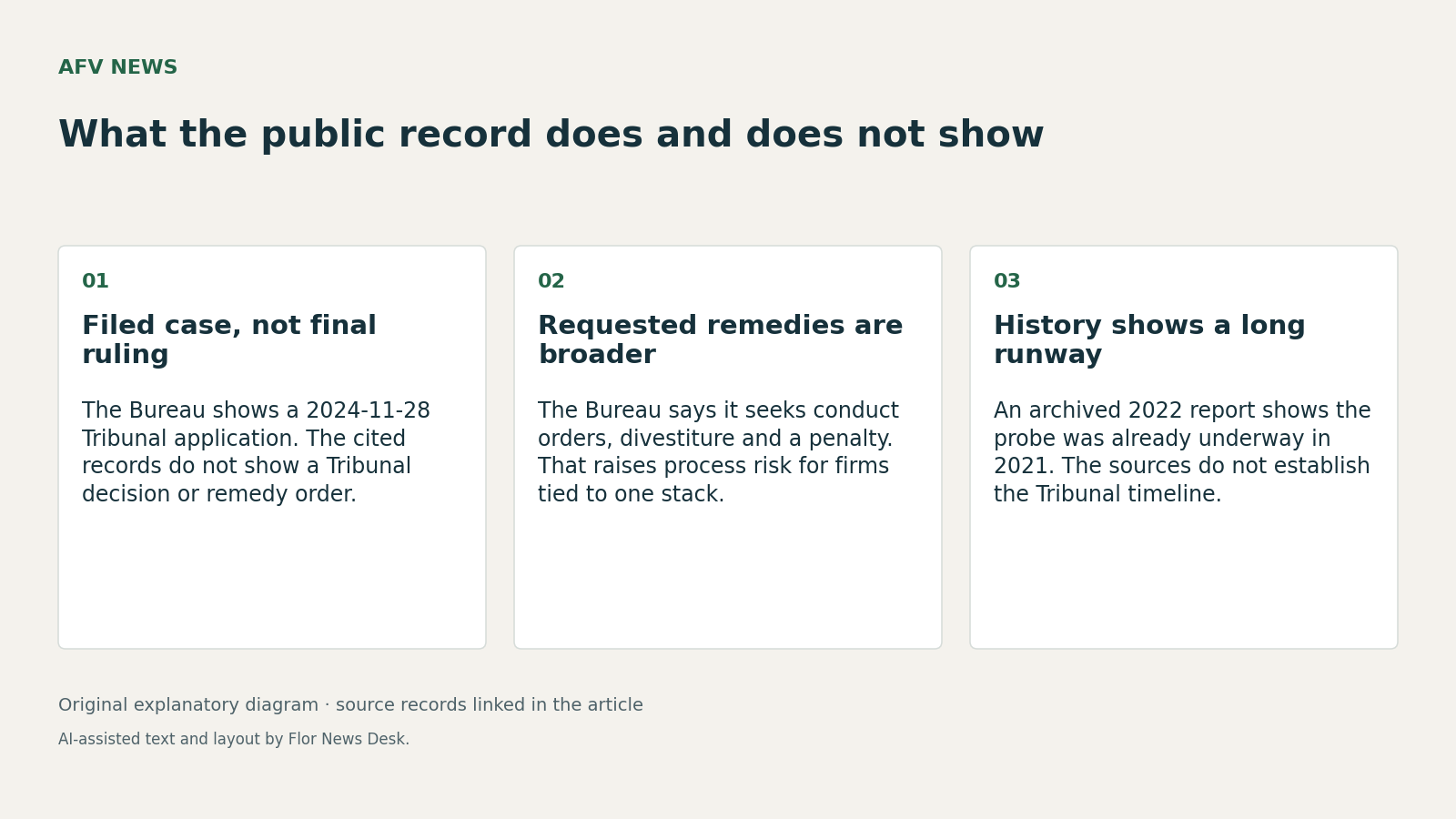
A live Canadian competition case against Google matters now because the public record shows more than an investigation but still far less than a market outcome. In its cases-and-outcomes table, the Competition Bureau lists an ongoing matter dated 2024-11-28, says it filed an application with the Competition Tribunal over Google’s conduct in online advertising technology services in Canada, and says its investigation found abuse of dominance in online advertising. The same page explains that the Tribunal is the quasi-judicial body that hears these matters, meaning the filing is an allegation seeking relief, not a ruling yet. Cases and outcomes
The Bureau’s 2024-25 annual report adds the clearest public description of what it is asking for. The Bureau says its application alleges Google tied ad-tech tools together, gave its own tools preferential access to ad inventory, took negative margins in some circumstances, and set terms for publisher transactions with rival ad-tech tools. It also says it is asking the Tribunal to stop the conduct, require Google to sell parts of its ad-tech business, and impose a financial penalty. Those are significant requests because they reach beyond a fine and into market structure. A New Era for Competition in Canada 2024-25 Annual Report
For Canadian publishers, the practical issue is dependency. If a case seeks divestiture of parts of an ad-tech stack, a publisher using Google tools across ad serving, exchange access or transaction settings cannot assume that current product links, commercial terms or technical workflows would stay unchanged if the Tribunal eventually orders remedies. That is analysis, not a sourced prediction: the premise comes from the Bureau’s stated request for asset sales and conduct orders, while the record cited here does not establish whether any order will be made. A New Era for Competition in Canada 2024-25 Annual Report
For agencies and advertisers, the immediate watchpoint is planning discipline rather than abrupt spending changes. The cited records do not show any Tribunal order, implementation timetable or forced product separation as of 2026-10-22. What they do show is an active case in which the Bureau is challenging how ad-tech tools interact. A cautious business response is to map where campaign execution, measurement, inventory access and billing depend on one vendor’s integrated tools, so management knows which assumptions would need review if the case moves forward. That is a governance step, not a claim that disruption is imminent. Cases and outcomes A New Era for Competition in Canada 2024-25 Annual Report
The older Bureau record matters mainly as a reminder of pace. In its archived 2021-22 annual report, the Bureau said it was advancing an investigation into whether Google was harming competition in online display advertising in Canada, and that it had obtained a court order in October 2021 requiring Google to produce information. At that time, the Bureau said the investigation was ongoing and there was no conclusion of wrongdoing. That historical record shows the 2024 Tribunal application followed years of investigation, but it does not establish how long the Tribunal phase will take. Building a More Competitive Canada
That limit is central for readers. The public documents cited here support three careful conclusions only: Canada has an ongoing Tribunal case, the Bureau is seeking both conduct remedies and divestiture, and no decision or implemented remedy appears in these records. Businesses can use that to stress-test supplier concentration, renewal timing and internal reporting lines. They cannot use it to assume Google has lost, that any asset sale will happen, or that Canadian ad-pricing outcomes are already changing.
Read our editorial standards or send a correction to the editorial desk.