

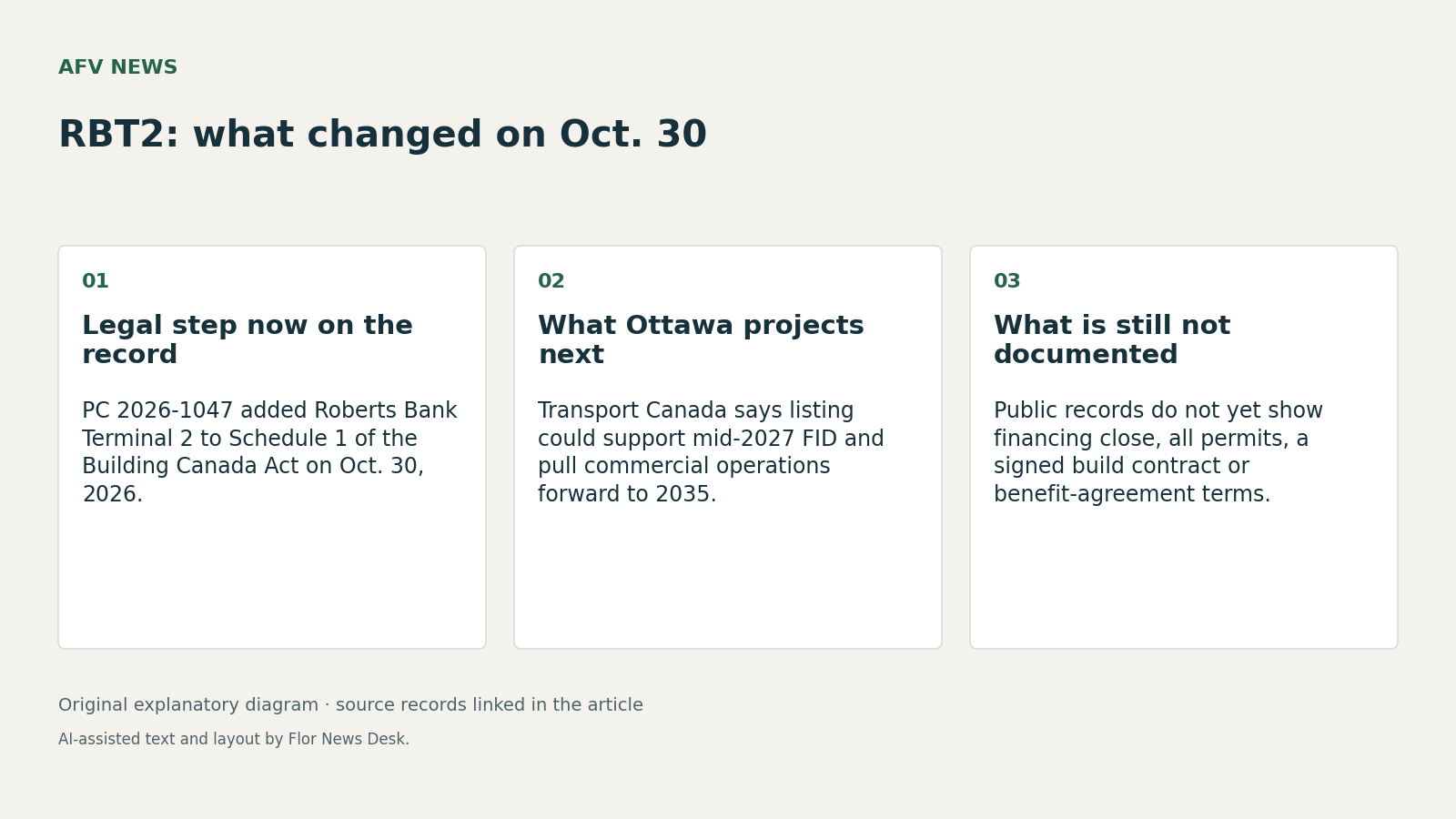
Roberts Bank Terminal 2 cleared a meaningful federal threshold on Oct. 30, 2026, when Order in Council PC 2026-1047 added the project to Schedule 1 of the Building Canada Act. That is a concrete legal change, not just ministerial rhetoric. It does not, on its own, prove that the Vancouver Fraser Port Authority has closed financing, signed all major contracts or started construction. Those steps are not shown in the public records summarized here. Order in Council PC 2026-1047
The order describes a large container-terminal buildout at Roberts Bank: an approximately 120-hectare terminal landmass and wharf, an approximately 45-hectare widened causeway, an approximately 3-hectare expanded tug basin, and on-land buildings, rail, equipment and other infrastructure for container handling. The recitals also show this was a staged federal process, with a potential-listing announcement on July 16, 2026, a Canada Gazette notice on Aug. 29, 2026, and consultation with British Columbia and Indigenous peoples whose section 35 rights could be adversely affected. Order in Council PC 2026-1047
What businesses are likely to notice first is Ottawa’s commercial framing. Transport Canada says the project carries an estimated capital cost of $5.9 billion excluding financing costs, would add 2.4 million units of annual container capacity, and would lift Port of Vancouver container capacity by about 50 percent. The department also says the listing provides certainty on remaining applicable federal authorizations, could advance commercial operations to 2035 from 2039, and places the project on a viable path to a mid-2027 final investment decision. Those are government expectations as of Oct. 30, not evidence that any of those later milestones have occurred. Transport Canada release
The environmental record is more complicated than a simple go-ahead. The order says the federal environmental assessment found the project likely to cause significant adverse environmental effects, including on the Southern Resident Killer Whale, and points back to a 2023 decision statement with legally binding conditions for the proponent. Transport Canada says those conditions remain in place and cites nearly $2 billion in measures tied to fish and fish habitat, marine mammals, Pacific salmon, Southern Resident Killer Whales and other species at risk. In practice, the national-interest listing sits alongside those obligations rather than replacing them. Order in Council PC 2026-1047 Transport Canada release
That matters for contractors and suppliers because the public record still separates policy momentum from execution. Transport Canada says the Vancouver Fraser Port Authority selected TerraMarine as the preferred construction partner after a competitive procurement process. Preferred-partner status is a real signal that commercial planning has advanced, but the available records do not show a signed construction contract, a public timetable for core work packages, or published federal contribution agreements. Transport Canada release
Another unresolved point is authorizations that remain outside the Oct. 30 listing itself. The explanatory note says Fisheries and Oceans Canada deemed the project’s Fisheries Act application complete in June 2025 and that, as recorded in the note, no decision on that authorization had yet been made. That distinction matters because a project can be politically elevated and still depend on later permit decisions before the build schedule is truly locked in. Order in Council PC 2026-1047
For Canadian port users, rail-linked logistics firms and construction suppliers, the immediate takeaway is narrower than the headlines. Ottawa has removed one level of federal uncertainty by formally listing Roberts Bank Terminal 2 as a national-interest project, but it has not yet publicly documented the financing close, final investment decision, all remaining authorizations, or the terms of Indigenous benefit agreements that would confirm the project has moved from policy signal to fully committed buildout. Until those records appear, the 2035 operations target and mid-2027 FID path should be read as federal projections, not completed facts. Transport Canada release Order in Council PC 2026-1047
Read our editorial standards or send a correction to the editorial desk.