

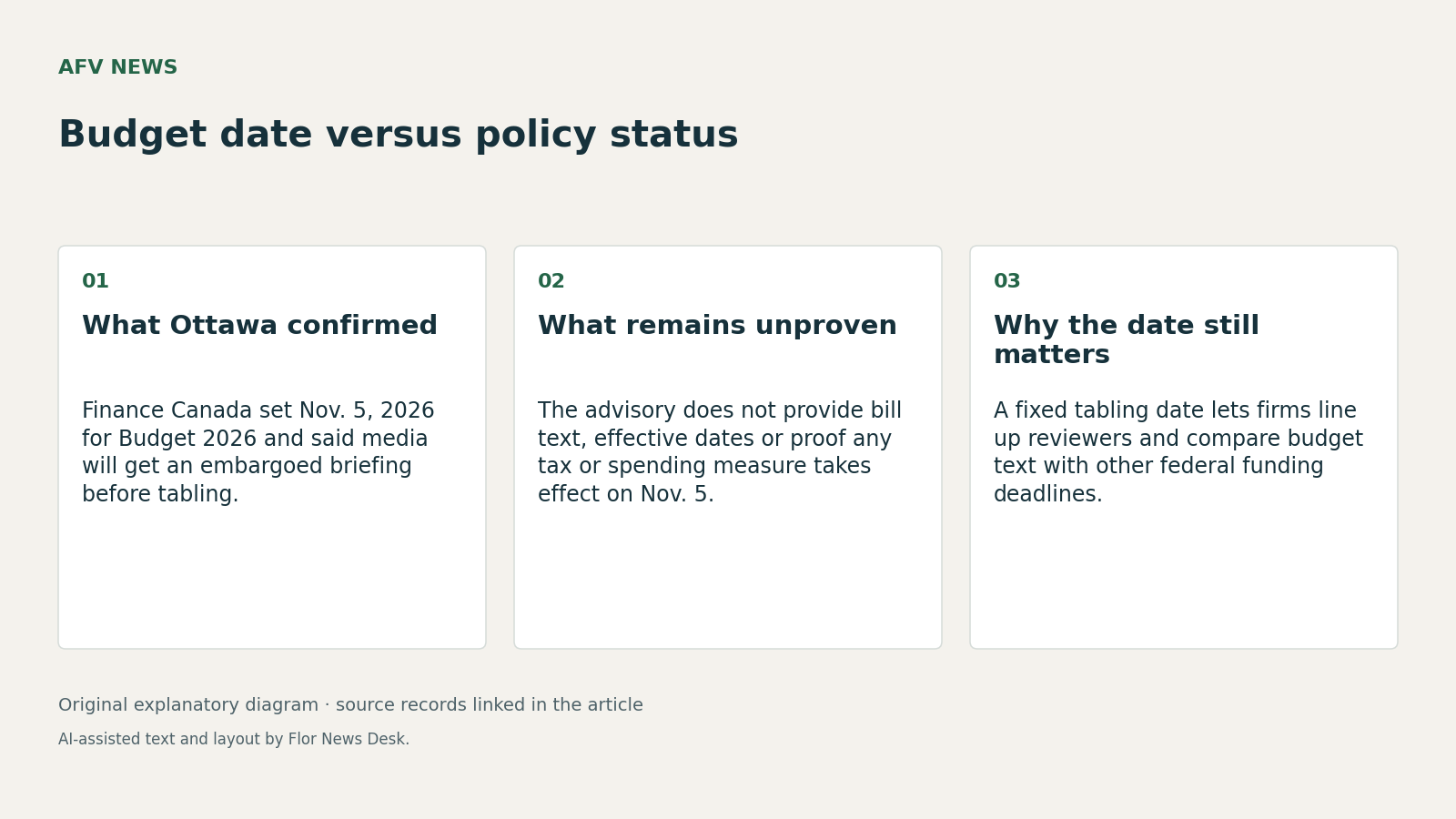
Ottawa has now put a firm date on Budget 2026. Department of Finance Canada said in a media advisory published on Oct. 20, 2026 that Minister of Finance and National Revenue François-Philippe Champagne will table Budget 2026 in Parliament on Nov. 5, 2026, and that media will get an embargoed reading and press conference beforehand, with logistics handled through the Parliamentary Press Gallery. For Canadian businesses, the value of that notice is not new policy content. It is a verified deadline for when federal budget text should become visible. Finance advisory
That may sound procedural, but it changes the planning problem. A fixed tabling date lets finance teams, investors and operating managers decide when they need internal review capacity for any tax, spending or financing measures that might appear. The same advisory is also clear about its limits: it confirms a schedule and a media process, not bill text, effective dates, appropriation votes or proof that any proposed measure will take effect on Nov. 5, 2026. Finance advisory
That distinction matters because the earlier Budget 2026 record was mostly about consultation, not decisions. On July 6, 2026, Finance launched pre-budget consultations, set Sept. 8, 2026 as the deadline for submissions through Your Budget, and described Budget 2026 only as a fall budget. Consultations launch On Sept. 9, 2026, the department said those consultations had concluded after visits to 23 cities, 44 roundtables, 56 bilateral meetings, more than 18,000 online survey responses and nearly 2,000 written submissions. Consultations conclude Those records show the scale of input and the issues participants raised, but they do not establish which proposals, if any, made it into the budget package.
The practical change, then, is timing rather than substance. Before Oct. 20, businesses could infer that a fall budget was coming. After Oct. 20, they know the date on which to compare any federal measures against year-end cash-flow plans, capital budgets and financing calendars. That is an analytical inference from the source record: a known publication date supports workflow planning even when policy outcomes remain unknown. What the record does not support is treating consultation themes as settled policy before budget documents are released. Consultations launch Consultations conclude
The same caution applies to nearby funding announcements. On Oct. 22, 2026, Innovation, Science and Economic Development Canada announced Canada’s Venture and Growth Capital Plan with $1.75 billion in federal funding, including a $1 billion Venture and Growth Capital Catalyst Initiative and a $750 million Early and Growth Stage Investment Strategy to be administered by the Business Development Bank of Canada on the government’s behalf. The release also opened expressions of interest for one stream until Jan. 21, 2027 and invited feedback on another stream until Nov. 23, 2026. Venture and Growth Capital Plan That places Nov. 5 inside an active federal capital-policy calendar, but the release does not show funds disbursed, managers selected or any budget-linked change to those dates.
One operational implication follows from the sources. Because embargo access before tabling is being routed through the Parliamentary Press Gallery, most businesses should assume they will need to react when the budget becomes public on or after Nov. 5, 2026 rather than expecting direct early access. Finance advisory In practice, that means the useful preparation now is document readiness: knowing which pending investments, financings or program applications would need fast review if Ottawa changes terms.
So the Oct. 20 advisory is meaningful, but in a narrow way. It does not prove what Budget 2026 will contain. It does give Canadian businesses a fixed checkpoint after months of consultations and amid separate funding announcements, which is enough to organize review and avoid confusing a proposal timetable with an implemented policy outcome. Finance advisory Venture and Growth Capital Plan
Read our editorial standards or send a correction to the editorial desk.